
EDITION 73 - OCTOBER 2, 2026

Your window into the stories, history, and ongoing work to preserve Yosemite’s climbing legacy.
A Note from the Editor
Temperatures have climbed back up into the low 90s with smoke from the Dome Fire still affecting air quality in the Valley.
The U.S. Forest Service has officially identified the cause of the fire to have been an abandoned campsite fire. The fire has now been burning for two weeks and as of October 1 has reached 5,777 acres at 40% containment. The head of the fire is approaching Glacier Point Road, which remains closed to the public due to firefighting operations and poor visibility. Cal Fire has stated that the fire is reaching areas previously burned by the Empire Fire in 2017, which will hopefully assist firefighters in containing the spread of the fire.
September was a busy and tragic month in the park this year. On Sunday September 20 a helicopter was dropping water buckets on the Dome Fire when it crashed with two crew members on board. The men on board were identified as Greg King and Ryan Cutter, both experienced helicopter pilots and cherished members of the wider wildland firefighting community. On the same day, 19-year-old Ryan George was hiking the Panorama Trail near the top of Illilouette Falls when he slipped and fell 400 feet. All three bodies were recovered by park rangers on Monday, to help bring closure to their families. Our thoughts and hearts go out to all who knew the three individuals lost.
As I write this week’s newsletter on October 1st, today marks one year since Balin Miller died in a rappelling accident on El Capitan. As we go into this year’s Fall season in the Valley, I would like to hold space for Balin and his family here. To honor Balin and his passion his family has started the Balin Scott Miller Foundation, which will award grants to support the dreams of young climbers who embody the values that Balin held dear. You can donate to help support this continuation of Balin’s memory. These words written by our mutual friend Ethan Berkeland remember Balin well.
This week’s newsletter will remember the cherished lives we have lost this month. October 15 marks two years since Chris Gay passed away in a climbing accident in Tuolumne Meadows. For this week’s feature I remember Chris Gay, who I lived and worked alongside on Yosemite Search and Rescue from 2021 to 2023.
Miles Fullman
Editor, YCA News Brief
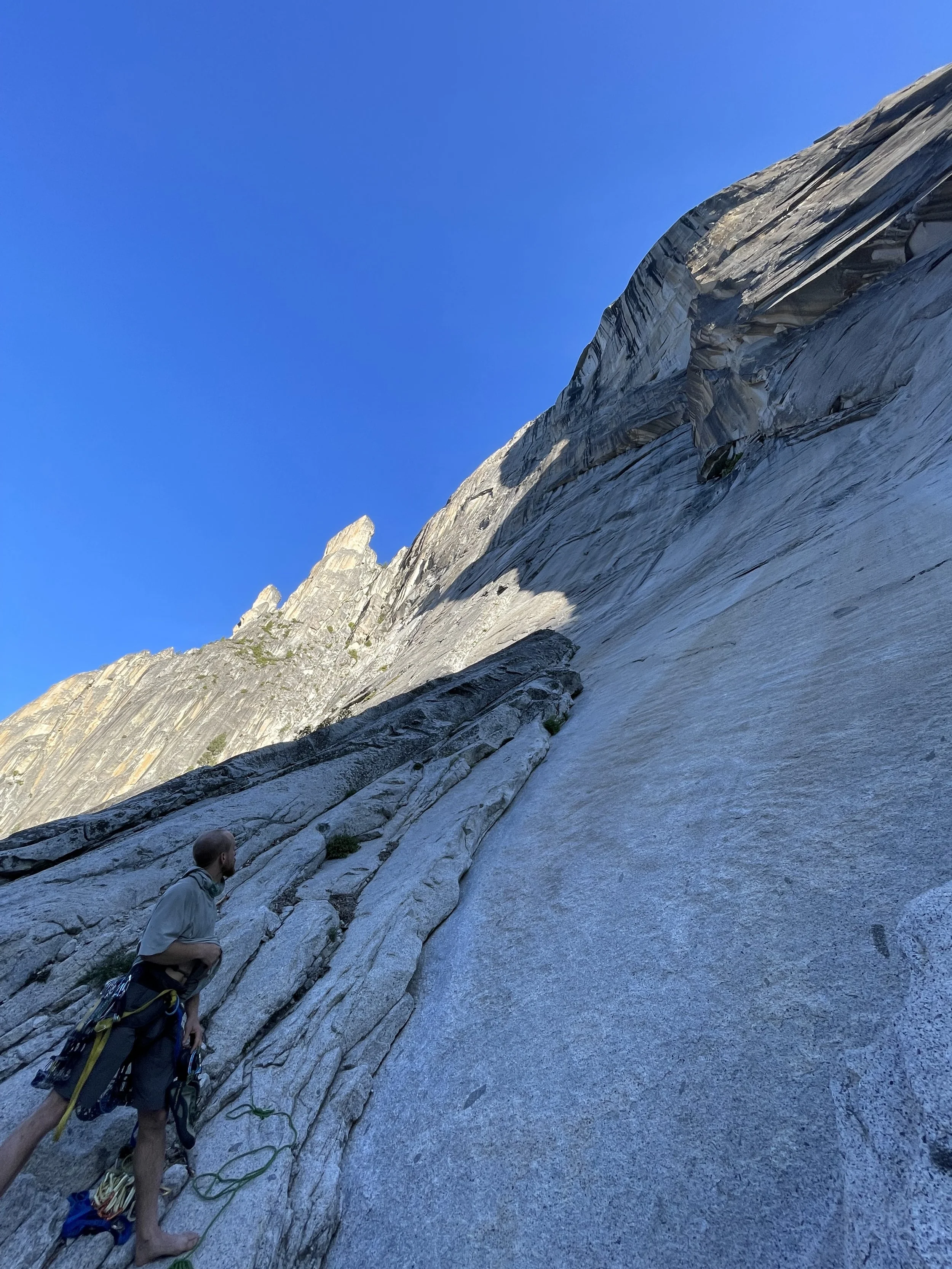
Chris Gay looking up at the South Face of Mt Watkins before starting to climb. Photo: Miles Fullman
Remembering Chris Gay
June 16, 2023
We looked at the slick log precariously lodged across the churning whitewater of Snow Creek. We looked at each other and then back at the log. This was the best crossing we had been able to find in the predawn shadows.
“Well, only one way to find out” I said, as I offered to go first. Placing one foot on the stripped surface, I quickly changed my mind and swallowed my pride. It would have to be scooted. Straddling the log I quickly shimmied my way across, my laughter drowned in the cacophonous spring torrent. Once clear on the other side, I looked back across to see the whites of Chris’ eyes wide open. He tied the rope a little tighter around his back and cautiously followed suit. Scoot by precise scoot, he was utterly focused on the log between his hands and thighs. Finally safely across, he let out a long sigh of relief and we burst into laughter.
“Well we’re not going back that way,” Chris says.
“The only way back to the Valley is over Mt Watkins!” I replied gleefully.
We picked our way up Tenaya Canyon, losing the trail and finding it again in sections, climbing over downed trees. The fixed lines leading up to the base of the route were in poor condition and we tried to weight their long sections of exposed core strands as gingerly as possible.
Chris took the first block, leading us up the glassy corners and wandery face pitches to Sheraton Watkins. Chris had climbed the route a number of times and was well familiar with the terrain, something that was true for countless classic routes around the Valley. I’ve only ever climbed Beggar’s Buttress with Chris, and each time he would snake his way down the bewildering descent with ease. He knew the park so well and his memory for the smallest things about a climb was amazingly accurate. If I were to go back and climb the route again now I would surely lose my way.
Chris kept a beloved copy of the Supertopo Yosemite Valley Free Climbs guidebook with notes from each time he climbed one of the routes - who he was with, how he was feeling, what he noticed that day, what he would do differently next time. The ticklist at the back of the book was nearly completed, it had been his goal to tick every route in the book. Very few routes were remaining at the time of his passing.
Roping up with Chris rarely had so much to do with the climbing itself as it had to do with the whole experience of being up in those places together, which is saying something because he absolutely loved to climb. He would draw your attention to the smallest details with the deftest suggestion: the monkeyflower sprouting from a seam, a peregrine swooping out of the corner of the eye, the swifts playing with each other on the evening wind, a certain plant that was edible.
The rock also became the canvas for whatever emotions he was feeling most strongly at the time. He was someone who truly felt what he experienced. If he was feeling calm and peaceful, it was about the beauty of our surroundings. If he was feeling angry and frustrated, as he often did, the wall would resound with the deep shouts and screams of trying as hard as he could to stay on the rock no matter how difficult the climbing became.
On the long pitch off of Sheraton Watkins with the old fixed RURPS with decaying wires sticking out, Chris couldn’t reach the bolt near the top of the pitch from the mantle. I could hear his cursing and frustrated shouts as he tried to get past the move over and over again. He tried the move several times, falling onto the rope. He tried to hook past it and fell another time or two. Finally he yelled down to me that he was off belay and the rope was fixed.
I jugged up to Chris to see that he had stopped to build an anchor just a few moves below the anchor, unable to reach the ledge above the bolt. We laughed about it but I could tell he was frustrated and disappointed with himself for not being able to finish the pitch. Chris was unbelievably hard on himself, and had high expectations of himself and sometimes of others. Everything he did he did with deliberate focus and intention. His successes were hard won and genuinely deserved.
As we hiked off over the summit and down the Snow Creek switchbacks, we strategized about how to be more efficient and climb the route even faster. It had taken us nine hours to climb. Chris dreamed of climbing the Triple Crown and was steadily dedicating himself to whittling away at his personal best times on the three major walls of the Valley.
His dedication to whatever practice caught his attention was astounding. When Chris decided to learn to play the shakuhachi, he dove in with full force. Every morning living at the SAR site I would wake up to hear the low breathy note of robuki being blown with steady precision and infuriating persistence. Every night as Camp 4 quietened down, Chris would serenade the site to sleep with his instrument, lending the site a layer of magic and mystery on top of the aura it already exuded.
Chris was a true steward of the land, and he loved Yosemite with all his heart. Chris served in the park for nine years, initially as a climbing steward volunteer before joining the search and rescue team and going on countless operations to help people during their hardest moments.
While his character burned with intensity, Chris was also deeply playful. I miss his mischievous smile when he would pull out a hacky sack and shake it invitingly in his hand to get a group together to play. I can still hear his deep belly laugh and see his sparkling eyes. He was also a profoundly good listener, and would go out of his way to make you feel seen and make the effort to understand what you were experiencing.
Chris left this world with our relationship in an imperfect place. It was extremely painful. It reminds me to tell the people close to me that I love them. We might not always have more time. Chris and I may have parted ways in a tough place but he was nonetheless my friend, and I loved him. I feel his spirit all around me in Yosemite.
I miss you, dear friend.
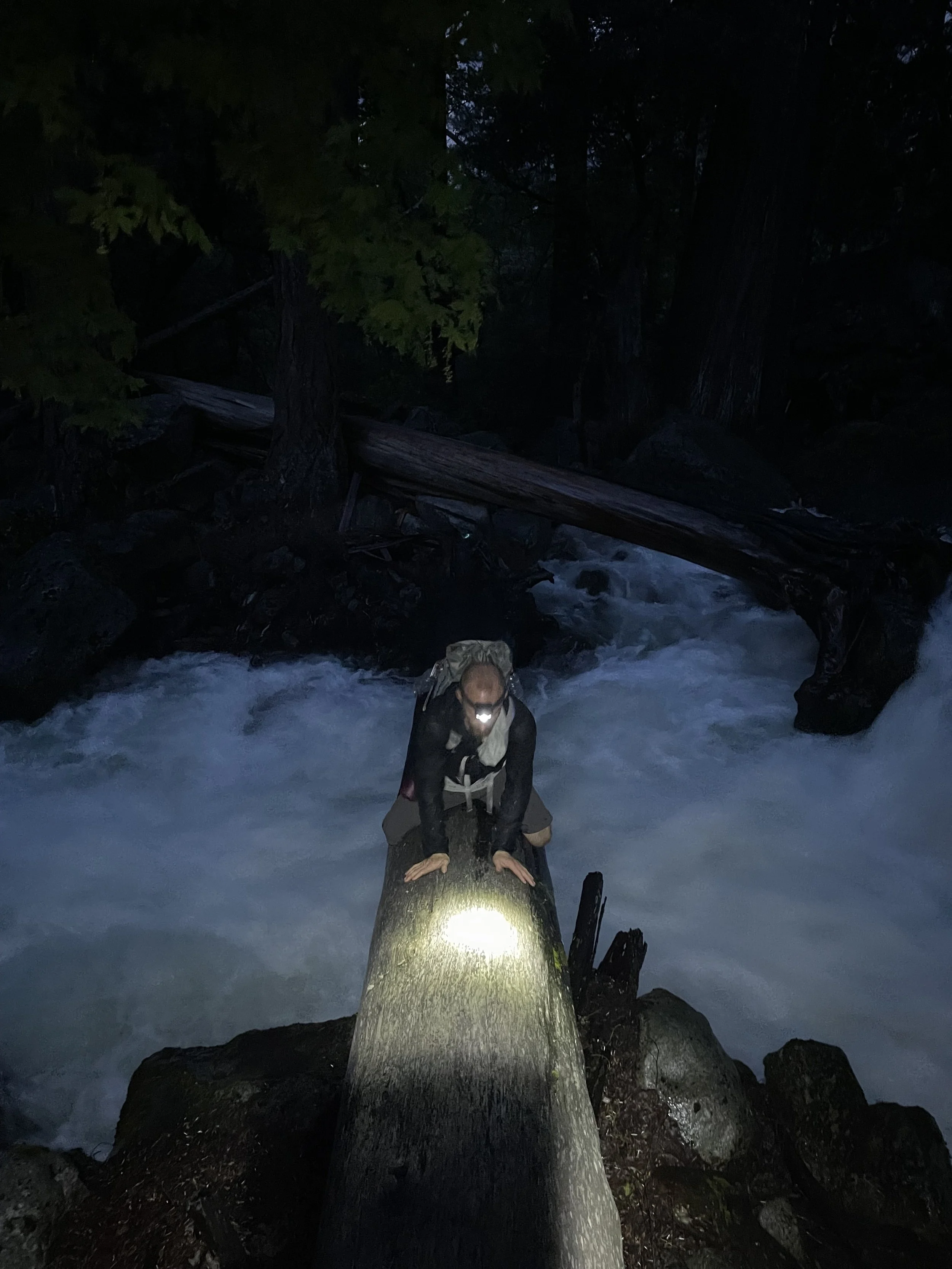
Chris Gay crossing the slippery log over Snow Creek on the approach to Mt Watkins. Photo: Miles Fullman
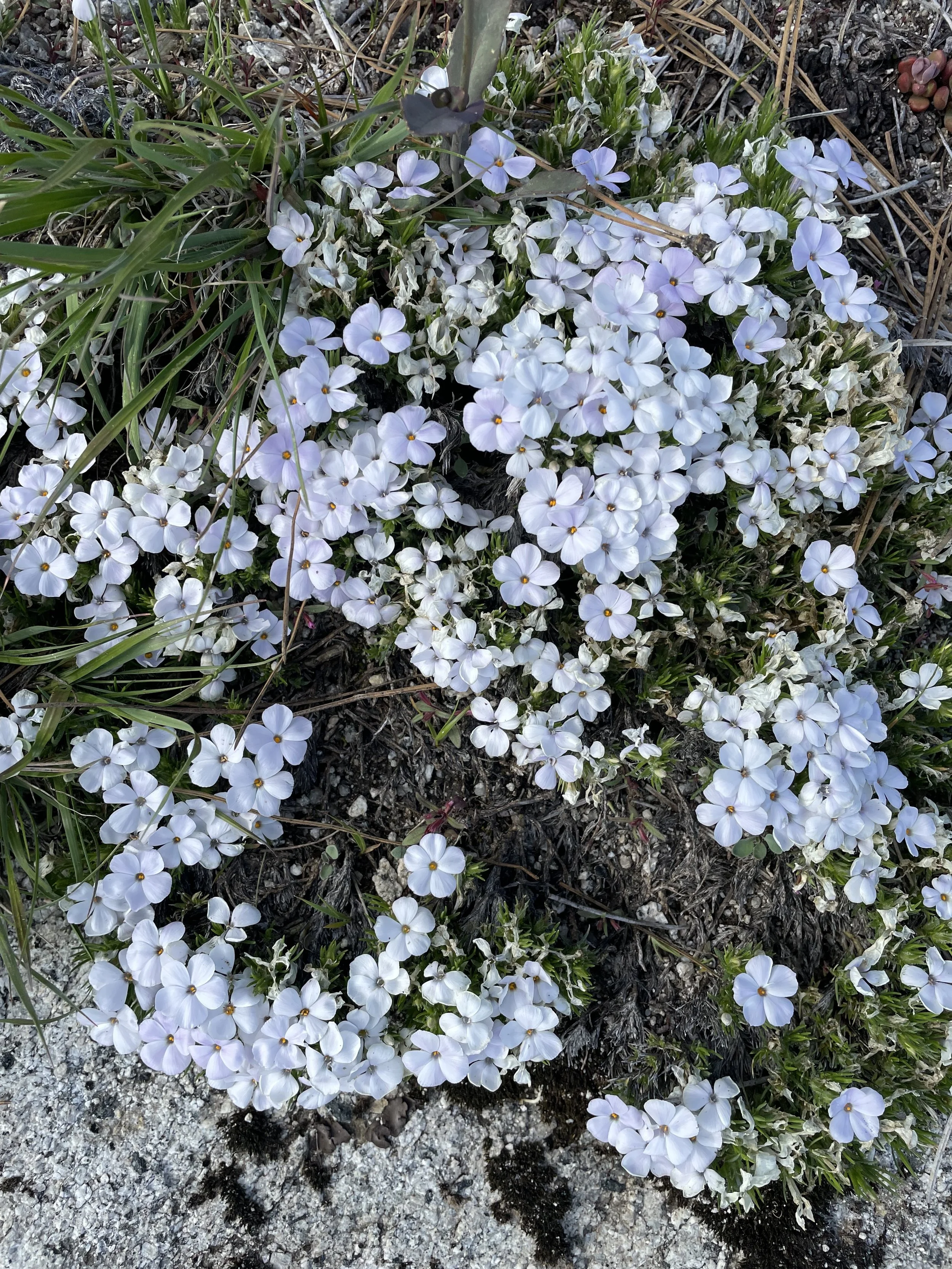
Taking it all in on the Snow Creek switchbacks on the long slog back down to the Valley from the summit of Mt Watkins. Photo: Miles Fullman
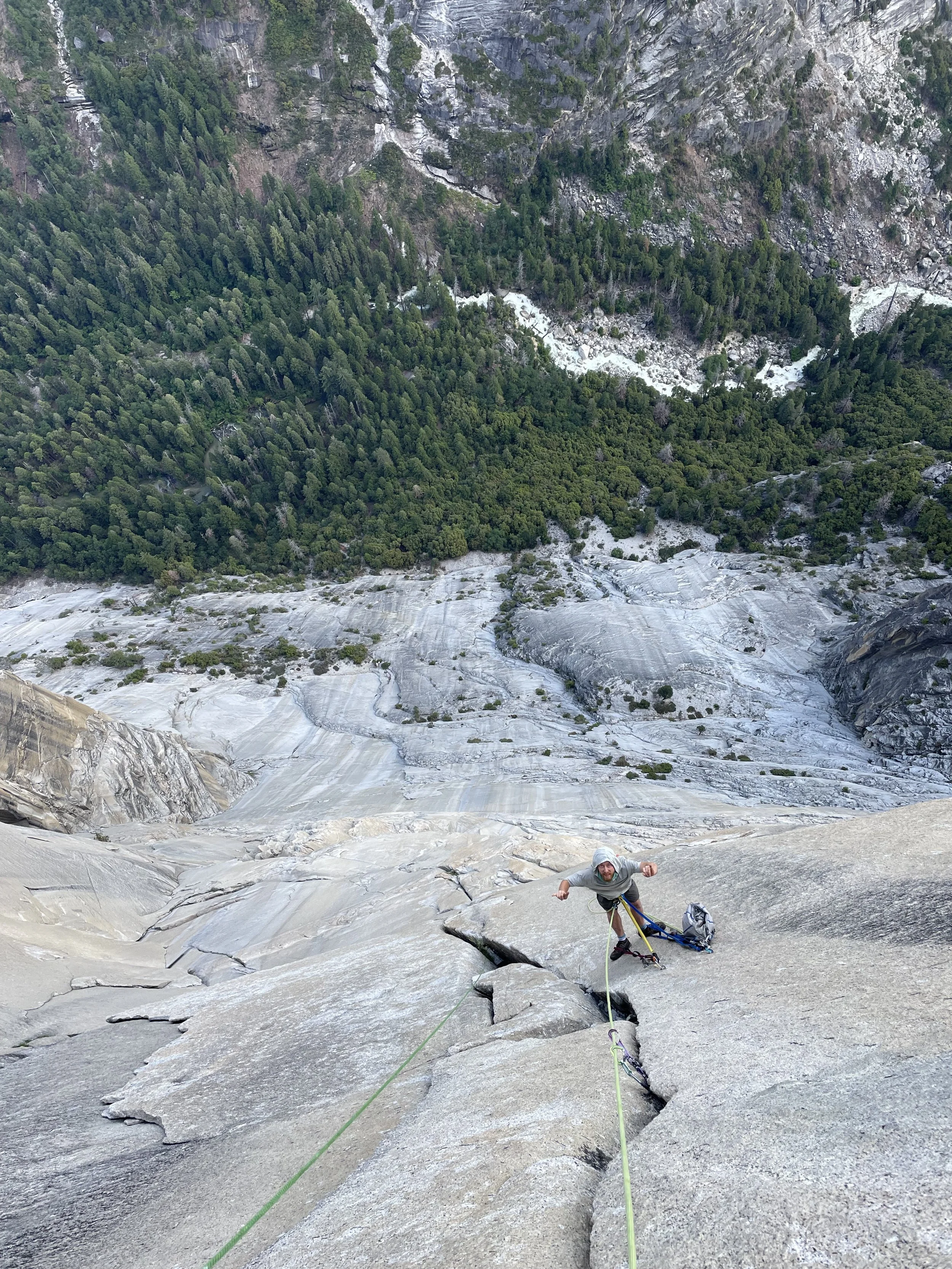
Looking down at Tenaya Canyon from the top of the South Face of Mt Watkins. Photo: Miles Fullman
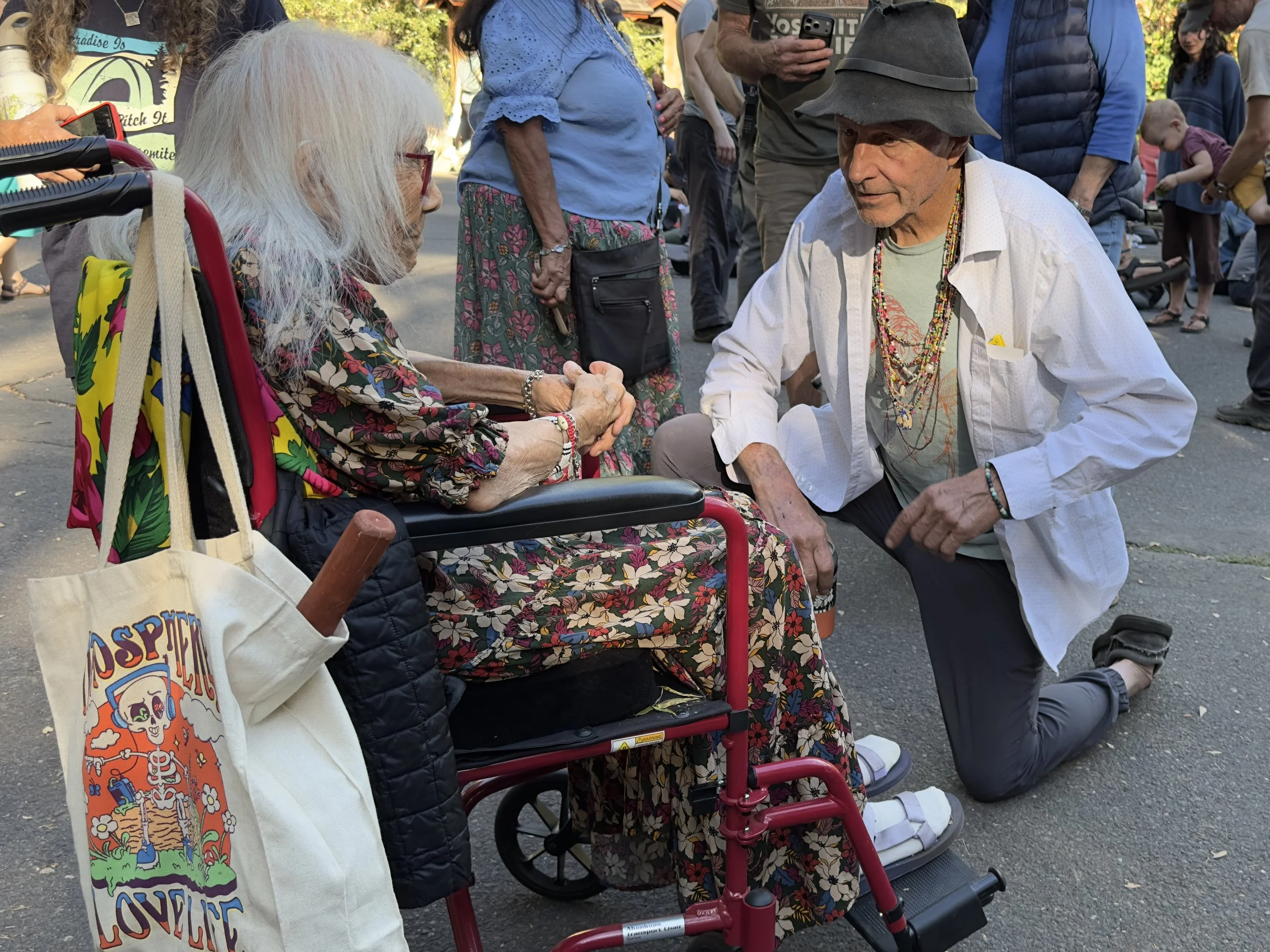
Dr. Julia Parker and Ken Yager at Yosemite Facelift. Photo: Tracy Barbuetes.
Facelift and Our Public Lands
After completing our 23 rd annual Yosemite Facelift I have been reminiscing about the early days and how it has evolved into the largest volunteer event in a National Park in the United States. It has shown me that together, we can accomplish anything, divided we accomplish nothing.
A little history, I started the Facelift in 2004, mainly for selfish reasons. I worked as a climbing guide for the Yosemite Mountaineering School and part of my job was teaching people how to behave in the outdoors to preserve it for future generations. I felt so hypocritical spouting the benefits of Leave No Trace and the “Carry it in, carry it out” slogan. Every turnout and climbers trail had toilet paper and other trash (diapers, cigarette butts, etc.…) that was hidden from the road. I decided to spend three days cleaning up some of my favorite areas and asked the Camp 4 climbing community to help me. 120 of us cleaned up roughly 40 pickup trucks full of garbage over the course of 3 days. We hardly made a dent in it which was demoralizing. We did have a lot of fun, and we felt like we were doing some good. I decided I would organize another one. Unknowingly, it was during National Public Lands Day weekend and our efforts garnered attention.
The following year, I made it a 5-day cleanup and invited park visitors, local residents, as well as the climbing community. I added a few evening programs in the form of movies and speakers. The turnout was triple of what it was the year before and despite removing huge amounts of trash, it again felt like we had hardly made a noticeable difference. The enthusiasm of the volunteers was off the charts, so I promised myself to make it an annual event until the park was clean.
Every year I added things to the cleanup to attract more volunteers. We have daily drawings for the kids and adults to receive nice prizes as a thank you. The evening programs are as good as any at any climbing festival in the world. The local schools make a field day trip out of it. It is now the largest volunteer event in a National Park and has been for some time now. Getting it to that point was not easy and there were difficulties. Working as an outsider with the US Government is not straightforward.
I was required to have a permit which lists all activities for the event and to make sure we are insured and the US is not sued. In the early days I had to meet with all the Division Chiefs of all the NPS departments and answer their questions about my plans and contingency plans if things went haywire. Many of them didn’t want the extra work it may entail. It was intimidating, but the one thing that kept me going was the knowledge that “How could anybody be against cleaning up trash?” and the fact that I had done a lot of interviews. I had access to a lot of news reporters.
Eventually I asked the NPS to partner with YCA on the daytime cleanup portion of the event. They agreed and it has been smooth sailing ever since. We work together now and have made it into something that we are all proud of. Since 2004 we have cleaned up over 1.2 million lbs. of trash that had been building up for many years. The trash we find now is small, hard to clean up trash that doesn’t weigh very much. We now find anywhere between 10,000 – 20,000 lbs. a year.
At some point, I realized it wasn’t only about the trash. It is about community, making friends, working together, enjoying beauty, and stewardship. I put a lot of thought into it. Why do so many people take a week out of their life every year to come up and help? Why is it so enjoyable? It is Yosemite of course, but I think there is more to it. We know that public lands belong to “We the People”. Most of the time it does not feel that they do. When working together cleaning up the landscape in Yosemite I felt for the first time that I had some ownership of the park and so did everyone else. Having ownership means taking care of the place. Stewardship. Then it hit me, what we were doing not only benefited us in our lifetimes, more importantly it benefits future generations. Public lands are not ours alone, they need to be protected and taken care of.
They are currently being threatened like I have never seen before in my lifetime. I feel that removing the Roadless Act is the most dangerous threat to our public lands, including the National Parks. It will impact all forms of recreation and reduce the size of the areas to pursue them. It appears to be an attempt towards privatization of these lands for a short-term financial gain and a permanent long -term financial/cultural loss. If allowed, these beautiful lands will be forever changed. Lands that belong to all of us. Think about that.
During last week’s Yosemite Facelift, I was pleased to see so many younger people participating. I have no doubt that these young people will protect these areas in the future. Dr. Julia Parker with her daughter, Lucy, and granddaughter, Ursula, of the local Ahwahneechee tribe, sang and gave blessings to the group. Dr. Julia’s words struck me. She thanked all of us for taking care of Yosemite and our home. She said we all were a part of her family. That message was very emotional, and it resonated with all of us. These lands do belong to all of us! There was not a dry eye in the crowd. Powerful.
This year I met a couple of people high up in the Park Service. Both seemed like reasonable people when I met them. I met Frank Lands, the Deputy Director For Operations, at a christening of the new sewer plant project in El Portal. I talked to him for maybe ten minutes. I asked him if he had ever camped or hiked in the park. His answer was, no, that he worked too much and didn’t have time. I don’t know if he meant Yosemite or any National Park. I offered to take him out and show him Yosemite if he would like to. He thanked me for the offer, and I hope he takes me up on it.
During the Summer I met with the Secretary of Interior Doug Burgum. I spent an hour with him in El Capitan Meadow discussing climbing in Yosemite. He knew a bit about climbing. He mentioned taking an ice climbing class from Lute Jerstad when he was younger. He was friendly and came off as a likeable guy. Someone who you would enjoy a beer with.
I would like to think that some of our government officials are just misguided and that it is not too late to change. The men I met could become National heroes right now and be forever embedded in history with the likes of David Brower and John Muir. Or known as the ones who helped steal lands from the people of the future. To them, I ask. What is your legacy going to be and are you proud of it?
It is time for the rest of us to act. There are changes planned for BLM lands, Forest Service lands and in the National Parks. These changes will happen if we don’t speak up. If something moves you, take some time and comment on it. Write your government officials, speak up, and please vote before it is too late. Thank you.
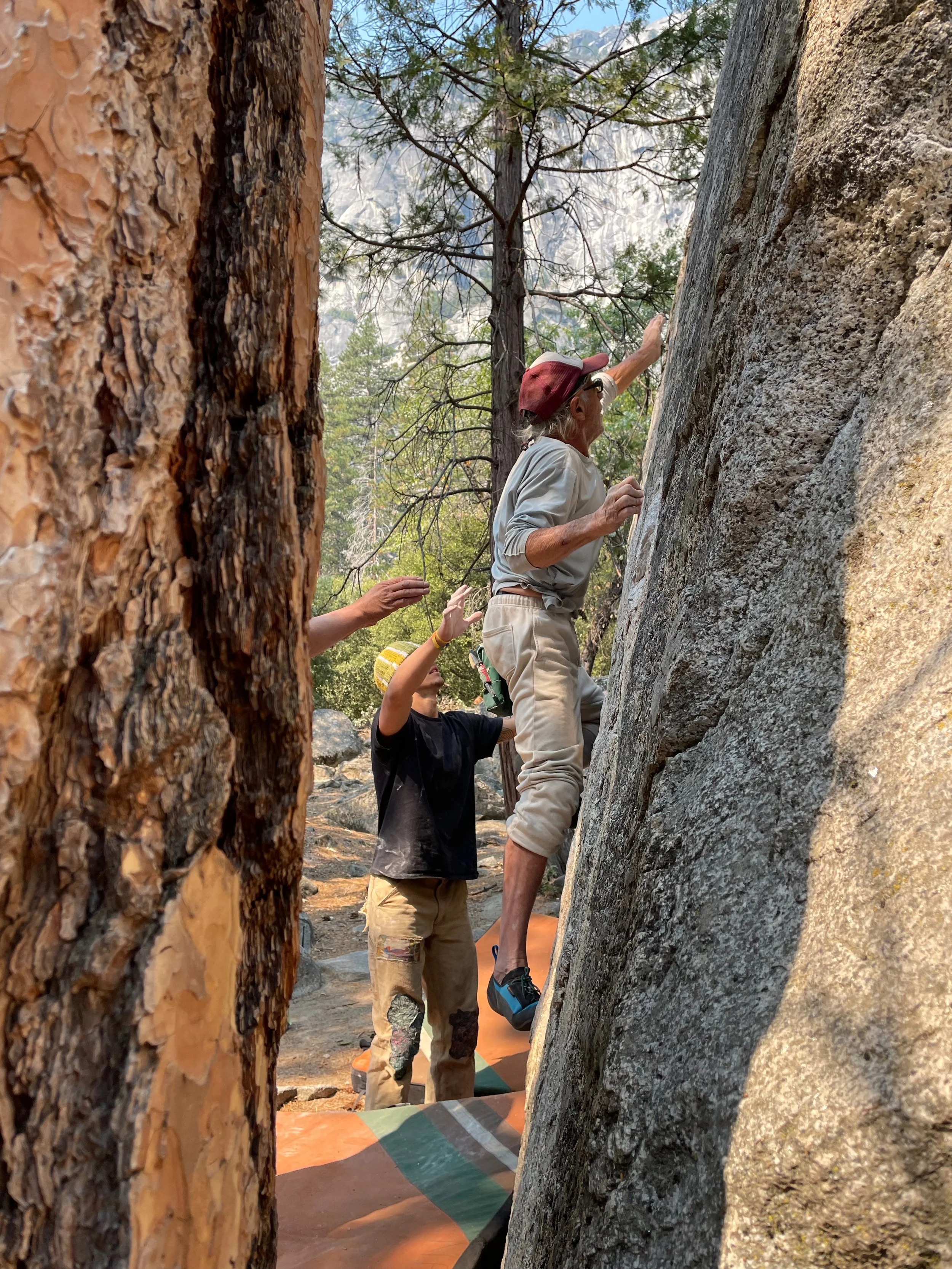
PHOTO OF
THE WEEK
Stu Kuperstock climbs the Kor Problem in Camp 4. Photo: Miles Fullman

Stay up to date on the latest climbing closures in effect!
Get your permits, do your research, and hit the wall!
Visit the Yosemite Climbing Museum!
The Yosemite Climbing Museum chronicles the evolution of modern day rock climbing from 1869 to the present.
The YCA News Brief is made possible by a generous grant, provided by Sundari Krishnamurthy and her husband, Jerry Gallwas