
EDITION 69 - AUGUST 31, 2026

Your window into the stories, history, and ongoing work to preserve Yosemite’s climbing legacy.
A Note from the Editor
This last week from August 22 to August 30 was National Park Week, with the theme being “Celebrate America’s Story” for both the 250th anniversary of the United States and the 110th birthday of the National Park Service. Entry fees were waived on August 25 in celebration.
Some rain rolled through the park on Friday, temporarily cooling down the Valley.
High Ground is an upcoming documentary about the plane carrying roughly 6,000 pounds of marijuana that crashed into Upper Merced Pass Lake in the winter of 1976. Its world premier will be held at the Yosemite Cinema in Oakhurst on Saturday, September 5. The film was directed by four-time Emmy-nominated filmmaker, Daniel Sharp. Ken Yager, founder of the Yosemite Climbing Museum, is featured heavily throughout the film. The premier will have an opening red carpet reception at 6pm, a live Q&A with the filmmaker and featured climbers at 6:15pm, followed by the screening at 7pm. Tickets can be purchased on the Yosemite Cinema website.
Yosemite Facelift is now just one month away, happening in the Valley from September 23 to 27. The second public screening of High Ground will kick off the festivities, with a free showing in the Yosemite Valley Auditorium on Tuesday, September 22 at 7pm. Free tickets can be reserved here.
For this week’s feature I asked Taylor Martin to write a short piece about the new routes they have been establishing in the park this summer. Martin has recently completed a new route on Half Dome’s northwest face, as well as two new routes in the Ribbon Falls Amphitheatre. Martin wrote a brief trip report about their two new routes in Ribbon Falls.
Miles Fullman
Editor, YCA News Brief
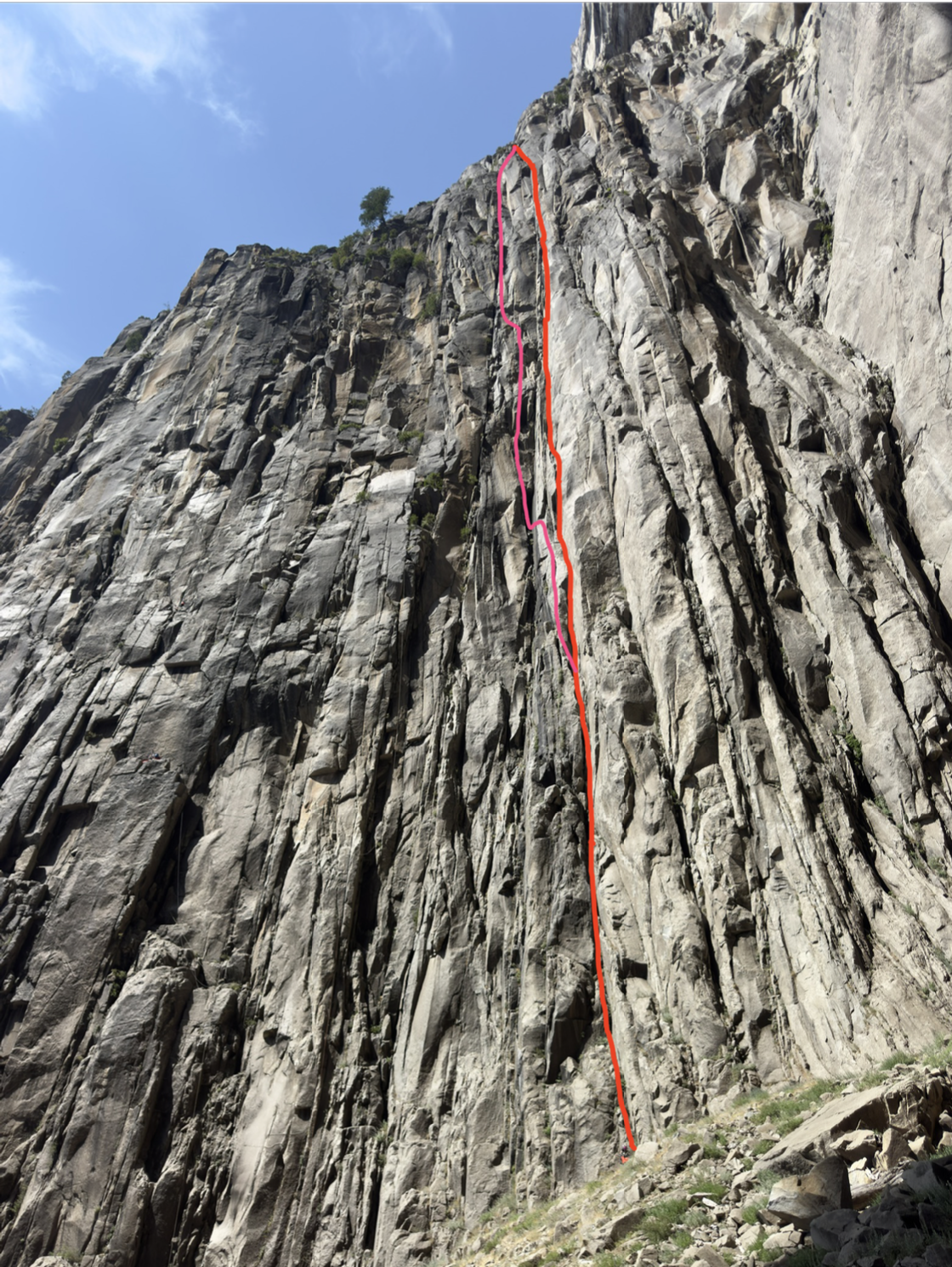
Route overlays for both the Nick Simon Memorial Route (left) and Destiny Express (right). Photo: Taylor Martin
The Pursuit of Shady Adventures: A Report of Two New Routes in the Ribbon Falls Amphitheater
Over the duration of August I had the privilege of establishing two new routes in the Ribbon Falls Amphitheater, one being with my good friend Ryan Doherty. With the Valley floor finally rising to over 100 degrees, the prospect of climbing anywhere but in the shade seemed foolhardy. Thankfully the Amphitheater, tucked behind El Capitan, offers shady walls with the eastern aspect being in the shade for all but three hours of the day.
On the initial trip I scouted many potential new routes on this eastern aspect, which has plenty of continuous crack systems. I settled on a route farther back in the alcove where the sun hits the wall the least amount during the day and began climbing. Over the first two weeks I moved ropes and gear up the wall, fixing lines all the way to the eventual summit. In some ways, I just wanted to sleep in my own bed each night. The other reason for fixing ropes all the way was to avoid the hottest and sunniest part of the day.
Most days of climbing didn’t start until 1:20pm and usually went into the night. As I neared the top of the route, I was rappelling over 800 feet and jogging down the approach trail to go hang out with friends each night. On the final day I climbed through the sun period and into the evening to finish the route and rappel the upper pitches.
Destiny Express is a new route at a moderate grade (5.10, A3) which is 80 feet left of the route Spaghetti Western (5.6, A3). Both routes top out at about the same height and offer around 1100 feet of climbing. Destiny Express takes a direct line up the wall, requiring minimal route finding and classic climbing in 9 pitches. It’s a great route for those looking to do more beak intensive A3 climbing.
The following week after finishing Destiny Express, Ryan Doherty and I went back to establish a 5 pitch variation after the first pitch of Destiny Express. This new variation climbed much better than it looked from the ground, offering consistently steep, engaging climbing throughout. All of the pitches offer quality climbing at a moderate grade with the most technical pitches being around A3.
After the 5 pitches of climbing, we met one of the ledges high on Destiny Express and decided that our cups were full. Arriving at the end of our route in the middle of the afternoon, we set up the portaledge and spent the rest of the evening rotating between conversations, trundling, and napping. It feels rare to have days like that up on a wall where the work is finished and it’s too late to go down. The light faded, and we found ourselves playing music and eating a last dinner before going to sleep. Ryan named the route the Nick Simon Memorial route (5.9, A3) after the loss of a close friend a few years ago.
The potential for more first ascents in the amphitheater feels endless. During the development of both of these routes, there was another team to the climbers left also establishing a new line. I’m excited to see how their route turned out, and it was fun communicating back and forth during our time up there. In the Ribbon Falls Amphitheater there are especially opportunities for free climbers to establish new lines. Destiny Express probably would go free other than the splitter corner on pitch 6, though I think you could go left onto the Nick Simon line to continue free climbing.
On the last day we rapped my fixed ropes on Destiny Express and installed quick links, enabling future parties to rappel these routes. Both of these routes are equipped with ⅜ by 2 ¼” stainless steel hardware.
In the end, it was hard to bring all the gear down to the valley floor. There was great potential to get vortexed up in that amphitheater for the rest of the year. There’s that much good rock. I’m sure that I’ll go back one day. Tucked up there above the valley is an experience that almost feels exclusive. I never saw any people visiting the falls other than the other party climbing up there which in itself is an odd happenstance. The Valley sounds typically heard on El Capitan are somewhat obscured up there, and during most of the year there is water to be filtered. It’s an oasis for wall climbers that not many people seem to experience. There is plenty more climbing to be done up there for those with enough curiosity to go and have a look for themselves.
Words by Taylor Martin
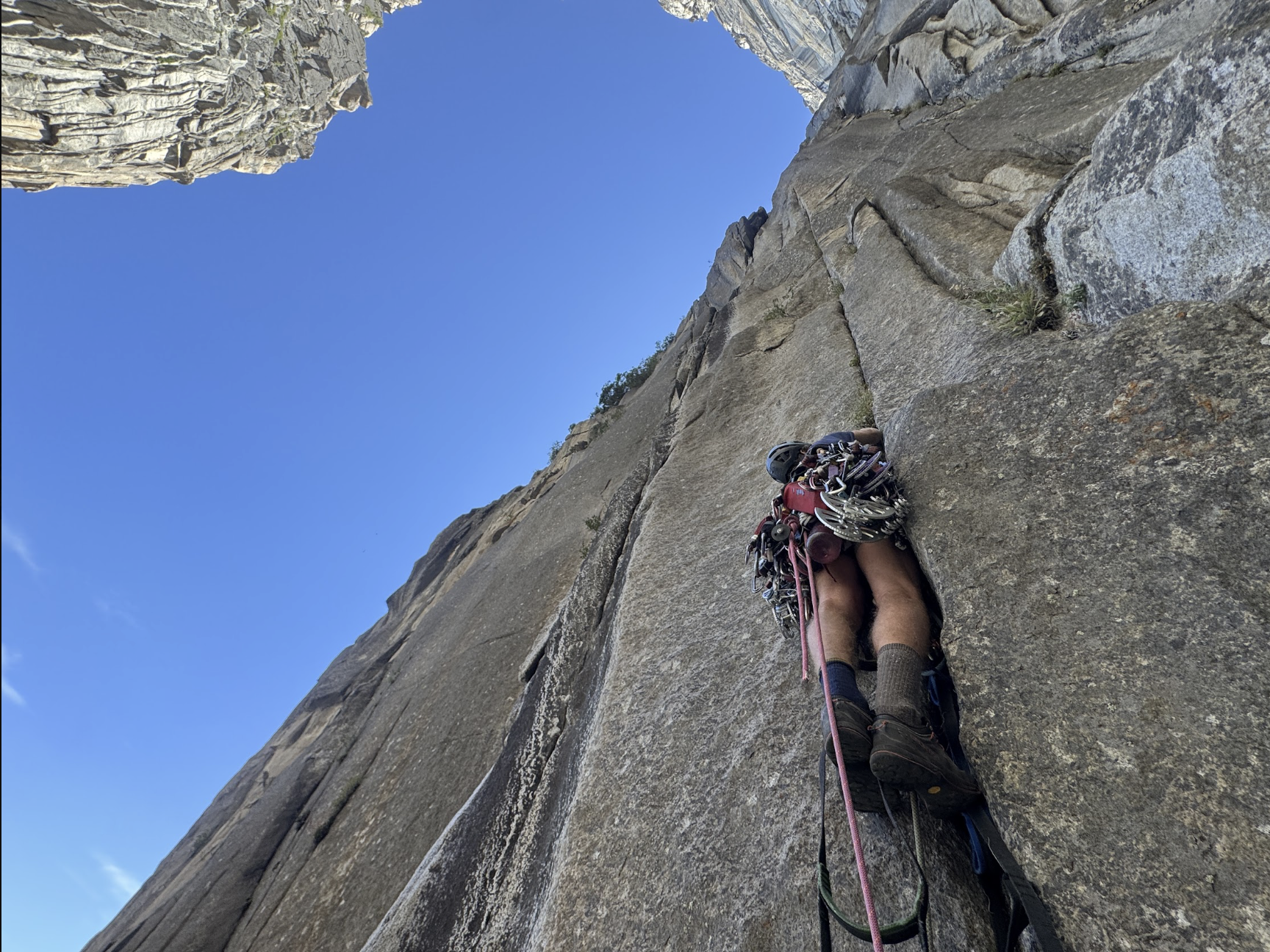
Ryan Doherty leading pitch 5 of the Nick Simon Memorial Route. Photo: Taylor Martin
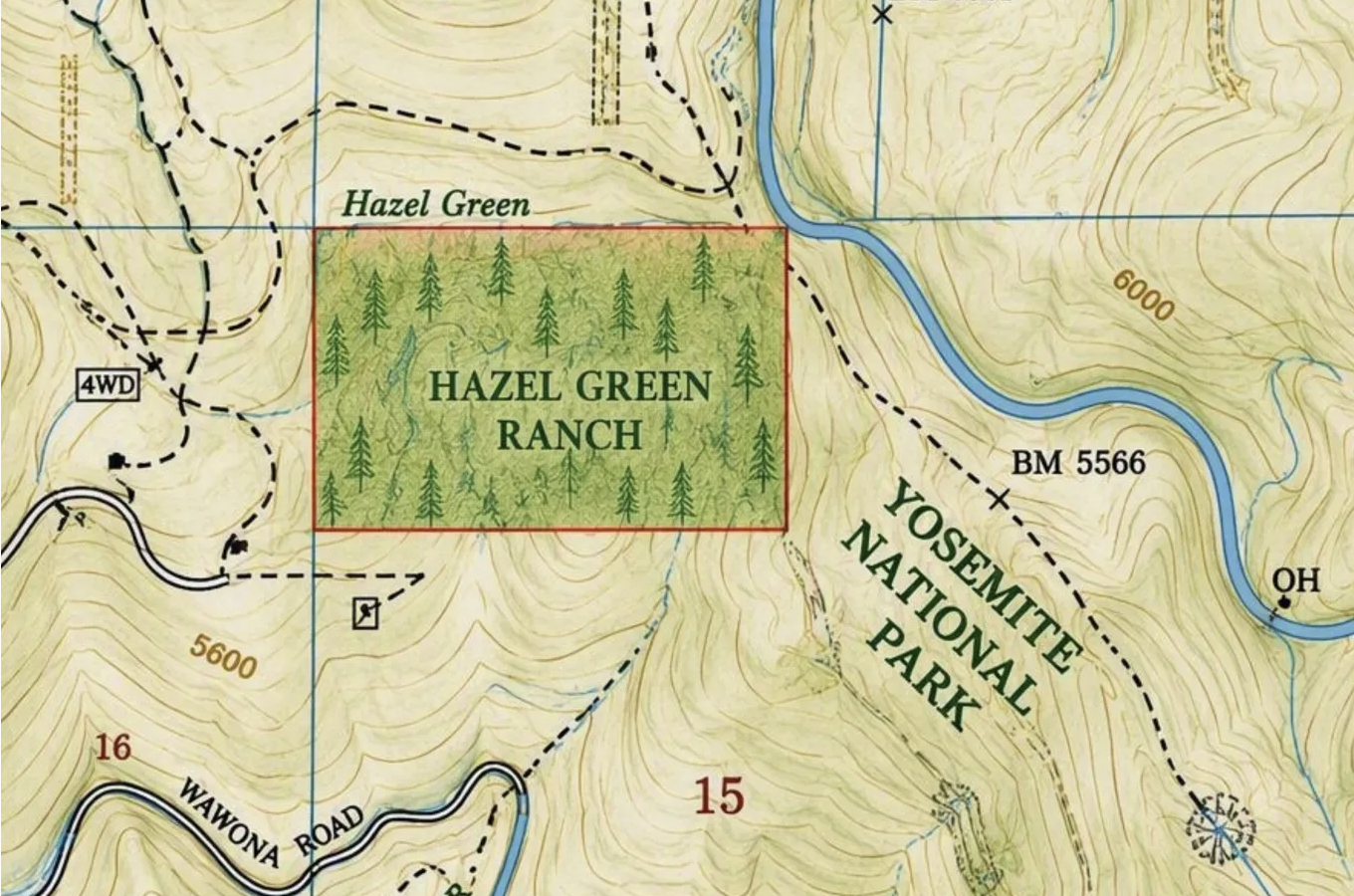
A map shows Hazel Green Ranch and Yosemite National Park. Source: Blake Land Surveys
Hazel Green
Hazel Green is a remote, 80+ acre piece of land on the western border of the park along Highway 120. It has been in the news lately. As one of the few people alive that has lived out there, I thought I would write about it. I spent two years living there with my family, between 1997 and 1999. It was hard living, but somehow very gratifying. We had the luxury of living so remotely, but had access to a completely modern world about an hour away. I don’t recall having taken any pictures while living there and in some ways, maybe that is better. My memories seem like pages from a classic novel that was written long ago…photos may ruin them.
During the winter of 1996-1997, there was a giant flood and by January 2nd, it had washed out Highway 140. Two mudslides covered Highway 120 below Devil’s Dance Floor. The whole Yosemite community was trapped for many days, and it was several months before Highway 140 was repaired. My wife, Schree, and I lived in a cabin along the creek with our six-month-old son, Guy. We had to evacuate across the creek during the flood. When we returned, the water and the septic were out. We were forced to find somewhere else to live, hopefully close enough so we could keep our jobs once the park reopened. Schree was a waitress at the Ahwahnee Hotel and I worked as a climbing guide for the Yosemite Mountaineering School. Only managerial positions received private housing, which allowed families with kids. It was hard enough to find housing without children, we were getting desperate.
Ed Hardy was the President of Delaware North, the concessionaire in the park. Ed had been running those operations for many years. He was a big fan of the museum project that Mike Corbett and I had worked on. He was so supportive and offered us an alarmed display case in the Winter Club room at the Ahwahnee Hotel for a climbing exhibit. Even better, he gifted us a free tent cabin along the river in the Camp 6 employee housing area. After a season in the tent cabin in 1993, Mike and I were given a wooden cabin at the Stables Housing area. Ed also offered me any job I wanted to have, but I declined it at the time. It is the only time I know of that someone had employee housing and wasn’t an employee. It was glorious!
I was talking to Ed one day and mentioned my challenge in finding a new place to live. He said that if I wanted to, we could caretake his property along Highway 120. He said that it was a little remote and lacking in amenities, but that it might work for us; if we wanted it, it was ours. At this point, I was ready to take it, sight unseen. I asked for directions and went to look at it with my family.
We parked in Hazel Green Dip, which is between Big Oak Flat entrance station and Crane Flat. As the name implies, it is a dip in the road and the only section of the road where it’s uphill on both sides. We parked in the east bound turnout and followed a faint, winding trail through a forest of giant trees for about 200 meters to an opening in a barbed wire fence. After stepping through, there was a dirt road. We turned right and walked out of the forest onto the edge of a large meadow surrounded by more forest in the distance. The meadow sloped to the southwest, you could see the Central Valley and the city lights of Madeira at night.
It was close to a ¾ mile hike to the buildings from the car. I spotted a newer looking barn on the left. To the right was an old line cabin that Ed had already given to a couple of young kids with summer jobs. They were related to him somehow. Behind the line cabin was a shower house and near that was the trailer we had been offered. The snow roof built over the trailer had partially collapsed from a fallen tree, making it impossible to open the trailer door. The trailer looked ok, the damage was light and right above the trailer door. We both liked the property and with free rent, it was within our budget. I told Ed we wanted it and grabbed my tools and a couple of car jacks. I lifted it enough to get the door open and braced it. The inside was pretty dusty, but after cleaning it up, I turned on the propane oven to cook dinner. After a few minutes, I smelled something burning. It was a mouse nest! We went running outside, trying hard not to vomit. I had to let it burn until it turned to carbon. The smell lingered for weeks after that. We lucked out and moved into the line cabin after the boys decided they wanted to live in employee housing with their co-workers. The cabin was small and had a wood stove for heat, propane water heater, propane fridge, and propane lamp. No phone service, no electricity. Water was pumped from a spring to a large water tank that gravity fed the cabin and outdoor shower house.
Ed had bought the property with the dream of building an exclusive hunting lodge. He built the barn and a massive log cabin lodge out of yellow pine milled from the property. Ed was going through a divorce when his interest and financing for the project disappeared. The lodge was built but the roof was never sealed and unfortunately, the structure rotted and had to be torn down. It was a real shame because it was a beautiful building. To drive to the property, you’d take Harden Flat Road from Highway 120, before the park entrance. After about ten miles, the pavement ended and the last several miles was a dirt road. One section was a chronic mud hole, making it a challenge to drive through. I only drove it when it was dried out during the summer months. It was a lot quicker to park in the turnout and walk or ski in.
Shortly after we moved out there, Ed sold the property to a company that had eco-resorts in Tahiti. They kept us on as caretakers. There was also another set of caretakers that had towed a trailer out there. Ken Elliot was someone I knew from his days working in the gas station at Yosemite Lodge. He was a red-faced, jovial character with facial hair reminiscent of Santa Claus. We were glad to have Ken and his partner, Linda, as our new neighbors in this remote area.
The property was a beautiful place to live. It was quiet, almost perfectly silent, except for the wildlife which was so much more abundant than in the more populated areas of the park. There is a spring on the property that was used by the local wildlife daily. There were obsidian flakes and whole arrowheads everywhere on the property. It had clearly been a hunting ground for Native Americans. Birds were everywhere. There were bears, mountain lions, bobcats, deer, fishers, and birds of prey. You could hear the great horned owls hooting at night and sometimes see them fly by in the darkness. We also dealt with persistent mice problems. It was the wildest place I had ever lived in. Not because of the terrain, but because of its undeveloped beauty and thriving wildlife population. It looked like it did thousands of years ago. The night skies were so dark that the star gazing was phenomenal. We didn’t have a tv and kept ourselves busy, cooking nice meals and reading a lot.
When we moved out there, my friend Les Chow was studying mountain lions on the property for NPS Wildlife Biology. After the mountain lion study, Les studied fishers. When the old Big Oak Flat Road was built, Hazel Green was the overnight stagecoach stop from Groveland. After going through the Merced Grove, it would end up coming down the west side of El Capitan, into the Valley at what is now the wood yard.
The Park Service is currently being pressured by the Hazel Green owners and the Trump administration to give up the NPS land, from the turnout I used to park in to the barbed wire fence. While it’s only a distance of 200 park land yards, it weaves through a forest of large trees, populated by the most varied wildlife I’ve ever seen in the park. I’m hoping this land is not given away or traded. It will set a precedent that it is ok to sell off sections of our public lands, if it suits the powers that be. If it happens in Yosemite, it will happen in every national park. Once lost, these lands are lost forever. An access road would destroy the wildlife and destroy the area. And why? So the wealthy can avoid waiting in line at the gate and have access, even if visitation is limited? The parks were designed for us to learn about our natural environment and immerse ourselves in nature, protecting it for future generations. I would like to see people stand up and stop this before it happens. Speak up, write or call your congressmen, protest, whatever we must do. If we don’t, we are going to lose our public lands, piece by piece.
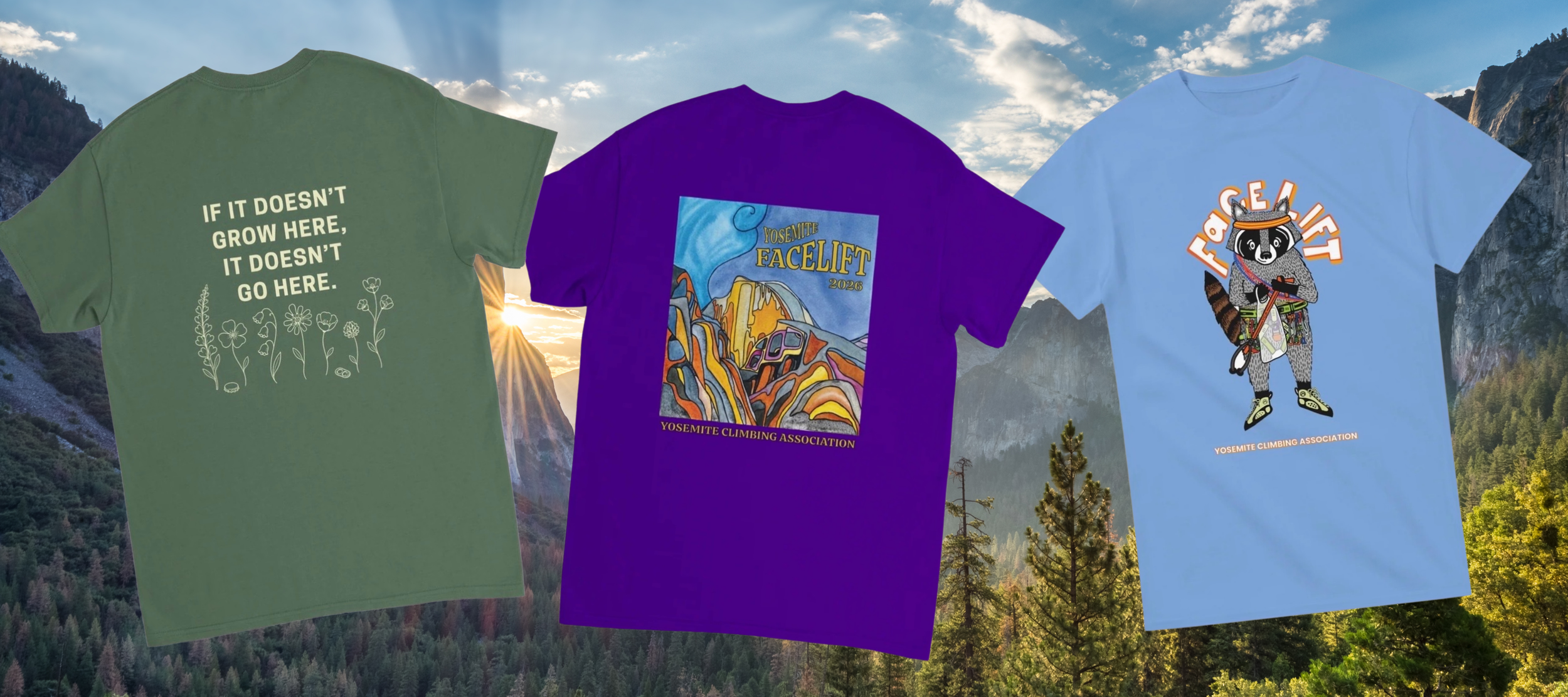
Facelift shirts are hitting the shop early this year!
For the first time, we’re launching a collection of Facelift shirts online before the event, with this year’s artwork available in a variety of colors and styles.
Coming to Yosemite? We’ll still have our traditional Facelift event t-shirt available during the week, with one design and color made specifically for the event.
Shop your favorite now, grab the event t-shirt in Yosemite, or do both. Every purchase supports YCA and helps make Facelift possible.
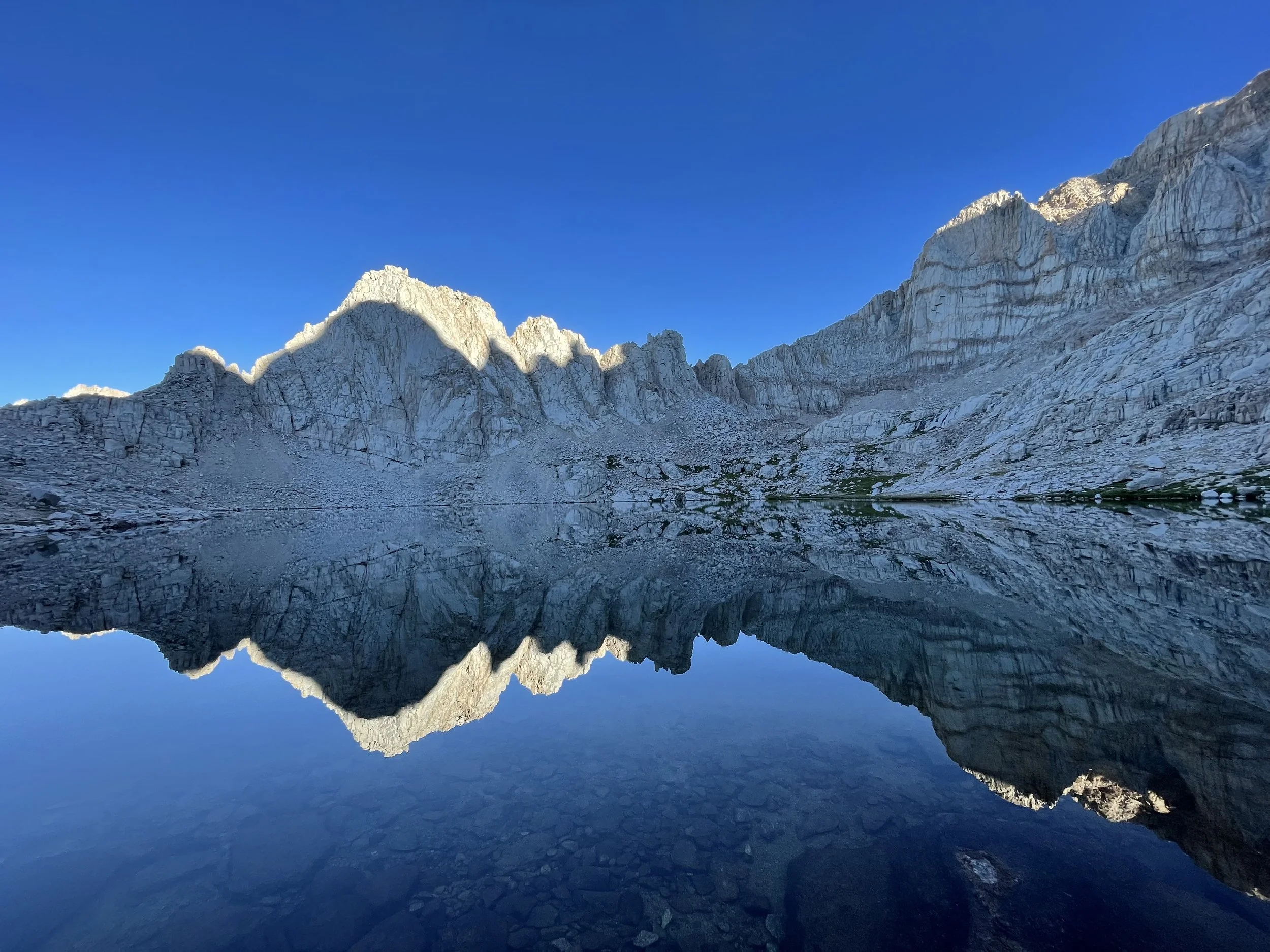
PHOTO OF
THE WEEK
Iridescent Lake above Miter Basin in Sequoia Kings National Park, with The Miter and Iridescent Wall reflected. Photo: Miles Fullman

Stay up to date on the latest climbing closures in effect!
Get your permits, do your research, and hit the wall!
Visit the Yosemite Climbing Museum!
The Yosemite Climbing Museum chronicles the evolution of modern day rock climbing from 1869 to the present.
The YCA News Brief is made possible by a generous grant, provided by Sundari Krishnamurthy and her husband, Jerry Gallwas