
EDITION 63 - JULY 20, 2026

Your window into the stories, history, and ongoing work to preserve Yosemite’s climbing legacy.
A Note from the Editor
At the Yosemite Film Festival, Tom Seawell and Jeff Wiant screened their new documentary Frost, The Story of a Lifetime, which took home the Grand Prize and Audience Award. Their film charts the life of Tom Frost, a man whose extraordinary achievements and experiences spanned every decade of the genesis of American rock climbing. What came through most for me is Frost’s sense of humility, gratitude, and ceaseless striving.
“When the time comes to start doing something else, and it’s one of the tragedies of climbing if you don’t, if you keep on climbing, that’s the only tragedy in climbing that I see, I don’t see injury and death as being a tragedy, because it means when I’m stepping up to life overall.”
This quote from Frost comes towards the end of the film, and brings home how close to his own values he lived. Nearly every aspect of his life showcases this unquenchable curiosity and desire for constant challenge and growth. To continue to be able to move and change with life and remain curious and keep finding new ways to be inspired is a remarkable virtue and one that Frost clearly embodied.
Frost not only shaped the mold of Yosemite climbing as it stands today, he also saved Camp 4 as a place of historical and cultural significance. How remarkable and special it is to have had a hand both in initially forging and later preserving the unique mold of the mecca of American rock climbing.
Frost appreciated a deeper, more spiritual, connection with mother Earth, with Nature. He notes that after decades of reflection on his early adventures, he discovered that his real partner on those ascents had been the wall itself. He expressed gratitude for having had good companions along the way, and clearly contained a real sense of spirit. If anyone embodies the tired adage “it’s not the summit that matters in the end, but how you got there”, it’s Tom Frost.
Miles Fullman
Editor, YCA News Brief
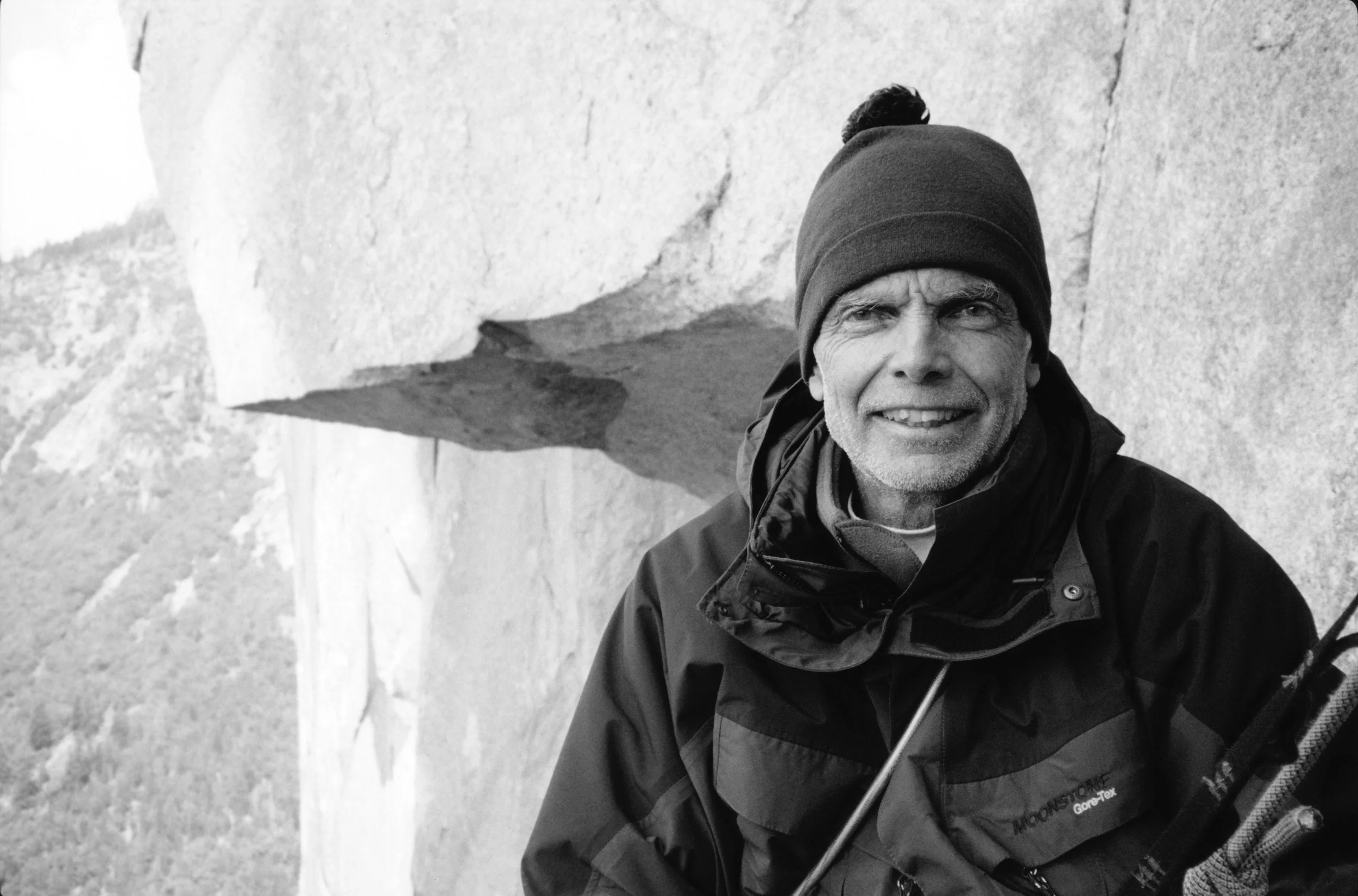
Tom Frost revisited the El Capitan routes he had climbed in his youth with his son, after forty years of not having climbed any big walls at all. Photo: Image provided by the Frost - NACHA Archive
Frost: The Story of a Lifetime | Documentary Directed by Tom Seawell
1. What led you to creating this documentary / how did you meet Tom Frost / what incited this project?
TS - I met Tom Frost in the early 1990s while I was working for Chimera, his motion picture and photography lighting company in Boulder, Colorado. At the time, he was living in his warehouse, yet he was a huge icon in the photography and motion-picture worlds, driving a white Porsche 911. Something interesting was going on, but he never talked about it.
We respected each other's work style and became lifelong friends. It was decades later that I found out that he was a legend in the climbing world. He never told me. I found out from a mutual friend of Jeff Wiant and me. Bill Hoshevnikoff convinced me to call Tom and ask him to start this journey. I nervously called him up, and after some uncomfortable rambling, he agreed to sit down with us. Neither of us knew that we would spend the next decade and a half working together.
2. Tom Frost's life spans so many major decades of both American rock climbing and American history in general. The film does a great job of documenting both - was that intentional or did it unfold alongside getting to know Tom?
TS - Nothing was intentional in the making of this film. We had no idea what we were doing 15 years ago. You have to remember that creating a film before the digital revolution was limited to big budgets and Hollywood-style crews. Our journey was a 15-year schooling in filmmaking and storytelling. Jeff and I had the skills and the stoke to craft an image based on decades of grinding it out in the photography world. We simply followed each crack in Tom’s life and did not stop until this Memorial Day, with our Mountainfilm World Premier.
Our non-climbing or Flatlander curiosity was blown away with each discovery we made. We got very serious about Tom’s history after we filmed the last interview with Tom and Royal Robbins together. When we found out that Royal was sick, we knew we had to pay attention to history and take that very seriously. When we started we had no idea who Royal Robbins was.
We got serious very quickly and aligned with the help of Steve Grossman. A passionate historian, and very interesting character on the now-defunct Chris McNamara’s Super Topo website.
3. How long in the making was this film? Were there any major challenges or setbacks along the way?
TS -15 years from start to finish. You have to remember that this was a self-produced and self-financed project. Jeff and I were just starting families 15 years ago while running successful production companies. I would say today we could have made this film in two years. But time passing was always an advantage for us, because the biggest challenge was working with the humble Tom Frost, a man who was part of the Silent Generation shaped by the Great Depression and World War II.
As time went by, Tom became more comfortable with this project, and we grew into close friends, which led to more open and personal discussions. We are proud to say that he very much enjoyed the adventure. There is a line that Tom says in the film. “I said nothing for 15 years, and I am starting to finally say it.” How lucky were we to be there with cameras to capture it? He got to read over 900 pages of transcripts before he died.
4. What is one takeaway you got from spending so much time with Frost that has impacted you both in a lasting way?
TS - Do hard things. How you do anything is how you do everything. Take care of Mother Nature and get outside, but also do family and run a business with the same intention. Live a full life. The climbing culture’s foundation is based on doing hard things. More comfortably gripped than waiting in line at Disneyland. This culture is so important because they are the ones touching nature every day, they can be seen as a selfish bunch, climbing is not a team sport, but when they get together on a topic they feel passionate about, they can make real change. Doing hard things comes naturally to them, especially when a life or lives are at stake. A very important culture for the future health of our planet.
5. The film does a wonderful job of describing the clean climbing revolution and positions it as one of the early environmentally conscientious climbing movements. Did you as producers have these kinds of influential movements in mind while making the documentary?
TS - Doug Robinson gave us a great line in the film.“ It was the first ever environmental moment that worked because it was fun!” Doug Robinson
I put it in because he was right. I tell this to my friends, family, co-workers, and use it in my volunteer work as a park and rec commissioner in my small town. Getting people behind a movement is hard; if you can make it more fun and more of a challenge, you have the momentum to change something. Not telling them what to do, but making it more fun while helping the environment, yes, I am in! That quote from Robinson is, in my opinion, an anthem to all the big problems in the world. Especially the environmental ones.
6. The film describes the shift of Chouinard equipment into Patagonia, from forging climbing gear to mass producing clothing. Frost seemed uncomfortable with that shift towards a more profitable business model. Can you speak more to his discomfort and what exactly about that shift gave him pause?
TS - I think Val Franco from the Patagonia archive team said it best: Tom was not comfortable with clothing; he tried, but he loved hardware. Tom and Yvon were total opposites, and in the end, they clashed. Pretty common narrative in the business world. That tension was necessary, but it also became bitter and painful. That break-up produced two great American brands that changed the world.
Tom was damn proud to have his products hand-sewn in Boulder, Colorado. He was able to rehire all the highly skilled craftspeople who had been laid off by the outdoor clothing industry, which was looking for cheaper labor overseas.
I got to personally meet some of those craftspeople. They loved working for Frost and Chimera. Forever loyal and hard-working folk.
7. The documentary really captures Frost's humility and lack of ego, and his selfless attention that made for such beautiful photos and finely designed innovations. In many ways your filmography and directing parallel this attentiveness. Did you find yourselves influenced by Frost's attitude and demeanor while spending so much time around him?
TS: I can speak to his lack of ego and humility. I personally think Tom was an extremely smart and sensitive person who felt vulnerable in the spotlight. Being vulnerable was harder than climbing El Cap for him. He would never show that to you in person. He was stoic in public. His language was his photography. His historic black-and-white photography collection is stunning. A metaphor for his personality. Dean Feldman got it right when he commented on how much he loved our choice to keep the film in BW. “Tom’s engineering mind was black and white, so keeping the film in BW was a great choice.” Jeff, more so than I, loves BW film. Looking back, I personally enjoy scraping away all that information from the color world, so I can simply enjoy the journey with less noise. Most people don’t notice that the film is 100% in black and white after experiencing it. That has been a wonderful experience to discover post-release.
8. How has this project differed from other projects you have worked on? Are you particularly proud of it?
TS - Almost all of the films I have worked on have been for brands, good brands, brands that do good in the world. We had the freedom to do what we wanted with this one. Frost was ours. And we loved that punk rock mentality. We aligned with wonderful sponsors that gave the freedom to create without any political ties to money. This is ours, and we get to do whatever the f**k want with it.
We were able to, as flatlanders, drop into an unknown world and culture and capture an important and missing piece of California, Yosemite, and World history that would have been lost forever. Working on a passion project like this is hard, tough on our families, friends, and running the business of a documentary film tests your weaknesses every day. The importance kept us going. I am proud that Jeff and I have remained friends and respect each other immensely over the past 15 years. That is what I am most proud of.
9. The film is entirely shot in black and white. Was that done intentionally as a stylistic homage to Frost's iconic photography? TS answered above.
JW - Tom Seawell and I both gravitated to B&W almost immediately. There is a certain quality of B&W photography from the 60’s and early 70’s that is really beautiful and specific to that era. I personally wanted to showcase the grandness and quality of Tom’s photography. By keeping the entire film in B&W we don’t have the subjectiveness of color in the way. Tom’s photography library is special and deserves to be presented in its best light.
10. Doug Robinson said of Frost: "One of the things I love about Tom is that he's the most cheerful non sherpa that I ever met." That sense of irrepressible joy breathes through the entire film. Was it as infectious to be around as it comes through?
TS - I am most proud that you can feel anything in this film. My fear was that I would end up having a puff piece of about Tom’s life. I never liked any of the early edits because that was all we had. Frost became more comfortable with the project over the years, and Marna, Tom’s daughter, agreed to be interviewed after Tom passed, which changed the film entirely. We rewrote almost all of it. Finally, we had a film that told the story of a complicated yet wonderful human being who was not perfect.
11. Anything else about the project you'd like to share about? Anything and everything is welcome!
TS - To gain the trust and friendship of such a humble person—someone with an amazing historical past who carried a Leica around his neck—was a gift.
In my opinion, those in the spotlight are no longer interesting to me. Are we hungover and ready for something new? Slowing down and being inspired and entertained by a humble person’s story, warts and all, is interesting to me if it’s told authentically and makes you feel something; that was our ultimate goal. These are the important stories to get out there, especially today.
JW - I had the privilege of previewing Tom’s entire photography library. And in doing so realized the importance of Doreene in his life. I would be looking at a contact sheet of Tom’s work in Europe. And I would see an incredible shot of his. Then a few frames later a beautiful image of Doreene. She was there with him on every major trip and traveled the world with him. It was a quite extraordinary love they had. I hope the film touches on it in a subtle way.
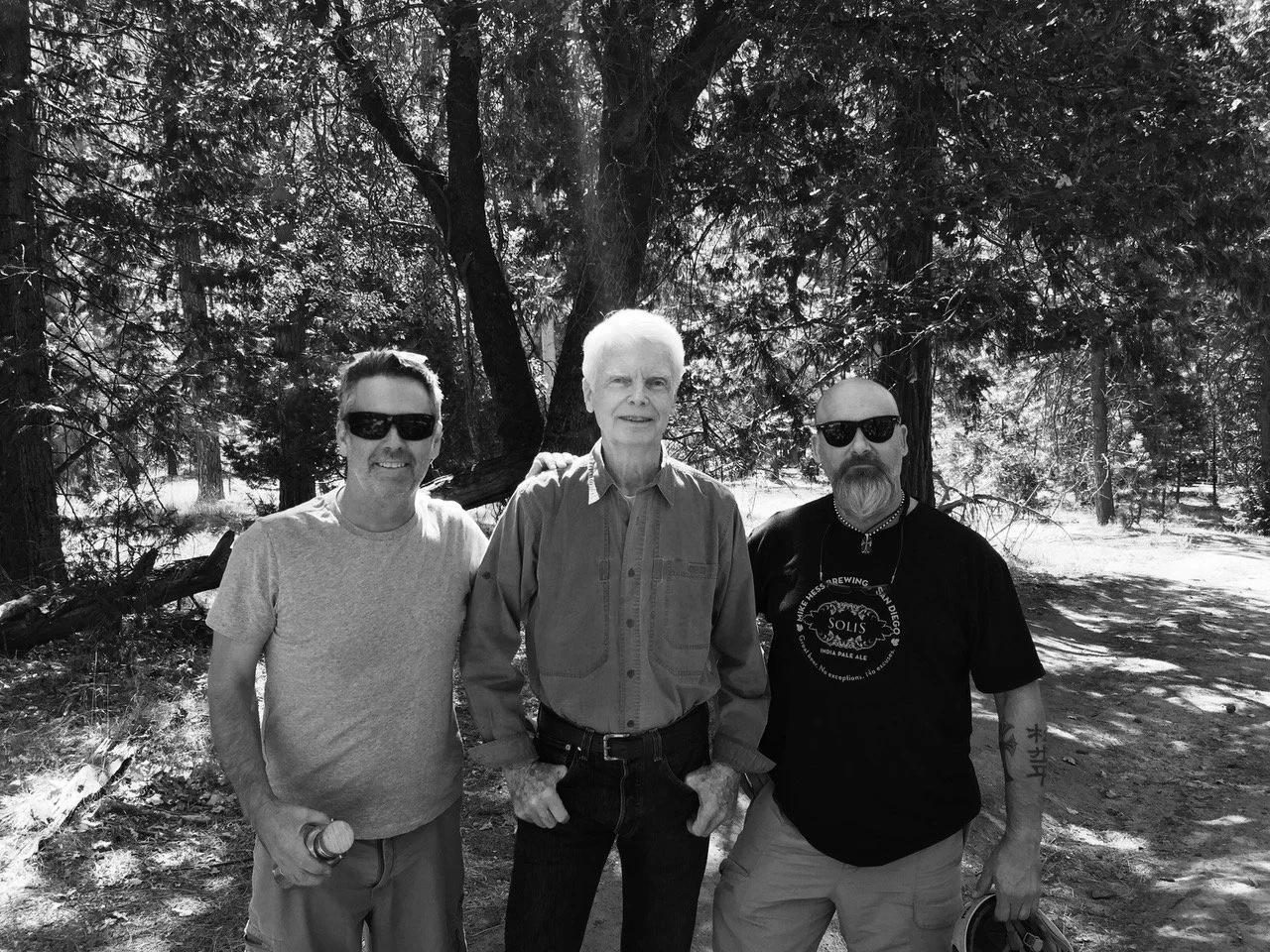
Tom Seawell, Tom Frost, and Jeff Wiant. Photo: Flatlander Films LLC
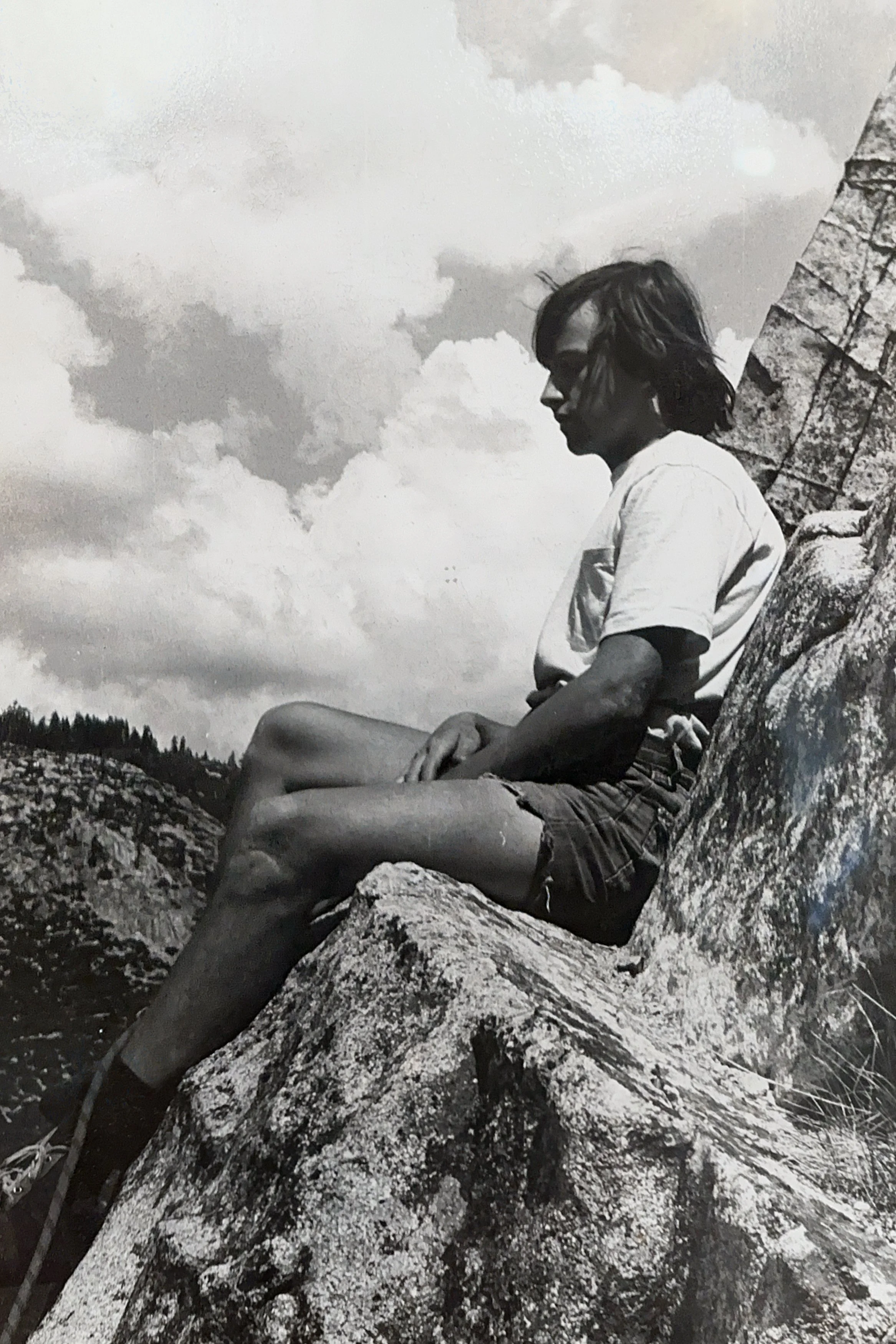
Ken Yager on Lover’s Leap, 1973. Photo: Ken Yager Collection
Falling
Every serious climber has stories of the falls they have taken and the legendary falls that they have heard of. These stories are shared around campfires by climbers all over the world. It is not surprising; nobody I know likes to fall. It is the most likely thing to hurt or kill you. Most of us try to avoid it at all costs.
After climbing for 55 years, I have taken my share of falls. I have caught them and I have seen some spectacular ones. I have never been seriously hurt when using a rope. Twice I broke bones bouldering. My first year living in Yosemite I broke my ankle at Housekeeping Boulders by rolling my ankle from 18 inches above the ground. The second time I broke my leg behind Camp 4 after falling 20 feet. Dean Potter carried me out and drove me to the clinic.
I remember my first leader fall very well. I was 13 or 14 years old and climbing at Lover’s Leap with my stepfather. I had worked my way up through the grades to where I was confident on 5.7. I felt I was ready to lead a 5.8 and decided on Haystack Crack. The roof was a lot bigger when you got underneath it. I put what gear I could in the left facing corner and clipped into the fixed pin below the roof. A perfect hand crack split the roof. The only problem was I didn’t know how to hand jam. I couldn’t figure out how to do it. According to Gene Drake’s guide there was a face variation that went out right to where the roof was smaller and had a line of face holds leading back left avoiding the hand crack. I went out to take a look and did a couple moves over the roof and then I was stuck. I couldn’t climb back down and the holds were insecure. I held on as long as I could with my legs shaking violently. I slid off the holds and went over the roof in a swinging 35-foot fall into the corner below. Other than a couple bruises, I was unscathed. I was lucky.
Shortly after my fall, I assisted with a carryout in the dark of an injured climber named Rick Sumner. The only positive thing about the carryout was that I got to meet TM Herbert. Rick had been climbing the second ascent of a new route he had put up called Wallflower. Somehow while following a pitch, he climbed faster than the belay and a loop of rope caught in a flake beneath him. He was pulled off and took a sizable fall hitting some of the horizontal dikes that the Leap is known for. The Leap is not a place you want to fall. It really opened my eyes to the dangers of climbing. He was pretty messed up, and he was in a lot of pain as we carried him down on the stretcher. To this day, his injury was the worst climbing injury I have ever seen. It influenced my climbing from then on. I realized that you didn’t have to be very far above a piece of gear to take a long fall especially with rope stretch. I quickly learned to calculate fall potentials and doubled up my protection to keep me from hitting obstacles when falling.
The longest fall I have ever taken is 60 feet. It has happened three different times. Each was completely unexpected. My first was on the A4 pitch on Horse Chute, a Charlie Porter route, in 1977. It was my first A4 lead and after 5 or 6 consecutive bodyweight RURP and knifeblade placements I had gotten past the crux and placed some good pieces. I had felt solid on it and I was psyched. Chuck Goldman and Mike Corbett were celebrating with a bowl of weed. The terrain got easier. It became featured with knobs and there was obviously some free climbing coming up. The aid placements zig zagged back and forth so I back cleaned behind me to reduce rope drag for the free climbing above. I got to a big knob that I should have just mantled. Instead, I got lazy and decided to blindly place a sling over the knob and step up a few more steps in my aiders. When I peeked over the top of the knob, I could see the sling was behind a white crystal. I was in my top step getting ready to step onto the knob when the crystal went shooting over my left shoulder in a puff of granite dust. I watched the sling roll right off the knob in horror. It was over before I knew it and I ended up slightly below a shocked Mike and Chuck at the belay. I was embarrassed and climbed back up and mantled the knob and after some easier climbing I reached the anchor.
Another time I was leading the first pitch of Haard with Sue McDevitt belaying. I ran it a little at the end and came flying off the last move. I am quite a bit heavier than her. She wasn’t anchored and she got yanked close to thirty feet off the ground stopping at my first piece. I nearly landed on her as I went past.
The third one I took was while guiding on Liberty Cap. I placed a cam behind a flake and was standing on it with my aiders. The flake suddenly broke off and I went flying. When guiding I always had my clients use a Grigri and asked for plenty of slack so as not to get pulled off. I should have gone only half that distance.
When I was learning to climb, I remember hearing about Yvon Chouinard taking basically a 300-foot factor 2 fall on a perlon rope. This story was told around many campfires, and I guess it was supposed to instill confidence in the modern ropes.
After moving to Yosemite, I heard of other notorious falls. Yabo was a legend by the time I got here. He had been soloing the 5.8 pitch on Magic Mushroom off Mammoth Terraces. He popped and went flying backwards through the air. The rope he was trailing miraculously caught in the crack saving him from death.
Glen Denny told me about a fall Warren Harding took when they were working on the West Face of Leaning Tower. Completed in 1961 it was the first overhanging wall in Yosemite. Warren pulled off a loose block resulting in a fall. He was knocked out and blood was dripping down alarming both Glen and Al McDonald. Fortunately, Warren came to fairly quickly and they lowered him back to Ahwahnee Ledge. He had a gash on his forehead that was bleeding profusely. They wanted to get him back down the ropes in the fading light to the base and drive him to the clinic for stitches. Warren would have none of that. He opened a bottle of wine, and they drank it before rappelling down. By the time they stumbled into the clinic it was nearly midnight and all three were pretty hammered.
Mike Corbett and Rick Cashner did the first one day ascent of the Direct Route on Half Dome. Rick was moving fast and free climbing without placing much gear. He took a hundred-footer. Mike was hip belaying and his hands were severely burned. Dazed, Rick could hear Mike yelling that he couldn’t hold him much longer and that he needed to get back on the rock before he dropped him further. They finished the route with Rick leading to the summit with Mike following with his damaged hands. Mike was one tough cookie.
I was guiding Higher Cathedral Spire once and I saw some climbers across the way on Higher Cathedral Rock. They were climbing on a 5.11c route to the right of the Braille Book called Perfect Vision. I had never seen anyone on it before, so I was watching as I belayed my partner. The leader had gotten through the crux pitch and was clipping the anchor when he went over backwards. As he fell there was screaming and the sound of clanking gear. He kept falling until he was back at the belay. Much to my relief his partner caught him after about a hundred feet. The guy was a badass, he ran right back up there and finished the pitch. I took a similar but much shorter fall once, falling backwards while trying to clip a piece. It was terrifying. I landed with my head three or 4 feet above the ground. I only went about 20 feet. I couldn’t imagine falling over backwards for a hundred feet.
Another time I was belaying Scott Burk on a hard slab project on the Glacier Point Apron. The routes on the Apron are runout on tiny holds. It is hard to find stances comfortable enough to hand drill from. Through practice longer falls could be controlled by sliding down keeping your feet under you. Scott put in a bolt a ways off the ground and continued climbing until he was 40 feet above the bolt he placed. He calmly yelled “Falling!” and started sliding down. I was worried he would hit the ground, so I locked him off and ran downhill pulling rope in. I stopped him at the bolt and he was impressed.
I set up a 120 foot fall off the top of El Cap for a movie once and it was the biggest whipper I have ever seen. I got to see it twice because the film had been exposed to fogging the first time we filmed the fall. It was quite impressive!
I spent at least five summers doing first ascents in Glen Aulin. Bud and Lucy Keene ran the High Sierra Camp. They had split shifts and could climb during the day. We would often help them with dishwashing or other chores so that we had longer to climb during the day. Bud went out to work on a route with Errett Allen. Bud had some good gear in and then ran it out, eventually getting a small cam in for protection. They had run out of time and Bud needed to get to work so he started lowering off of the small cam. Errett had lowered him nearly to the anchor when the cam pulled out and Bud took a long sliding fall down the slab below. When he got back to camp his fingers had gnarly burns and both his thighs were shredded from sliding down the rock. It looked very painful.
Captain Kirk was leading an aid pitch on one of the routes out of the Alcove on El Cap. He was leading a long pitch of fixed copperheads. For some reason he decided to unclip from the copperheads so that he wouldn’t yank them out if he took a fall. He ran out most of the pitch without leaving anything clipped behind him. He popped a copperhead and took a massive fall. He banged his head and ended up with a concussion. He was rescued and walked around the Valley in a daze for a while.
There was a climber that I recognized from the 1970’s that showed back up on the scene around the year 2000. He had the same long dark hair complete with a colorful headband. He had a swarthy beard and wore white sailor pants and a Chouinard rugby shirt. I swear it was the same outfit that I had seen him wear 25 years earlier, including the headband. He spent a lot of time drinking Olde English at the Deli when he first arrived. His plan was to solo an El Cap route which was ambitious for not having climbed in over 20 years. I stopped in El Cap Meadow one day to talk to Tom Evans who had his scope pointed towards something on the Zodiac. He had just called the rescue team about a person hanging upside down a few hundred feet above the ground. The climber was yelling for help. I looked through Tom’s telescope and could see a person in white pants, rugby shirt, and headband hanging upside down with a loop of rope wrapped around his ankle. It was reported he was drunk and unable to extricate himself.
The rescue team showed up and headed up to the base. There was a rope hanging off a haulbag and Scott Burk jumared up it and rescued him. It was a ballsy move by Scott as it was unclear what the rope was attached to. It turns out the climber had heard about body hauling and decided to try it out for the first time. He did not have a leash and his haulbag was light. It had some water and a bunch of empty beer cans in it. When he weighted the line and removed the second jumar, he took a ride down to the end of the rope and somehow his foot got wrapped in a bite of rope as he fell. It may have saved his life. He was hanging by one leg with a single jumar on the haul line. Dangling upside down, he yelled for help. I coined the nickname of the “Ankle biter”. He disappeared shortly after and has not been seen since.
Robbie Lesher was climbing at Positively 4th Street with two other guys. They only had one rope. Robbie led the first pitch to the big ledge and belayed the first person up. After he untied, the rope was thrown back down for the third climber to tie into. As the third climber was climbing the un-roped climber was peering over to watch him climb. The third climber fell and as Robbie caught the fall the rope tightened and flung the un-roped climber off the ledge. Robbie was so shocked he lost control of his hip belay, dropping the third climber to the ground. The un-roped climber landed flat on his back in a patch of sand amongst the talus field. He was unhurt. The roped climber did not fare as well but was also extremely lucky. He was hurt but still able to walk away.
Pat Sullivan and Brad Jarrett were doing a winter ascent of the Jet Stream on Half Dome. It was a real winter and there was a large cornice rimming the summit. After freezing in the shade for days with cornice chunks and sheets of ice flying by, they were underneath the final obstacle. They had brought ice axes and crampons for the summit cornice. Brad led up to the summit and built an anchor beneath the cornice at the lip. He tied into the haul line and continued climbing over the cornice. He was post-holing back to build another anchor when a horizontal crack appeared in the snow in front of him. The detached cornice slid over the edge taking Brad with it and slammed him into the wall a hundred feet lower. Pat felt the full brunt of it as the cornice hit him directly at the anchor. A piece was ripped out and one of Pat’s daisies was broken. Both were knocked unconscious. Coming to, both men were dazed and thankful to be alive. Pat led over what remained of the freshly fractured cornice and anchored behind it. They made it to the Valley floor without further incident and headed straight to the bar. Ed Hardy, the President of Curry Company was very impressed and bought endless rounds for the local heroes.
Free soloing falls are generally fatal, but not always. Rick Cashner is the only person I know that survived two falls while free soloing. He was hospitalized both times and he still climbs to this day.
Royal Arches is a popular free solo and done by many. I know of at least 2 top climbers that have slipped on the last slab pitch at the top. Both managed to grab manzanita branches to stop themselves from falling over the edge to the ground 1,500 feet below. I would wager it has happened to many others. The slab can have sand on it at times making it a little bit committing.
By far my favorite free soloing story is about Roland Arsons. He was soloing Rawl Drive on Lembert Dome. A party to the right of him watched nervously as he climbed. Somehow Roland screwed up the sequence and barn doored off the crux. As he took flight, he calmly said “Well, it looks like I am out of here.” He fell sliding down the glacial polished slabs in his shorts until it started leveling out. He went a couple hundred feet severely scraping up both thighs. He had the worst scabs on both buttocks I have ever seen. It must have really hurt.
Falls are fickle. People can get hurt on a ridiculously short fall and yet walk away uninjured from a horrendously long one. In the 1970’s we were willing to risk long runouts on slab climbs. Our shoes had slick, hard rubber on them and once they started sliding there was no stopping them. The trick was to keep your feet under you and to step over any obstructions as you were sliding down. The falls were slow enough that a competent hip belayer could pull in some rope to reduce the fall. With the introduction of sticky rubber, I noticed an increase in leader injuries. Some were broken ankles from the shoes catching the rock. There was also an increase in head injuries from people getting flipped upside down. We never wore helmets back then, now I wouldn’t think of leading a pitch without one. Even with all the new tools, climbing is still dangerous, but it sure is fun!
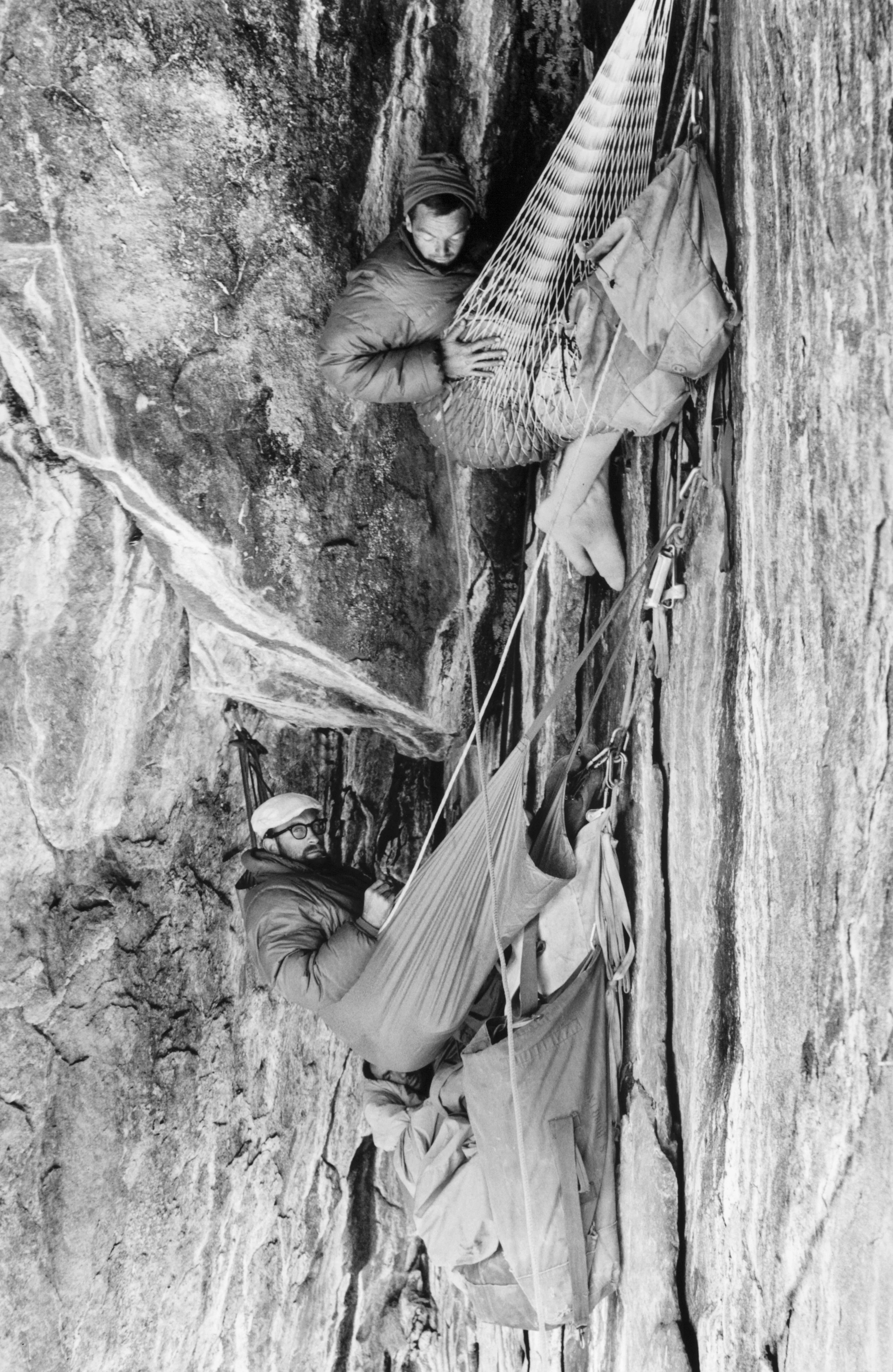
PHOTO OF
THE WEEK
Chuck Pratt’s iconic photo of Tom Frost, Royal Robbins and Yvon Chouinard dangling in hammocks below the Black Cave on the first ascent of the North America Wall, El Capitan. Photo: Image provided by the Frost - NACHA Archive

Stay up to date on the latest climbing closures in effect!
Get your permits, do your research, and hit the wall!
Visit the Yosemite Climbing Museum!
The Yosemite Climbing Museum chronicles the evolution of modern day rock climbing from 1869 to the present.
The YCA News Brief is made possible by a generous grant, provided by Sundari Krishnamurthy and her husband, Jerry Gallwas