
EDITION 62 - JULY 6, 2026

Your window into the stories, history, and ongoing work to preserve Yosemite’s climbing legacy.
A Note from the Editor
The inaugural Yosemite Film Festival was a great success, with many people traveling to the Valley from all over the place to come see the films being played, gather with the community, and share the passion for Yosemite rock climbing and its widespread influence.
The current draft proposals for the EXPLORE Act are still open for public comment. Visit the following link for a clear explanation of what this Act means for climbers on the American Alpine Club’s page: CLICK HERE.
The park was packed with visitors over the Fourth of July weekend, creating traffic around the loop and keeping the search and rescue team highly busy.
Slightly cooler temperatures than the recent heat wave have allowed for some late season ascents of El Cap. Oliver Tippett soloed Dark Star (VI 5.10 A5), making what he believes to be the third ascent and first solo ascent. He then went on to make the second ascent of Every Man for Himself (A3), again solo, stating that the grade belied the difficulties of the route (unusual for Tippett’s tendency to downgrade the aid ratings of routes after climbing them). Tippett has called it his last ascent of a very busy spring season.
Taylor Martin finished a new route on Half Dome this week, topping out on July 4. Her route climbs some interesting new terrain, beginning to the left of the Regular Northwest Face before joining it at pitch 6 and departing it by continuing straight up above the first bolt ladder, trending leftwards on the face. At pitch 13 it joins Blue Shift to the top, for a total of 16 pitches. Martin is naming the route Stratosphere, at A4 5.9.
For this week’s Founder’s Log Ken Yager recounts meeting Abana Jacobs during the 2016 Facelift, and the ensuing sponsorship with Subaru and friendship with Jacobs.
For this week’s Feature, having just climbed the Direct Northwest Face of Porcelain Wall, I recount some of the history of Warren Harding’s first ascent of the formation, a route that was erased as it was being established and left in its chopped state until being resurrected in 2012 by Eric Sloan and Richie Copeland.
Miles Fullman
Editor, YCA News Brief
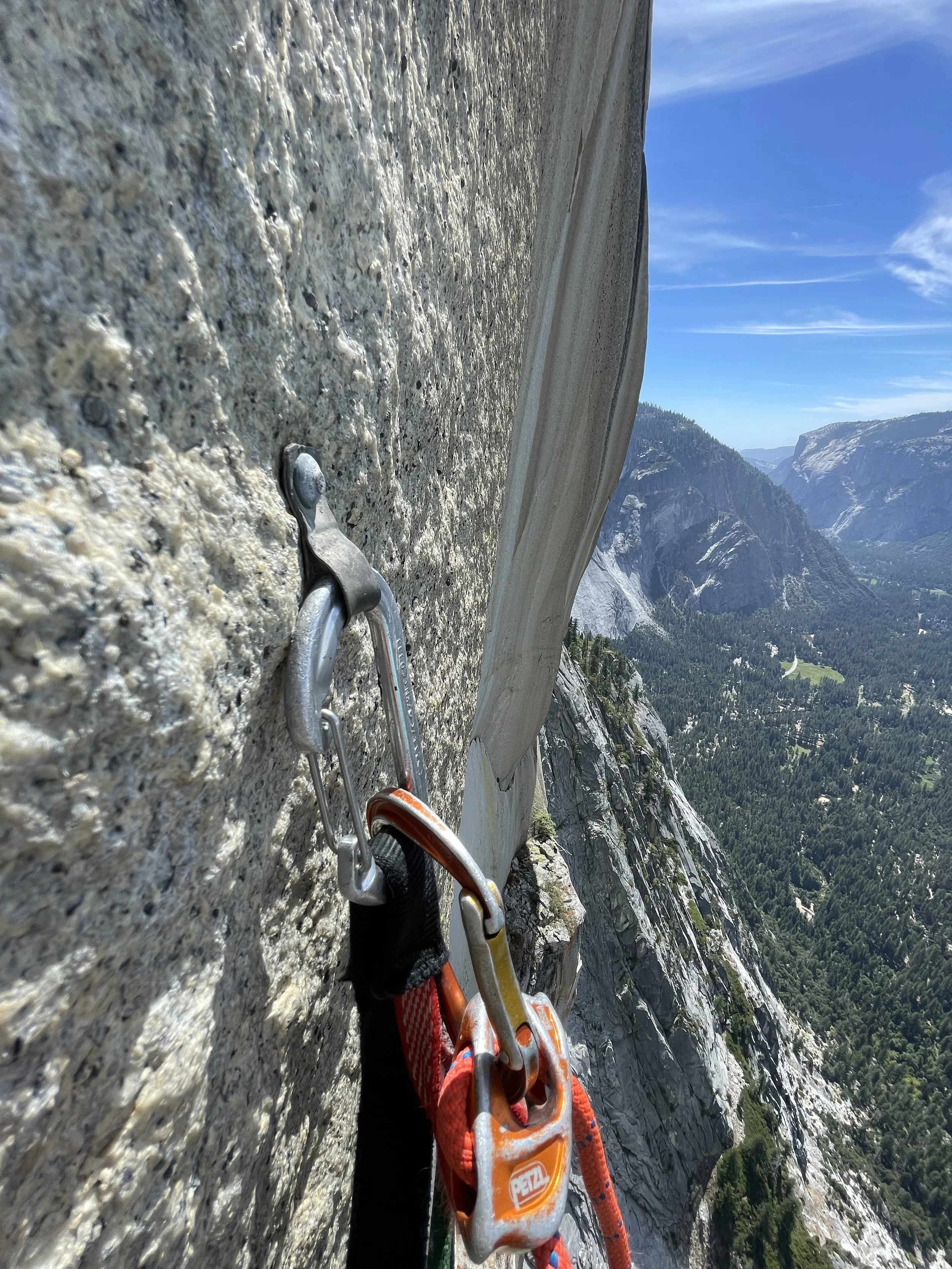
One of the original rivets left from the 1976 first ascent near the top of the route. Photo: Miles Fullman
Yosemite's Self-Erased 1976 First Ascent
In 1971, Royal Robbins set out to make the second ascent of Warren Harding’s Wall of Early Morning Light with a hammer and a chisel, to erase the long bolt ladders that linked the discontinuous features up the sheer wall. Harding’s willingness to reach for the drill when establishing new routes offended Robbins’ traditional ethos of conserving the nature of the rock and the challenges it offered to those willing to rise to the occasion.
…
The rivalry between Robbins and Harding is of course by now the stuff of legend, particularly dramatized by Valley Uprising. But the ethical, and perhaps spiritual, differences ingrained in the core of each of their thinly veiled competitive natures are as relevant today as they were in the so-called golden age of Yosemite climbing. These differences of style are still essential waypoints by which to understand the tradition and direction of climbing as an endeavor.
The majority of the major first ascents put up on Yosemite’s walls by these two climbers are still classic routes, timeless in their own way and significant cornerstones in the world of rock climbing. Harding made the first ascent of El Capitan with Wayne Merry and George Whitmore via The Nose in 1958 in an epic 47 day siege spread over multiple seasons, famously drilling the final overhanging bolt ladder through the night and topping out at dawn.
In 1960 Robbins made the second ascent of The Nose in just seven days and in 1961 Robbins climbed the second route up El Capitan, the Salathé Wall, with Tom Frost and Chuck Pratt, using just 13 bolts on the entire 3,500 foot route.
Robbins and Harding would go on to put up many big wall routes around the Valley, but by the 70s the dawn wall was still considered too blank to be climbable without significant drilling required. Undeterred, if not encouraged, by this obstacle, Harding again pitted his obstinate tenacity against the stone and in the late fall of 1970 spent 27 days with Dean Caldwell establishing the Wall of Early Morning Light. The team famously refused a rescue when they became trapped on the wall in a major storm.
Just a few months after its first ascent, in February 1971, Robbins and Don Lauria made the second ascent of Harding’s route in five and a half days, chopping the first three hundred feet of bolts. The higher Robbins climbed, however, the more frequently he encountered stretches of unbolted climbing that required skill and grace. He began to doubt that he was in the right by destroying the route, and eventually put the chisel and his ego away and simply climbed Harding’s route to the top.
…
In 1976, Warren Harding, Dave Lomba and Steve Bosque hiked up the drainage to the right of the death slabs below Half Dome towards the yet unclimbed and intimidatingly steep Porcelain Wall. Spending twelve nights on the face the trio drilled their way up the blank overhanging face, and chopped the rivets behind them as they went.
Recalling the first ascent in an interview with Chris Van Leuven, Steve Bosque said: “I think a part of him just wanted to lift his middle finger to the Valley elite and say, ‘I’ll just save you the trouble, and I’ll chop it myself.’ I think we chopped just about the whole damn route.” The team used rivets and bathooks for upward progress on lead, with Harding ordering Lomba and Bosque to chisel the hardware off as they went, reusing the hangers from the chopped bolts for higher on the route.
Bosque recalled the line going from mixed free and aid climbing to steep A4, piecing together thin seams, expanding flakes and plenty of loose rock. Harding drilled something like 200 bolts. The Wall of Early Morning Light, nearly twice the length of the Porcelain Wall, had required 330 bolts.
Aside from the extensive drilling and chopping, the first ascent proved eventful. Lomba was hit in the back when a block was dislodged by the haulbags, Harding took a fall and ripped an entire section of RURPs before getting back up and finishing the lead, and at one bivy some of the pitons the trio had hammered in to use as their anchor fell out overnight and were dangling uselessly from the rope in the morning.
Out of water on the final day, Harding once again drilled through the night, as he had done before on The Nose, finally crawling on top of the outrageous Diving Board feature at the top of the wall.
The route was resurrected in 2012 by Richie Copeland and Eric Sloan, with a direct start added to the original Harding route, thus becoming the Direct Northwest Face as it stands today.
…
Curious to discover what this famous self-erased route was like, I went up on July 2 to climb the route with Owen Silitch. We encountered more bolts than either of us has ever seen in one place, interspersed with some interesting albeit brief sections of beaking, hooking, and free climbing. The position is truly outstanding though. And the route is certainly of interest for its unusual history. The endless bolt ladders feel comically out of place on the blank wall, trailing to the summit like a line of ants as far as the eye can see. They are a strange and lonely testament to the insatiable willpower of one determined man.
The clash of envy and competition between Harding and Robbins created some of the finest rock climbs in Yosemite and the world. One doesn’t pause to wonder if Harding was justified in reaching for the drill while clipping out the outrageously exposed final bolt ladder of The Nose, the entire expanse of El Cap sweeping below your feet. But something about Harding’s bolt ladder to the sky on Porcelain Wall is out of sorts with the nature of the wall.
Being adrift in the center of the blankest part of the steep wall feels unnatural, and exhilarating for being in that very impossible position. But do we need to be there at all? And to erase the path as they went, needlessly damaging the rock, is an act of sheer ego. It is a graspingly human statement that feels petty in its magnificent surroundings.
I felt conflicted while climbing the route and clipping my way up the bolt ladders. It felt out of place, but it was also a fun route in an amazing location that would otherwise be inaccessible, and the nonbolted climbing was challenging and enjoyable. What then is an acceptable amount of bolts, and who gets to decide? What is the appropriate ratio of bolted to nonbolted climbing that makes a route worth putting up at all? These are not quantitative measures but deeper, qualitative ones that require gentler questioning and intentional debate.
If anything, the route is of value for the questions it does pose. As long as climbing exists, so will the ethical dilemmas. And if any endeavor can continue to succeed in making us question ourselves, our values, and our place among things, then it has deep value to us as a species that is increasingly unable to think for itself. Taking a moral standpoint requires vulnerability and courage. And only through mutual vulnerability can meaningful discourse exist.
…
If we as climbers are unable to regulate our own impact on wilderness areas, more regulations will be the result. I once again encourage all climbers to familiarize themselves with the EXPLORE and PARC Acts while they are still in their open comment period, and to make your voices heard:
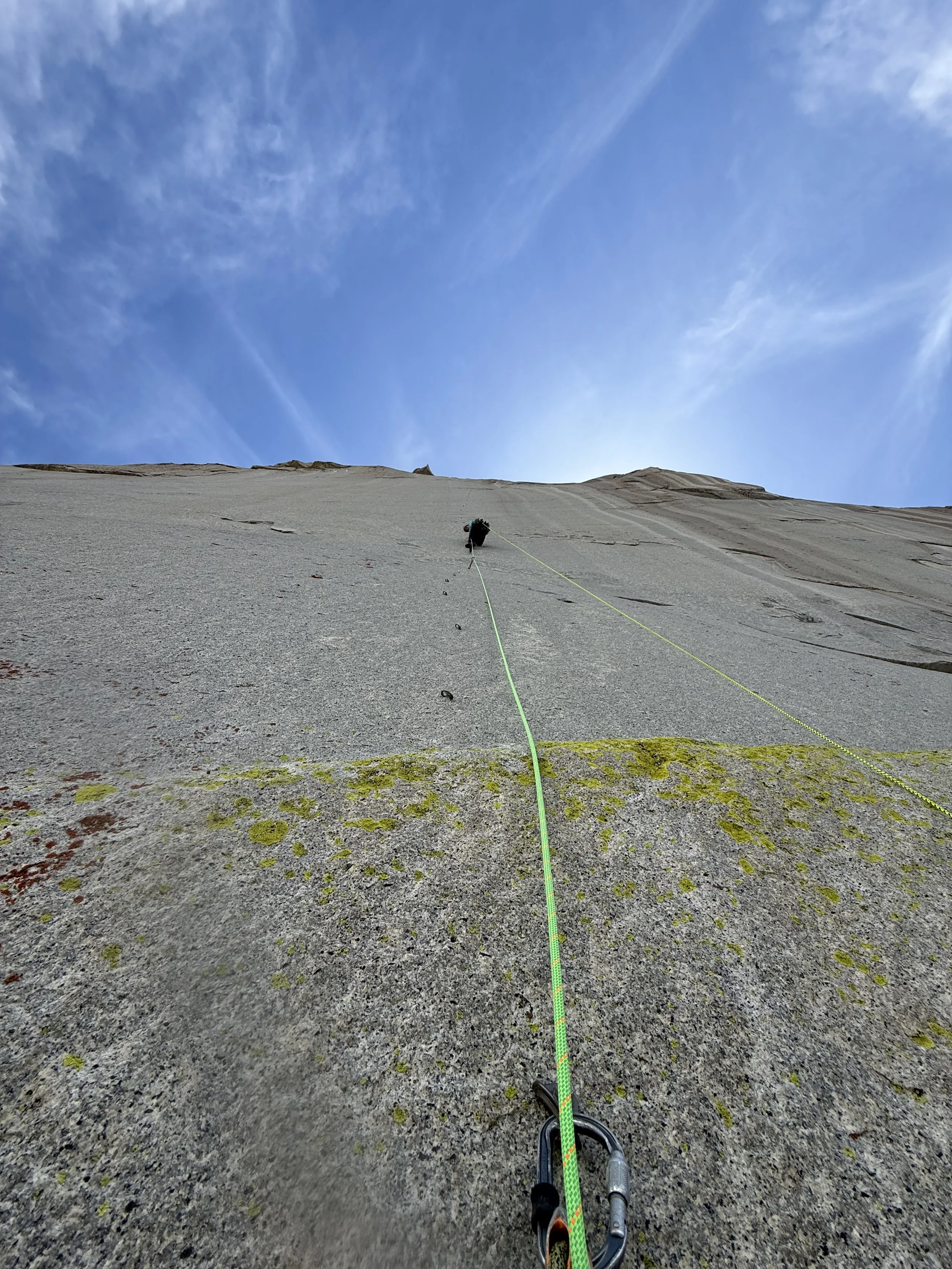
Miles Fullman clipping up the long bolt ladders leading to the Diving Board. Photo: Owen Silitch
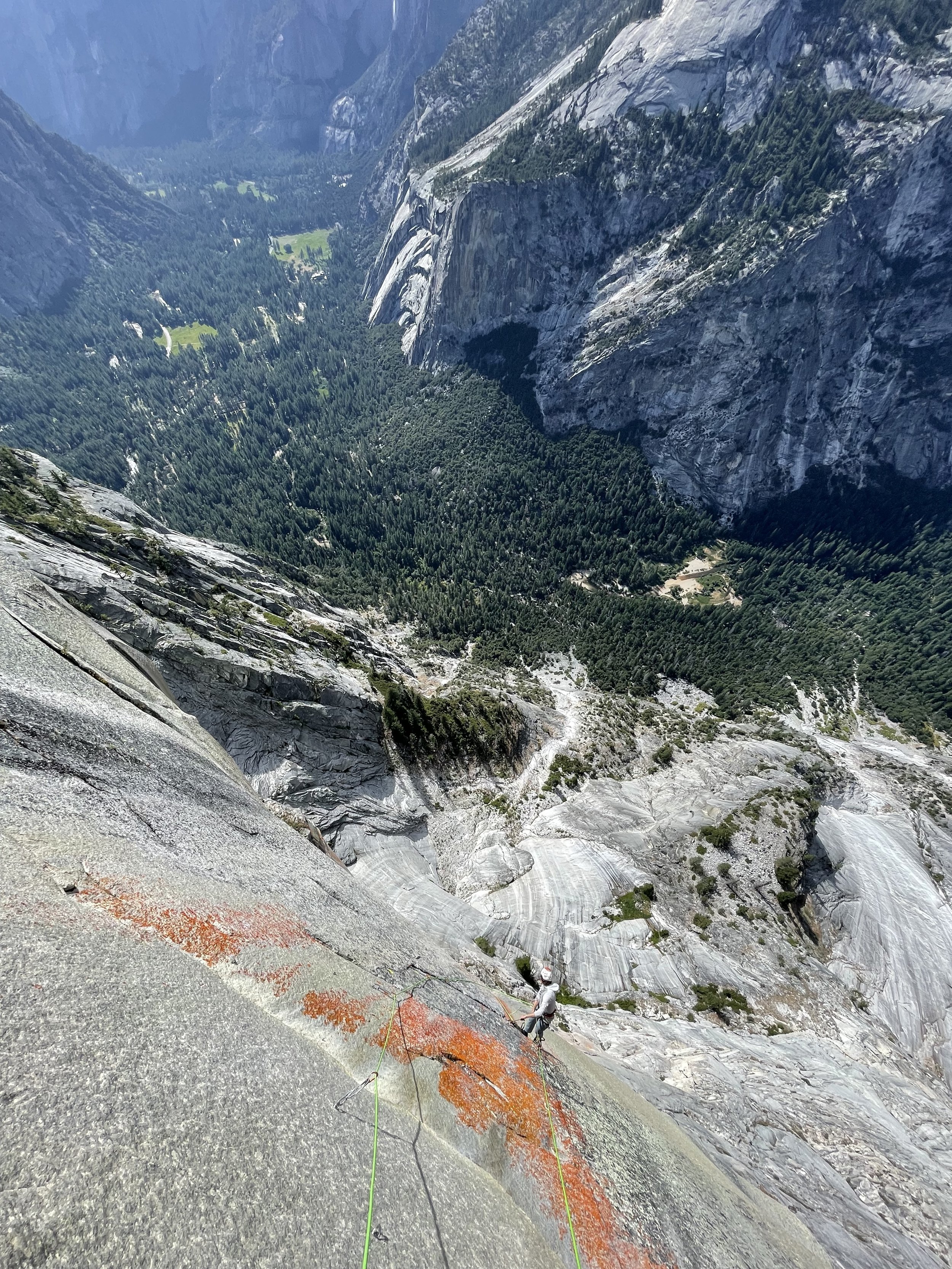
Looking down on a very small looking Washington Column from the vibrantly lichened headwall. Photo: Miles Fullman
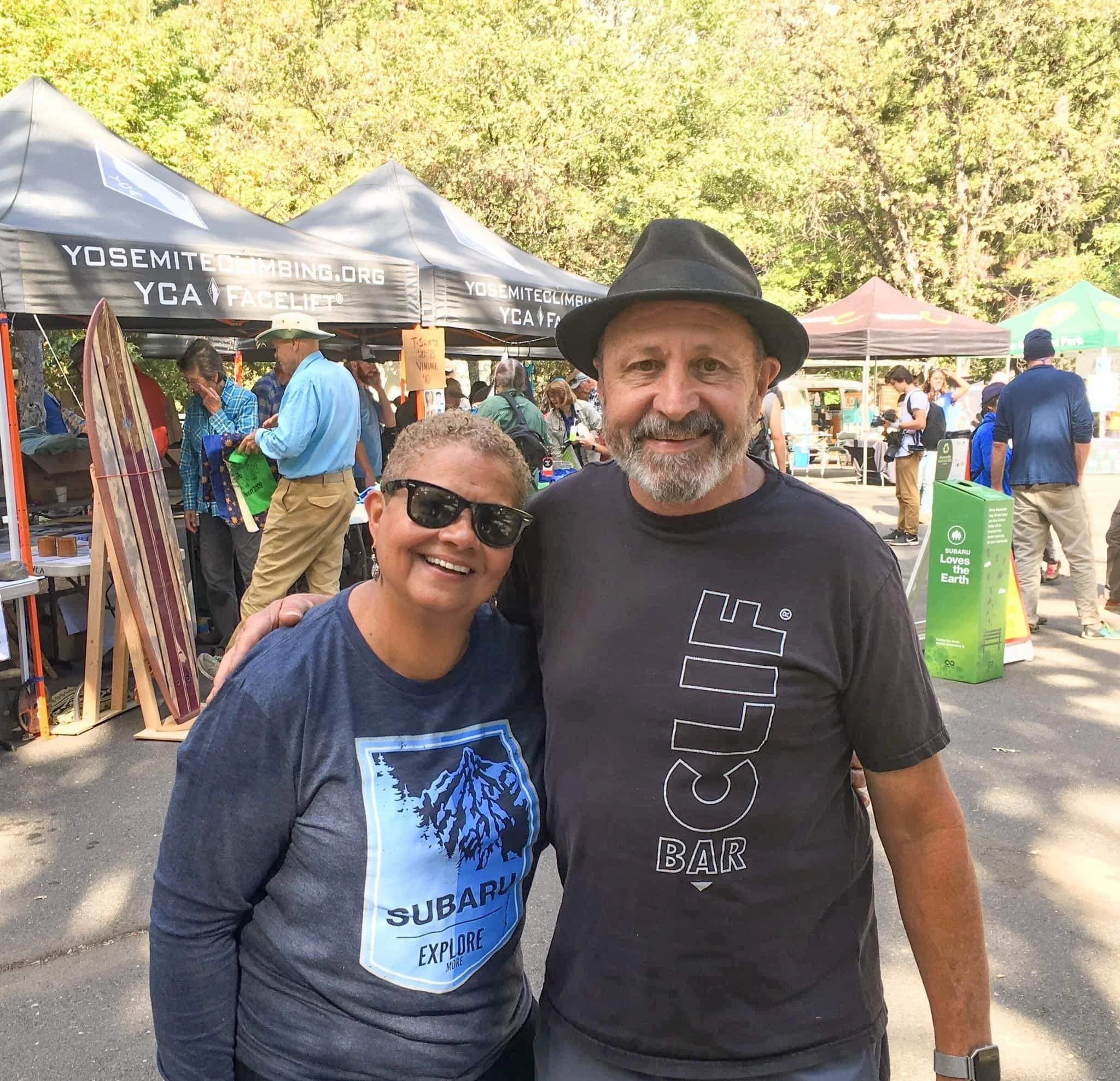
Abana Jacobs and Ken Yager.
Photo: Ken Yager Collection
Subaru Sponsorship
During the summer of 2016 I met with Jodi Bailey in her NPS office to discuss the upcoming Yosemite Facelift. She mentioned a woman from Subaru that she wanted me to meet. “She has similar interests as you and she will be here during the Facelift.” I told Jodi I would be glad to. I didn’t think any more about it.
In September after the daily setup during Facelift, Jodi came through the crowd of people on the mall with a formidable looking Jamaican woman with short hair and piercing eyes. The kind of eyes that can see right through any bullshit. That is how I met Abana Jacobs. She talked quietly, had an undisputed power about her and was very observant. She didn’t miss a thing. I gave her a tour around the different tables and introduced her to our core volunteers. Abana asked questions about operations and the history of the event. She stayed for several days taking in everything. She was there for the raffles at the end of the day and attended the evening programs including the music on the last day of the Facelift. We exchanged contact information as she left to catch her flight back to New Jersey.
Within a few days she called me to congratulate me on a wonderful event and said Subaru would like to be a part of it. She wanted a tent on the mall during the 2017 event. In exchange Subaru would give a substantial donation to YCA. She asked me if I would like to have a car to drive around for the year leading up to the event. Subaru would pay for repairs and take care of insurance. I would only have to pay for the gas, drive it, and talk to people. The car would have a wrap with YCA and Subaru logos along with Yosemite Facelift messaging. I agreed and she said she would put the contract together.
The contract came the next day, and I signed it after Allyson, our YCA lawyer/board member looked it over. I sent a copy of my driver’s license and the required paperwork. The car was going to be shipped to the dealer in Fresno and after the wrap was put on it, I could pick it up. I couldn’t believe my luck. I needed a new vehicle.
I got a ride to Fresno and saw it for the first time. It was bright and colorful. It would always be easy to find in the parking lot. It was a brand-new Outback. It was also a high-end model with leather seats and fuel injection. It was the nicest car that I had ever driven. It also handled better than any other car in the snow. I loved it. I drove it all over the place answering questions from folks interested in the advertising on the car wrap. I drove it to the Outdoor Retailer shows. It created a lot of attention everywhere I went. At times it was embarrassing. I was walking to the car once as a hiker was trash talking the car. I walked up to it and chirped to unlock the door as he was saying he would never be caught dead driving in it. I told him that I only had to put gas in it. Subaru took care of the rest. He asked where he could sign up which amused his female companions.
The partnership worked out well for both of us. I was able to offer a VIP discount to people and was told I would get a free car if I sold 10 of them. Why not? Abana gave me a different car to try out the following year with a new wrap. It was their biggest model called the Ascent which Abana thought was the perfect car for a climber. It was a tank. I drove it on some very slick roads and never could get the wheels to slip. It held 8 passengers. The mileage was not great, and I found it more difficult to park than the Outback. The following year I turned in the Ascent and received another high-end Outback with a Thule on top of it for extra storage. This car I drove for two years.
I attended two other events with Abana outside of Yosemite Facelift. One was a multi-day sustainability conference at Asylomar in Monterey. The other was a Facelift type event at Eldora. Both events were successful and I got to learn more about her during dinners after the workdays were over. We became friends. I admired her. Abana got things done and she didn’t waste any time. She always had a plan and knew how to implement it. She planned to retire at the end of 2020, and we talked excitedly about projects we wanted to work on together after her retirement. She wanted to bring her grandsons to Yosemite to climb.
Covid hit in 2020 and it changed everything. Large gatherings were not allowed, and Facelift was not going to happen in Yosemite. Companies were cancelling events and the world slowed down. I did not want to cancel the Facelift nor give up any sponsorships. I decided to do an online Facelift event that I named Facelift “Act Local”. The idea was for people to clean a local space they felt safe in. It could be a favorite walk, park or maybe at home. When I told Abana about it she immediately jumped on board. She helped me with the planning and with getting word out.
We were going to livestream from the Auditorium in Yosemite just like we would if we had a crowd of people. The raffle would be done on air and signups done electronically. We had the AV set up and were ready to go. A fire started up near the park about four days before the event. NPS was going to close the park because the air quality was horrendous. We removed all the audiovisual equipment and drove it to a house in Daly City that I rented. Ed Whittle did a fantastic job setting the equipment up as we helped build a studio. Somehow, we pulled it off. It was an all-hands-on deck effort, and it wouldn’t have been possible without Abana’s help. We had people sign up from all over the world including Saudi Arabia which blew my mind. All Abana’s doing. I have no doubt that with some effort it could be a huge world-wide event.
Shortly after the Act Local event Abana texted me that she was in the hospital with Covid. NO!!! She texted me she was doing ok on October 4th. Great news!!! October 5th, she texted me that she was in ICU. NO!!! I told her I was thinking of her, and the following day she sent me a smiley face. She was a strong woman and figured she would beat this.
I had been asked by my friend Mike to tag along with a four-wheel drive group that were going to do a cleanup in the Mojave Desert during the second week in November. Mike had just become Superintendent but would be gone so he asked me to go instead. I asked how the roads were and he said they were fine and you didn’t need 4-wheel drive to get to an illegal dump that was the focus of the cleanup. I agreed and drove down to the Mojave Preserve to meet up with the group. I was only given a location tag on the Eastern edge of the park. I found them just before dark at a camp with a distant view of the Colorado River. There were 50 vehicles, most of them were jeeps outfitted with intricate fold out camping setups. I walked over to the fire and introduced myself. Most of them were retired firemen or policemen. There were dune buggies driving back and forth by us well into the night stirring up dust. I sat quietly and listened to a world I had never experienced before. They did not care for the dune buggies and called them cockroaches. I found out we were going to drive for two days on the Mojave Trail before we got to the cleanup area.
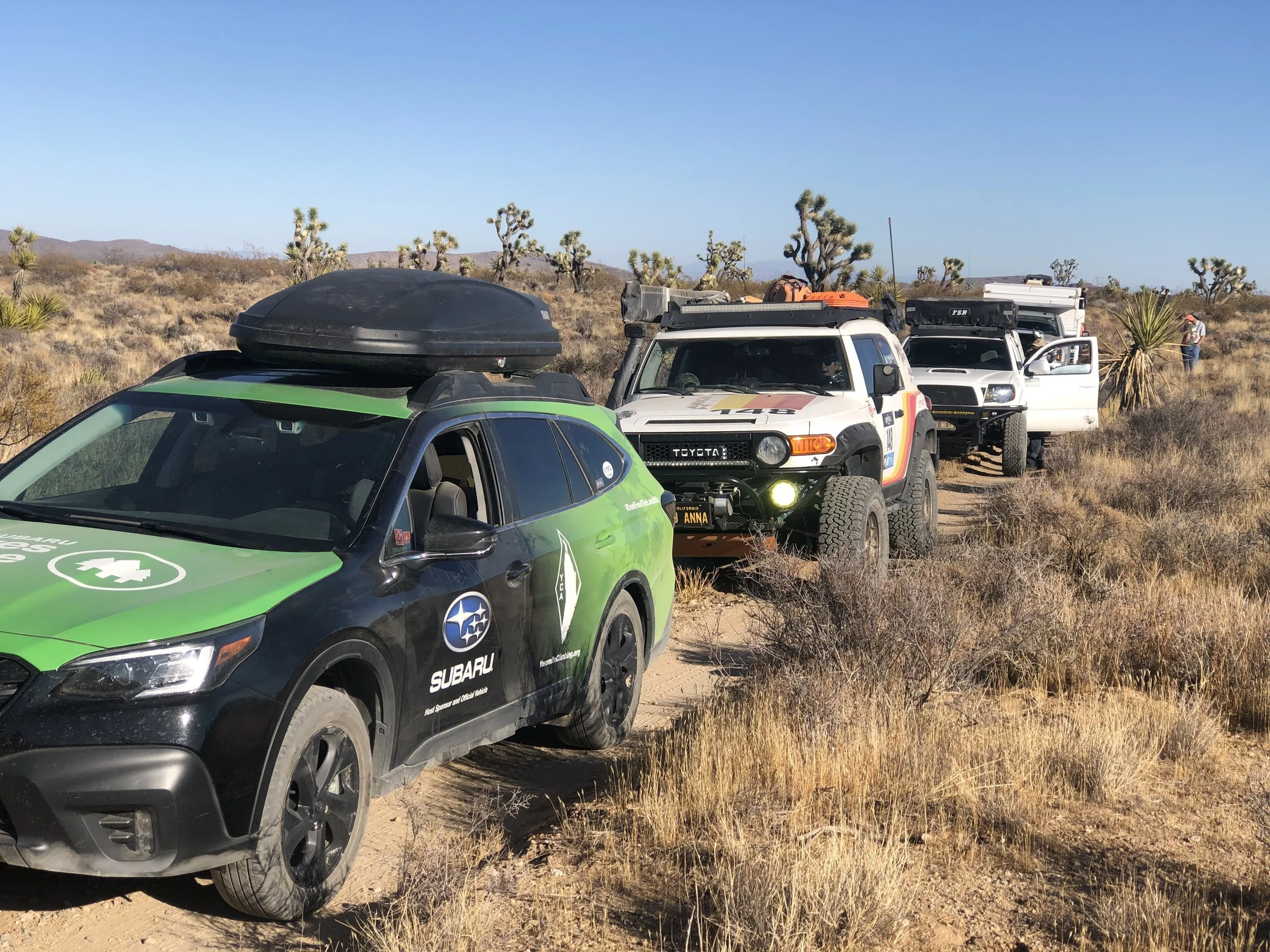
Photo: Ken Yager Collection
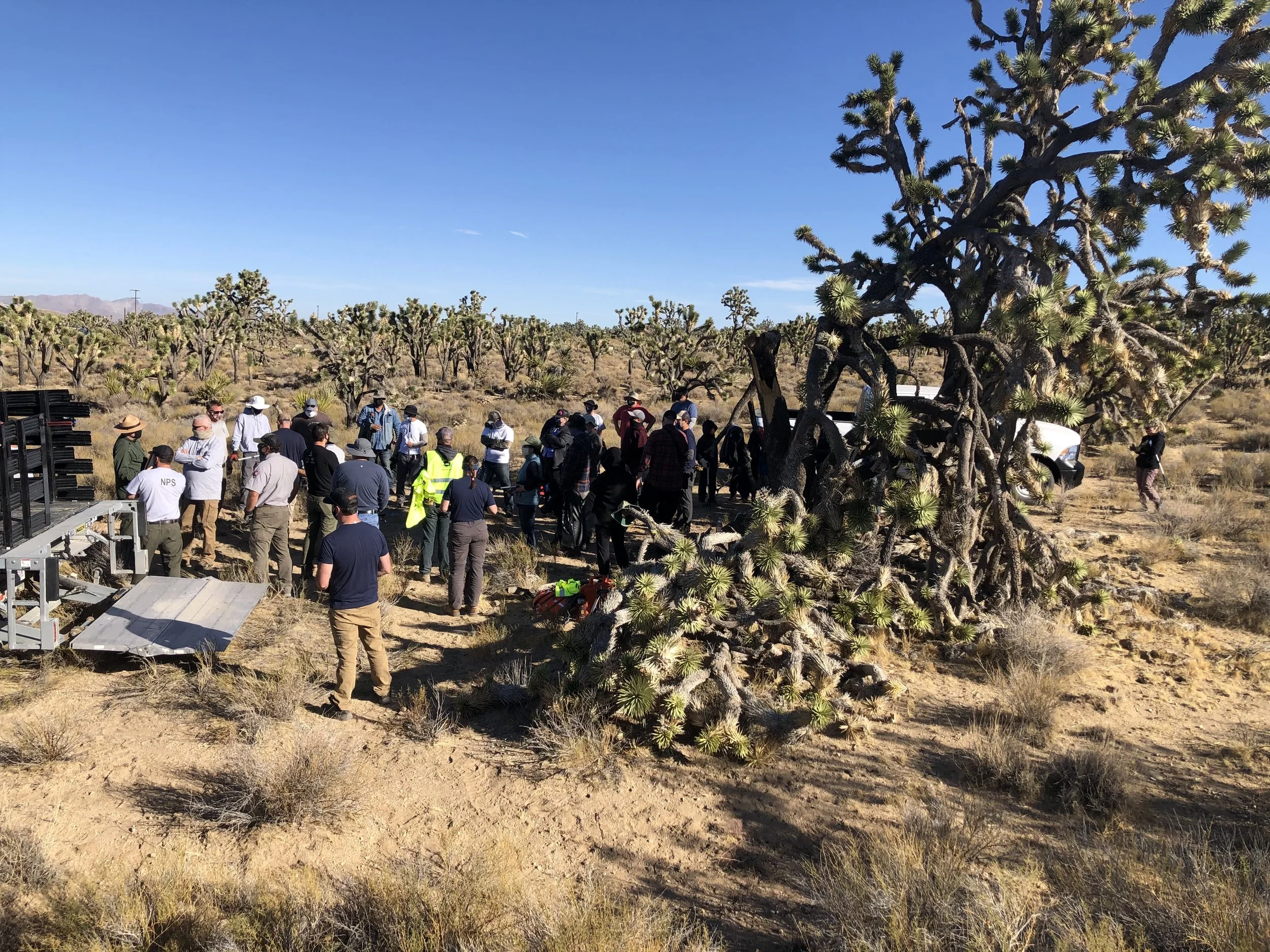
Photo: Ken Yager Collection
The next morning, we lined our vehicles up and the group leader had a safety talk laying out a couple rules. He would drive first with each person following each other and he designated a person to be the sweep. There was to be no passing and if you lost sight of the car behind you, you were supposed to stop until you caught sight of them again. Easy enough but seemed a little extreme. I was introduced to everyone and noticed I was the only one in a car. I was also the only one without a walkie talkie. Quite a few of them were looking at me and the brightly branded Outback with an amused look. The only other branded vehicle had numbers on it. It belonged to a woman that raced, apparently quite successfully. Everyone spoke of her with reverence. I was starting to wonder what my friend Mike had talked me into.
We took off much like the wagon trains that had passed before making dust as we headed west into the mountains. It started out innocently enough and the Subaru’s suspension worked wonders on the washboards. We took a lunch break at a historical cabin to learn some history from Dave, the NPS interpreter. After I stopped, the female racer that was behind me walked up with the shark fin antennae from my car and handed it to me. The Thule had loosened and slid back knocking it off in the washboard section. I thanked her. I was embarrassed and disappointed that I had damaged the car. I pushed the Thule back forward and tightened the fasteners.
We started back up after lunch and the real 4-wheel driving started. I was suddenly realizing that I could get stuck or even worse if I got a flat all I had was a donut for a spare. I felt ill prepared and it was too late to back out. I navigated over rocks, around potholes, through sand mostly on 3 wheels. It was nerve wracking and exciting at the same time. I had visions of having to leave the car in the middle of nowhere. I didn’t want to let Abana down. I had already damaged the antennae.
Somehow, I made it over 50 miles to the cleanup site which was only a couple miles from the highway. Technically Mike was correct. Passenger cars could make it to the cleanup location. The drive went through beautiful country, and I got to know my new friends. We camped for three nights together. I was impressed that they were carting all biological waste out with them. They had a rule that you had to be able to break down your camp and be ready to go in ten minutes. Evenings were spent showing off each other’s Jeeps outfitted with the latest accoutrements. The final night while around the campfire the group leader introduced me as the best driver because I was in the Subaru. Apparently, everyone had been talking about me on their radios, when I was driving through every tough section. Things like “Let’s see what happens here.” or “Oh the Subie made it.” There were a couple of new club members that were nervous and it would give them confidence when I made it through the bad sections. It was a fun evening, and I learned that everyone initially thought I would not make it. I believe there were wagers on it. It impressed them enough that I sold a car to Dave the NPS interpreter making it the 10th car I had sold.
On the third morning we reached our destination, a pit filled with many years of trash from a group of homesteaders. We put our masks on and filled up a giant dumpster and several NPS flatbed trucks that met us there. We found some creepy stuff in that pile including an old wooden female mannequin that scared the crap out of us when the face was exposed. It looked like it belonged in a horror film. The group was going to do one more day on the Mojave Trail on a notoriously deep sandy section. I didn’t want to press my luck any further, so I said goodbye to the group headed back home once we hit the highway dividing the trail.
I never did hear from Abana again. She was put on a ventilator and passed away after a 47-day fight on November 23rd. She died days before her retirement. Her death hit me hard. I kept the car through the next Facelift per the contract and then returned it. The sponsorship program ended with her passing and Subaru moved on to different marketing strategies. I still think about Abana and how she was shorted by fate just before enjoying retirement. I miss our conversations. We had big plans together only for it to be thwarted by a virus.
Abana always told me that I should meet a friend of hers and that we would get along. Her friend was an outdoor enthusiast and volunteered for and supported many worthwhile causes. She was also a well-known movie star by the name of Pamala Grier. During an Outdoor Retailer show Abana put me on the phone with her briefly to see if I could help her with a cause. She was looking for helmets to give to schools that are in tornado prone areas. I passed Pam’s information on to the different companies that sold helmets and always wondered what became of it.
Three years after Abana’s death I received a text from Pam talking about missing her. We traded a few memories, and we texted a few more times until she called me out of the blue. We have since talked on the phone quite a bit and have become friends. Abana affected both of us in much the same way. It was nice to talk to someone else that knew her. Abana was one of the most competent people that I have ever met. She was a Badass! She worked hard and saw things clearly. Abana was right Pam and I do get along.
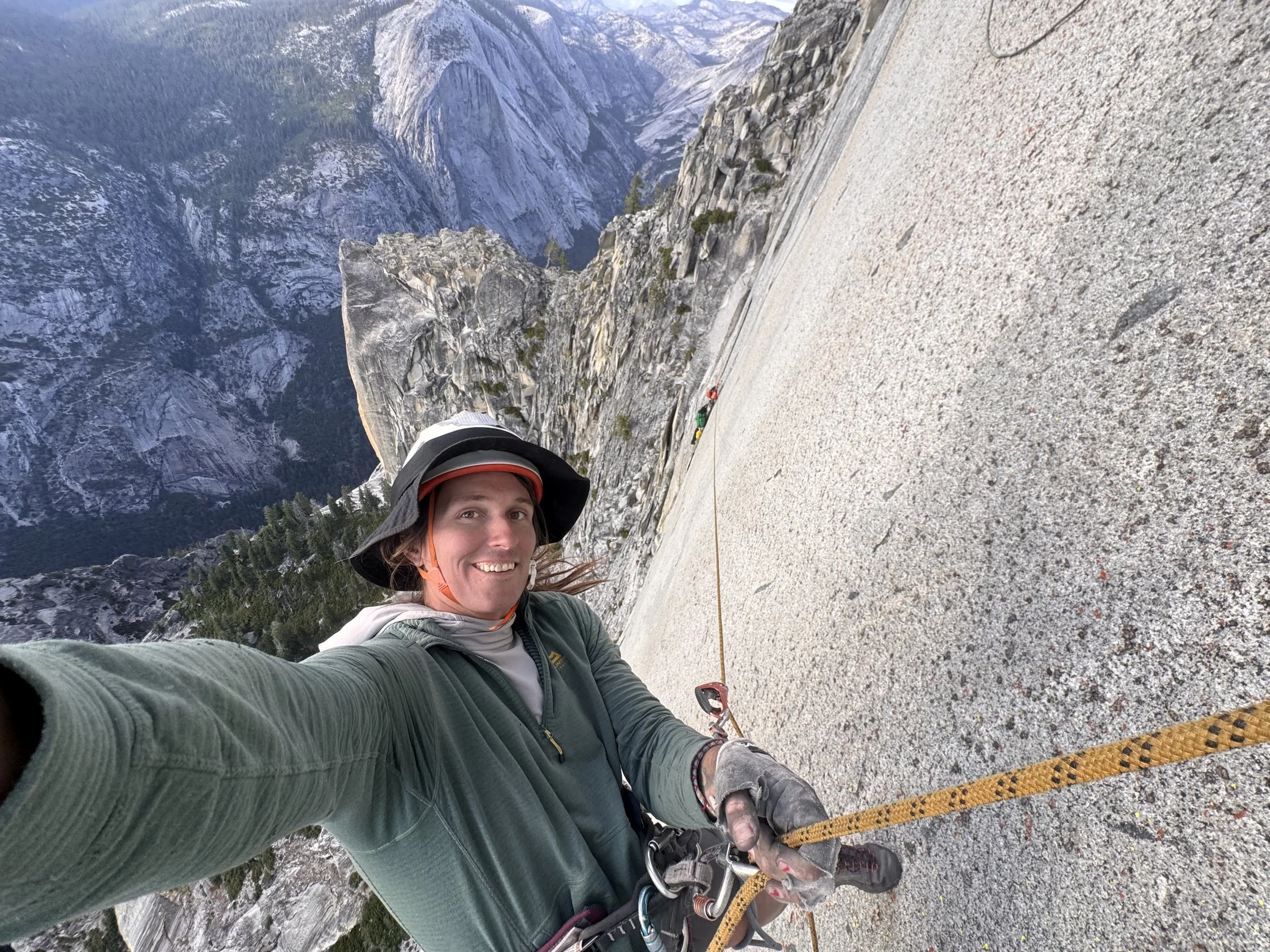
PHOTO OF
THE WEEK
Taylor Martin rappelling back to the bags after a long traverse near the top of her new route Stratosphere on the northwest face of Half Dome. Photo: Taylor Martin

Stay up to date on the latest climbing closures in effect!
Get your permits, do your research, and hit the wall!
Visit the Yosemite Climbing Museum!
The Yosemite Climbing Museum chronicles the evolution of modern day rock climbing from 1869 to the present.
The YCA News Brief is made possible by a generous grant, provided by Sundari Krishnamurthy and her husband, Jerry Gallwas