
EDITION 61 - JUNE 26, 2026

Your window into the stories, history, and ongoing work to preserve Yosemite’s climbing legacy.
A Note from the Editor
The Yosemite Film Festival is currently in full swing, with films showing every day through this Sunday, June 28. Tickets are on sale for different screenings throughout the event on the Yosemite Climbing Association website. Don’t miss the inaugural Yosemite Film Festival! Come out for the weekend to see some of the amazing films, sign up for the morning photography workshops, or just come hang out between showings.
As mentioned in last week’s newsletter, the NPS, BLM, FWS and USFS released draft guidelines for climbing management guidance. These guidelines were required by the 2025 Protecting America’s Rock Climbing Act, which was part of the EXPLORE Act. The PARC Act acknowledged rock climbing as a recognized and appropriate activity in wilderness.
The current draft proposals align with the PARC act in allowing established climbing routes to continue to be used and maintained. The current draft seeks to protect America’s climbing while also protecting the resource and character of wilderness. The Access Fund has stated that it supports the current draft, with a few clarifications mostly pertaining to the definitions of what constitutes fixed-anchors and practical management of new-routing and existing hardware maintenance.
The Access Fund also has noted that the drafted guidelines in their current state are a marked improvement from 2023 proposals which endangered climbing access, historic routes and climbing development opportunities. These changes were made in large part thanks to the climbing community speaking up and advocating for its needs.
The current draft guidance is open to public comment until July 18. Climbers can voice their comments and concerns through the Access Fund “Take Action” page on their site. The more we make our voices heard as climbers, the more we can ensure the protection of our sport’s unique nature and show our appreciation for the opportunities available to us.
For this week’s feature I speak with Zoe Klein, an ecologist who works with American Forest, an NPS adjacent organization, to study the conservation of whitebark pines in Yosemite and Sequoia-Kings National Parks.
For this week’s founder’s log, Ken Yager recounts the shenanigans involved in rigging for a movie to film a 120-foot whipper from the top of El Capitan with Dave Shultz, which incidentally turns into a bad acid trip.
Miles Fullman
Editor, YCA News Brief
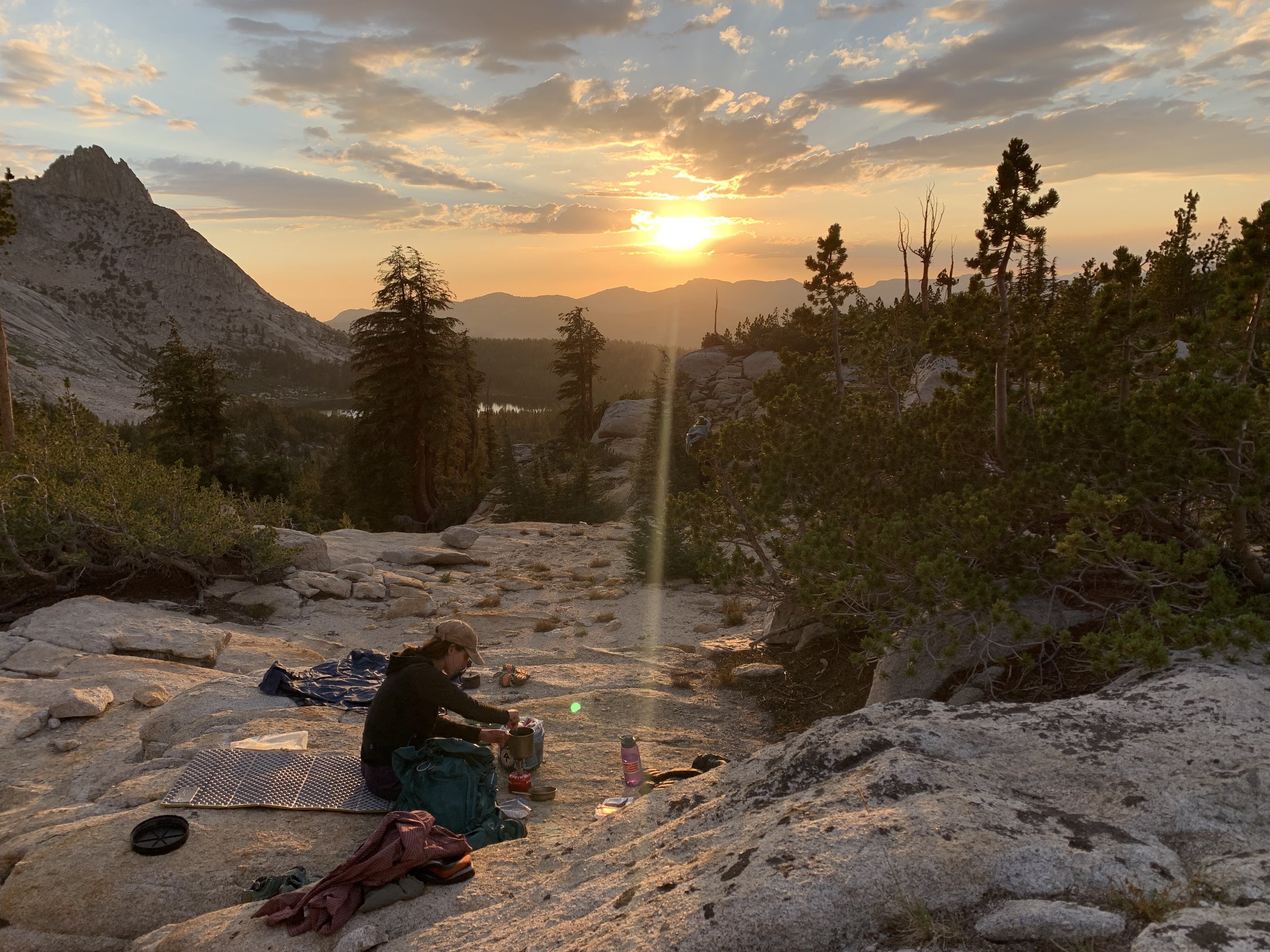
Zoe camping near Young Lakes in Yosemite amongst Whitebark pine, Rafferty Creek behind. Photo: Zoe Klein collection
Interview with Zoe Klein
Zoe Klein grew up in San Diego and attended UC Berkeley to study environmental science. She pursued postgraduate studies at Northern Arizona University in the environmental science and policy program . She initially fell in love with molecular biology and genetics,but an interdisciplinary course at Berkeley taught by a poet and a scientist deeply affected her. The course explored wilderness, science, caring for ecosystems and what that means on both technical and spiritual levels. She joined the environmental science and policy department shortly afterwards.
Klein first came to Yosemite to work in 2018. She worked for the Sierra Nevada Inventory and Monitoring program, where she took stock of whitebark pine around Yosemite. She mostly worked in the backcountry. Over the years Klein has held several different positions, from an intern for Scientists in Parks to being a biological field technician for the park service, and now working as an ecologist for American Forests in association with Yosemite national park.
Most of Klein’s work has revolved around studying whitebark pine. When prompted as to why she has been so interested in this one particular tree, she responded:
“First and foremost, I just love high elevation places and I felt obsessed with the High Sierra high country. I wanted to be thinking and working and living in those places. Whitebark pine is a tree that is there always. The more I learned about it the more I came to appreciate how special it is as a species. It acts as a proxy for the whole high elevation ecosystem. Any time you go on some big adventure hiking or climbing, whitebark pine is there. All my favorite places have whitebark pine in them.”
Klein is passionate about her work, and when asked how she feels about her field of study in general, she shared:
“The thing I love about ecology is that it gives me tools with which to observe the natural world. Important in caring for any thing is to be able to observe it. Ecology is a particular lens for observation that we can use to care for ecosystems.”
Klein took the time to share some information about whitebark pine and what makes it so special here in the Sierra. Because its cones don't open to release seeds, whitebark pine relies on help from a bird to disperse its seeds. The tree as a species has thus coevolved with Clark’s Nutcracker, a bird which cracks open the cones, stores the seeds in a special pouch under their tongue and then caches them in different locations as food for the winter. In this way whitebark pine is able to reproduce, thanks to the bird dispersing its seeds.
Whitebark pine evolved to live in extreme high elevation areas. It supports a lot of wildlife, and also acts as a sponge for water and snow within the ecosystem. Its shade and protection from wind delays snowmelt in high elevation areas of treed ecosystems, which reduces drought conditions and makes water available for longer in the summer. It also stabilizes subalpine soil.
There are a number of threats to whitebark pine, most notably white pine blister rust, a disease caused by an invasive fungal pathogen, which slowly strangles the tree, either killing branches or the entire trunk. Mountain pine beetles also strangle the tree by laying eggs and multiplying until they shut off sugar and water transfer through the tree. Lastly, climate change is producing more drought, increasing habitat loss, and an increase of wildfire.
While whitebark pine has been considerably impacted by these threats (almost three quarters of whitebark pine in the Canadian Rockies have been affected by blister rust), Southern Sierra Nevada populations have remained relatively unaffected. However, whitebark pine in the US is projected to experience an 80% reduction in climatically suitable area by the mid 21st century as conditions tend hotter and drier, and snowpacks become increasingly smaller. The California Sierra in particular is expected to act as a refugium of sorts for whitebark pines. The Southern Sierra populations are special in that they are genetically distinct, relatively healthy, and exist almost entirely in designated wilderness.
Klein continues to study emerging mortality among whitebark pines, trying to find more methods of early detection to continue to protect this unique and special species in the High Sierra. She also continues to get outside and play in her favorite areas of the park, all of which are high elevation areas where whitebark pine can be encountered.
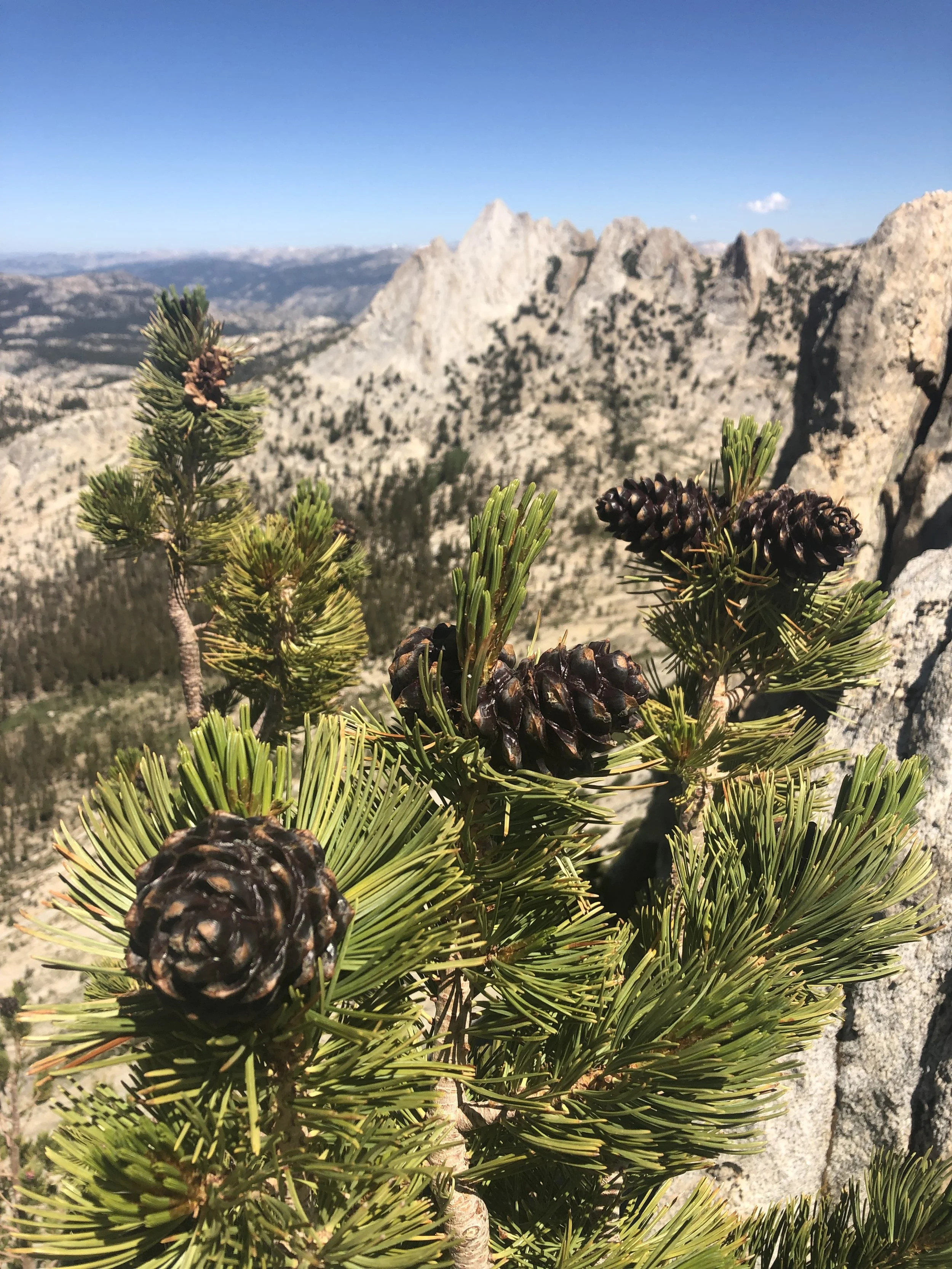
Whitebark pine cones on Matthes Crest. Photo: Zoe Klein
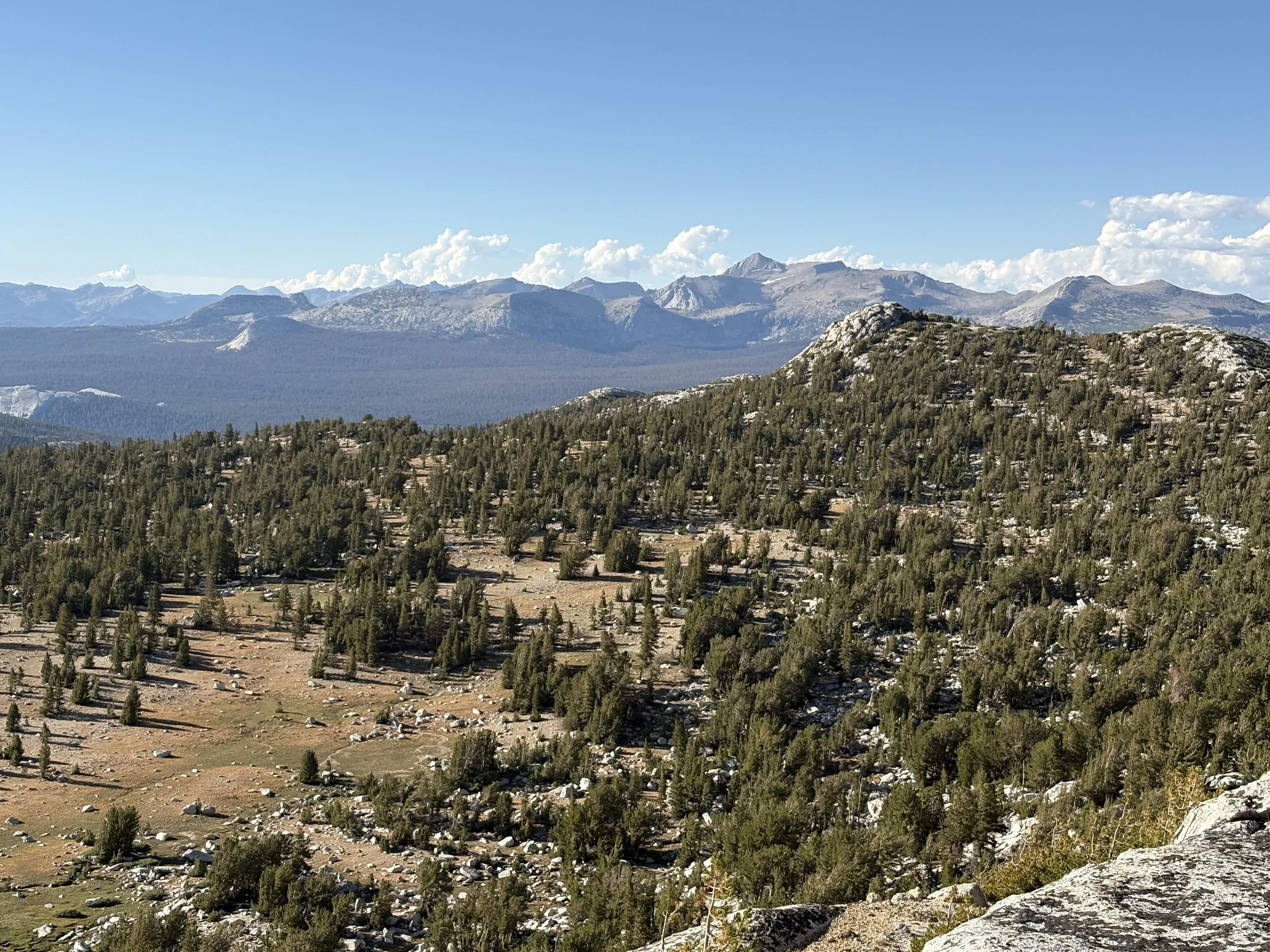
Whitebark pine forest above the Tuolumne watershed near Evelyn lake. Photo: Zoe Klein

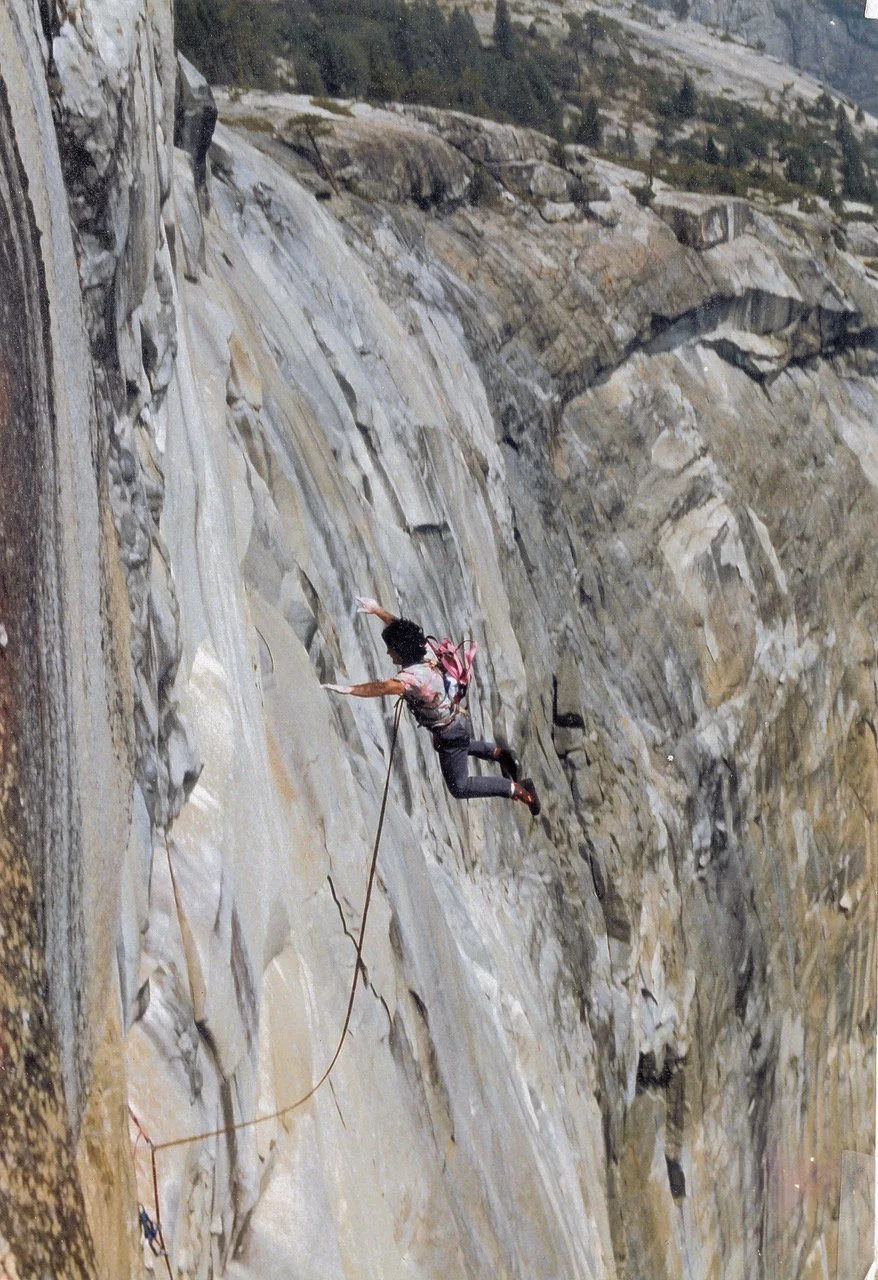
Dave Schultz taking the fall. Photo: Ken Yager Collection
The Whipper
It was 1987, almost a year after Dave Schultz, Jim Campbell and I had climbed Karma on the South Face of Half Dome. Dave had picked up a movie job and asked me if I wanted to work with him on it. I asked to hear more about it. The movie makers were a married couple named Ian and Katie Stobie. They wanted Dave to take a leader fall from the top of El Capitan for a film they were making called Over the Edge. Dave wanted me to help set up the fall for him. I was hired as Technical Director. It was a low budget operation. The pay was pathetic. I was paid $80 a day. I was also offered 10 VHS copies of the movie when it came out. Dave was offered $800 to take the fall. It sounded interesting so I agreed. John Harpole was hired to help carry loads and he rounded out the team. We gathered three days’ worth of supplies and met the film makers at Tamarack Creek Campground early in the morning. Dave, John and I loaded up most of the weight and we started walking down the gated paved road to where the trail branched off. Katie and Ian followed as we all had a similar pace.
The trail turned steep immediately and we slowed down. It was hot. A lightning fire had started in Stanislaus County, and it was getting big. Smoke could be smelled in the air, and it would roll in with wind changes. Katie and Ian expressed worry about getting a clear shot of the fall without a smoky haze. I had not hiked the trail before, and I was surprised by how long it took. We made it to the top of the Dawn Wall in the afternoon and set up our camp for the next few days.
The next morning Dave and I rappelled over the edge and figured out where to anchor the ropes Dave would fall onto. To avoid a factor 2 fall I ran the ropes from the main anchor through an anchor 10 feet above. I used two new identical ropes and used rubber bands to hold them together, so it looked like one thick rope. One of the ropes had an extra 20 feet at the lower anchor. The idea was that if he burned through the first rope he would drop onto the other rope. I ran the ropes through bar tacked slings with locking carabiners on the anchor above the main anchor. These slings were called Shock Absorbers and were relatively new. I didn’t really trust the sewing completely, so I backed them up with standard runners. We set it up for a 120-foot fall which was longer than any other fall for a film stunt to date. Dave was nervous and I was nervous for him too. After we had set it up, we had lunch on top with Ian, Katie and John. It was hazy and they decided that filming would have to be the following day.
Dave and I wanted to do a drop test with an inanimate object to make sure Dave wouldn’t bounce and slap into the wall during the fall. We did one of the stupidest things I have ever done. We loaded up two empty one-gallon jugs that we found on top with sand. Dave rappelled down 120 feet into space as I attached the jugs to the rope for the drop test. I looked over and he yelled to let them go. Something didn’t feel right and it looked to me like he would be right in the path. I asked him to rappel further down, and he pulled himself into the wall a bit. I let them go. The bottles never stopped moving. They didn’t even slow down. The handles ripped off like butter and the bottles narrowly missed his head grazing both ears. With horror we yelled “ROCK, ROCK, ROCK” until they hit the ground with a loud bang. We heard some screaming and yelling. We both felt pretty stupid, but we still needed to do a test. I clove-hitched a thick branch to the rope and we tried again after Dave pulled himself way out of the way. The test was successful and we were happy with the setup. We had dinner around a campfire and shared stories.
The following day was still a little hazy, but it was a lot better than the day before. The breeze was cooperating for now. Dave put his harness on, and Katie pinned a dark wig over Dave’s blond hair to match Randy Leavitt’s hair color. Randy was the lead actor for the film. Dave tied into both ropes at the release spot. There were two 16mm cameras. Ian was going to be filming Dave from above as Dave fell away from him. His wife Katie was going to rappel over the edge and shoot the fall from the side with a view towards Half Dome. Katie put her harness on and set up her rappel. She seemed nervous. As she was leaning back over the edge, she changed her mind and refused to do it. They decided to show me how to operate the camera and I would do the filming for her. John Harpole was set up at the lip with a 35 mm camera to shoot stills. When we were in position, we waited for the sun to hit the wall to give the film makers the shot they wanted. The smoke haze was still there but hopefully not bad enough to ruin the shot. Once Ian was happy with everything, Dave was told he could let go at any time when he was ready. We would just need a signal from him so that we could make sure the cameras were framed properly. It looked terrifying. The overhanging wall dropped away below him for nearly 3,000 feet to the talus below. Dave stood on good footholds for over an hour trying to get his nerve up to let go. He tensed up with determination and started a count down. “3, 2, 1, FlatTop” We lifted our cameras into position; I pressed the shutter as he yelled FlatTop and let go of the rock. 321 was the call sign for Dave’s least favorite ranger and his nickname was Flat Top. It seemed like Dave fell forever. It was the longest fall I had ever seen, a full 120 feet. The bar tacks on the Shock Absorbers popped loudly as they blew apart. I let out a huge sigh when the rope held Dave as he swung into the wall. When he stopped swinging and came to a stop, I dropped a rope for him to jumar out with. Everyone was giddy with relief. We celebrated around the campfire with a few warm beers.
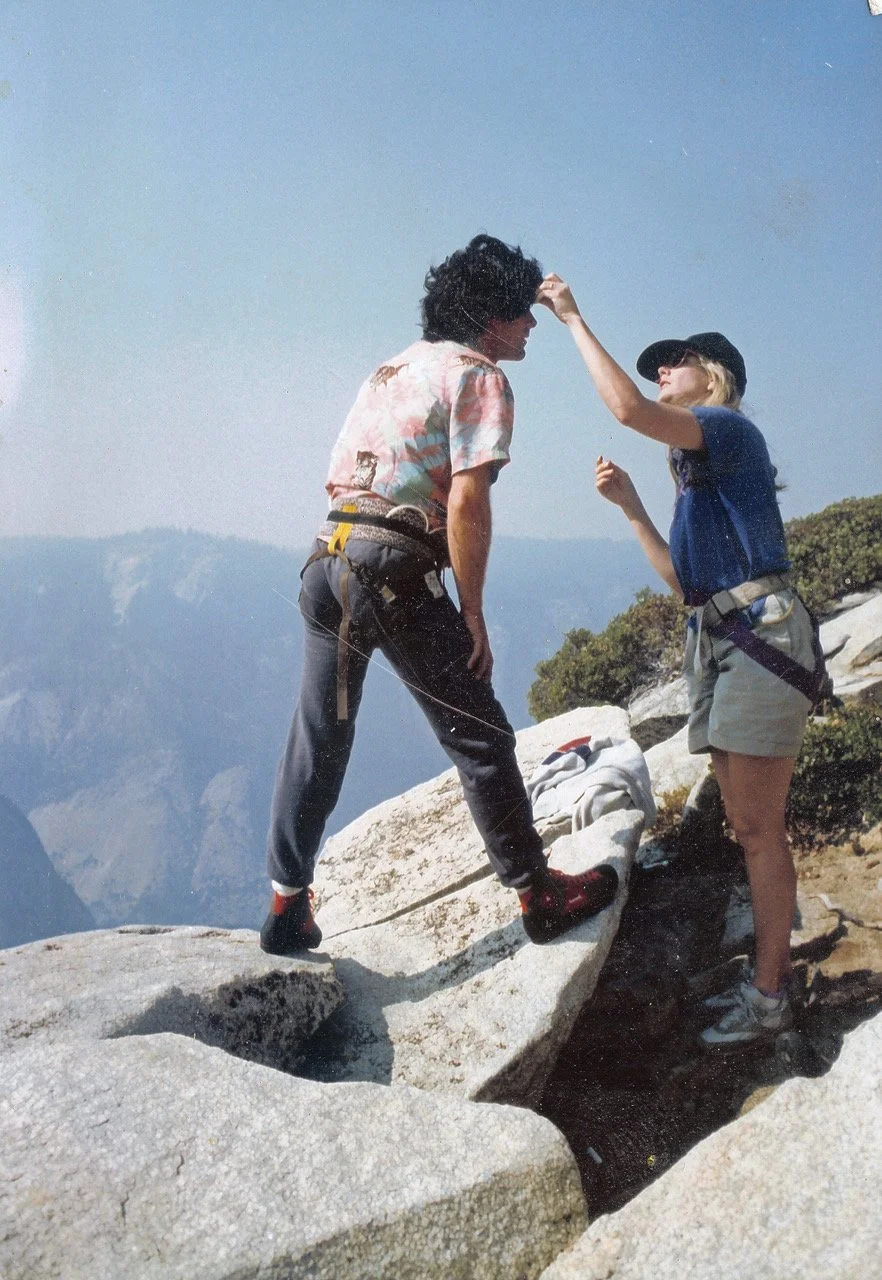
Photo: Ken Yager Collection
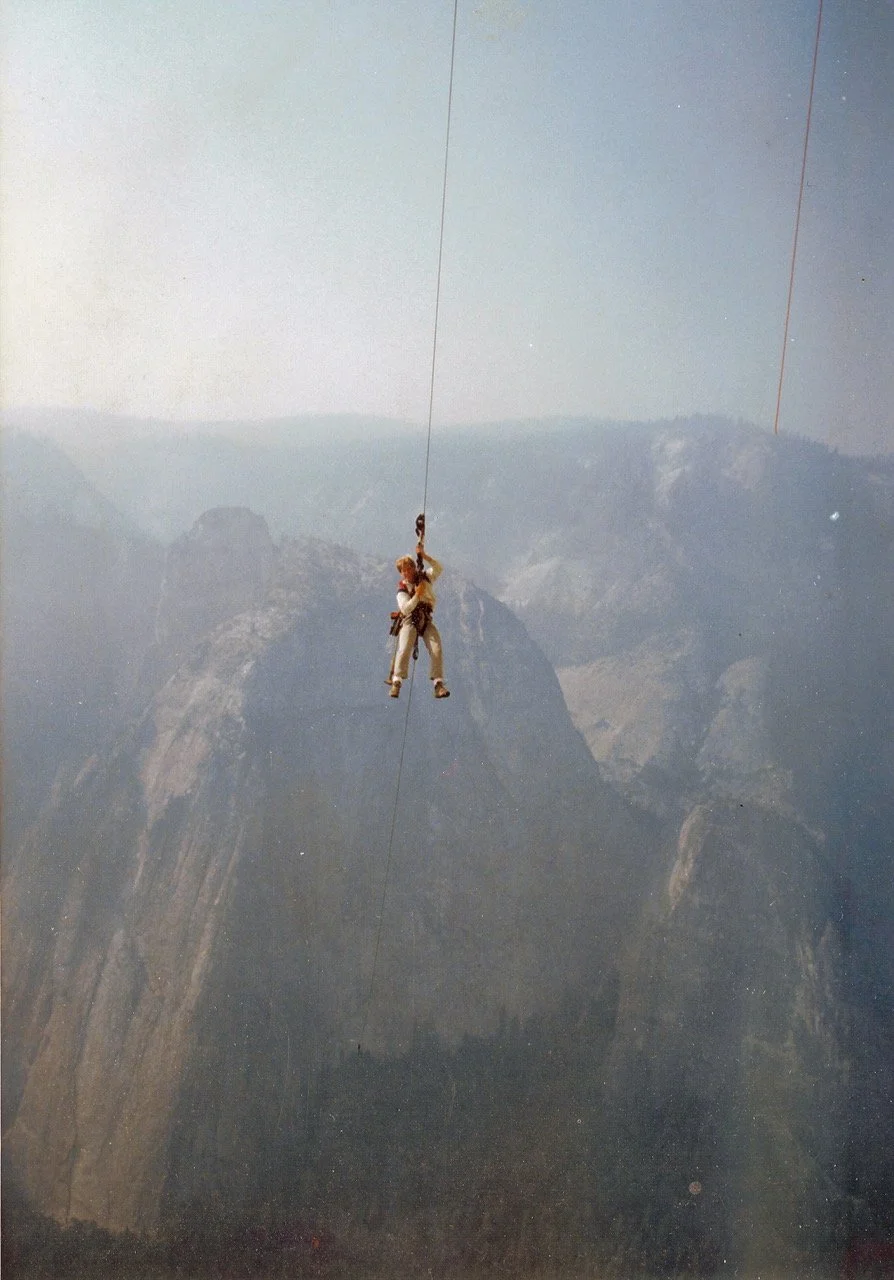
Photo: Ken Yager Collection
The next morning Dave and I rappelled down and cleaned up the anchors and the ropes. We packed up for the hike out. The wind had changed and it was very smoky. It was obvious the fire was blowing up. Visibility was not good and it was deteriorating. There was a pinkish glow and the air smelled heavily of burning forest. It was eerie. I had 4 hits of acid that I offered to the others for the hike out. Everyone declined and I ate them all. We threw on our packs and started the hike out. I had a little more energy than the others and I hiked out ahead of them. At the top of Ribbon Falls, I ran into a couple of guys setting up their tent. I chatted with them briefly. They looked strange in the pink smoky glow. I was starting to feel the LSD so I said goodbye, and I continued toward Tamarack Flat Campground. It was really pretty and I enjoyed the hike as the sky got pinker in the receding sunlight.
I was thirsty when I reached my truck. I opened the back of the camper shell and propped the door open with a snow shovel. I threw my pack in and grabbed my water purifier and a bottle. Turning towards the creek, I was greeted by a law enforcement ranger with three others behind him. I was asked my name and where I had been. “Holy shit”. It was not a good time to be answering questions. I was really starting to feel the acid. I answered the best I could and asked if I could fill my water bottle. One followed me to the creek to watch as the others went through my truck and threw everything on the ground. They found a small pipe and film container with a little weed in it. That was confiscated.
A half hour later Dave and John showed up and the three of us were separated as law enforcement continued their search. Ian and Katie were the last to roll in and they were separated as well. Each of us was interrogated 3 times each by all four Rangers. The same questions were asked repeatedly. “Where are you hiking from? Who were you with? Did you see anyone else?” None of us knew what this was about. We all had skeletons in our closets and were wondering how much they knew. Katie and Ian had not gotten a film permit, so they were worried about that. Dave had shoved a potato into the tailpipe of Dimitri Barton’s VW van and that crime had blown up into a big deal.
I finally peaked out on the acid during the interrogation. The faces of the interrogators were melting as I answered their questions. It was all so confusing. I felt like breaking out laughing. I had no idea what this was about and then it hit me. I must have hit someone with the water bottles full of sand. I was horrified. Oh god! What have I done? During the second round of questioning, I was certain that I had killed someone. I had an inner dialog deciding whether to just come out and admit that I had accidently killed someone hoping they would go easier on me for my honesty. The other option was to keep my mouth shut. I kept my mouth shut dreading where this was headed. I only answered their questions and volunteered no additional information. I described the two men I had seen on top of Ribbon Falls. I am sure I dazzled them with my ability to recall every little detail. I remembered everything, the length and color of their hair, what they were wearing, and even the moles on their faces. The others had also passed by the two men, but they had forgotten about them until it was brought up after I had been questioned. They didn’t have the enhanced recollection of detail that I did. We were detained for 4-5 hours.
Eventually, with relief they told us we were free to leave at about 8pm. I had not been ticketed for the pipe and little bit of weed and I wanted to leave before they changed their mind. They had emptied my truck without a warrant. Dave and John jumped in my truck; I started it up and headed for the Valley with Katie and Ian following in their own car. We were hungry and wanted to get to the Broiler Room before they closed at 9. We made it by a couple minutes, and we had a wonderful dinner with lots of laughter telling the interrogation stories.
We found out later that 2 people had been caught at a staked-out Marijuana farm several miles downstream of the campground. The rangers couldn’t find a transport vehicle and were looking for the driver. We probably would have been released sooner if I hadn’t remembered the two guys on top of Ribbon Falls. The investigators probably thought they were onto something. There was one slight problem with the footage we got, it had been exposed on one end which ruined the start of the fall. We had to do it all over again a few months later. To this day I have never seen the movie.
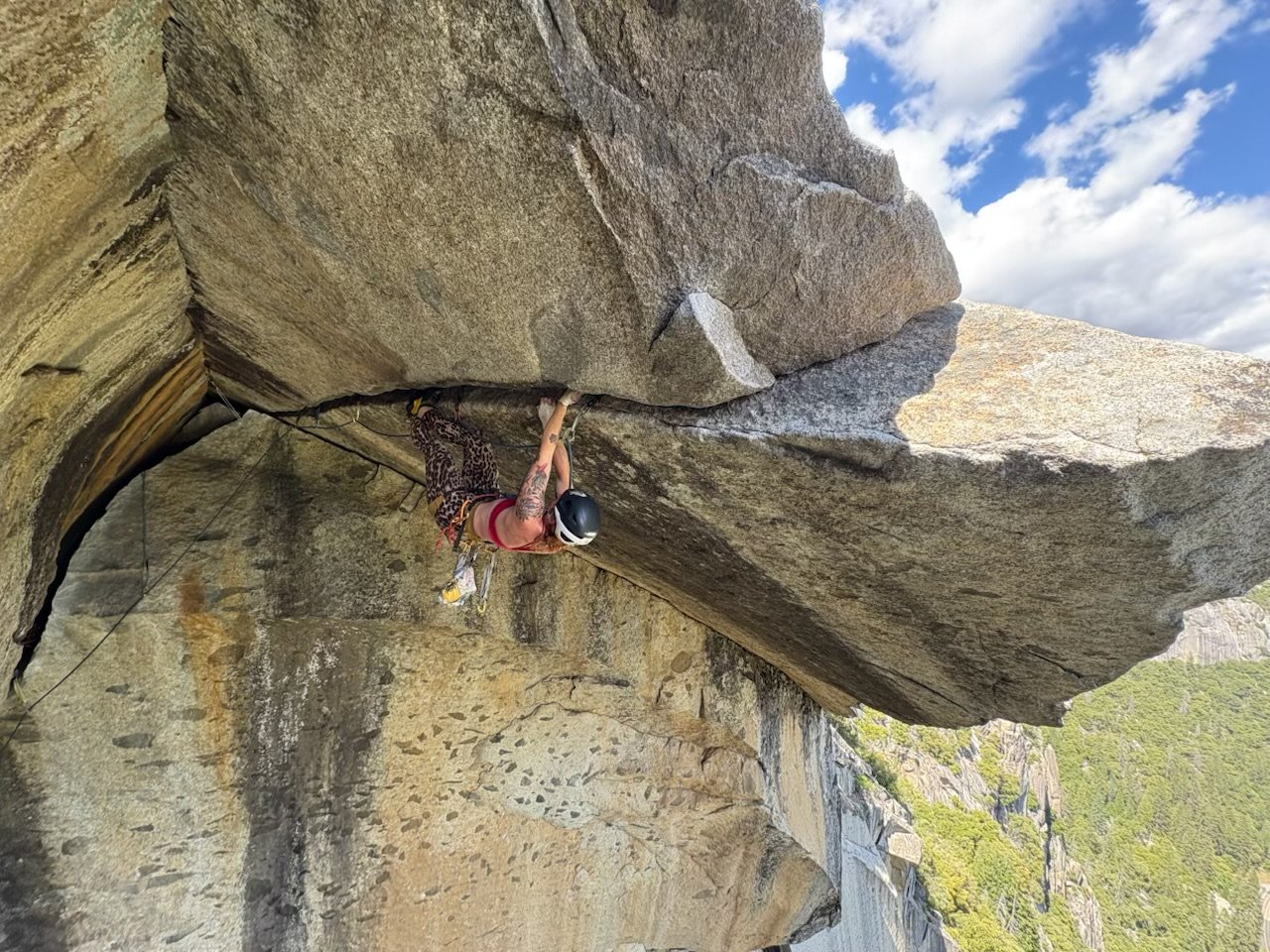
PHOTO OF
THE WEEK
Amber Smith climbing Separate Reality. Photo: Zoe Klein

Stay up to date on the latest climbing closures in effect!
Get your permits, do your research, and hit the wall!
Visit the Yosemite Climbing Museum!
The Yosemite Climbing Museum chronicles the evolution of modern day rock climbing from 1869 to the present.
The YCA News Brief is made possible by a generous grant, provided by Sundari Krishnamurthy and her husband, Jerry Gallwas