
EDITION 60 - JUNE 18, 2026

Your window into the stories, history, and ongoing work to preserve Yosemite’s climbing legacy.
A Note from the Editor
Summer has arrived in Yosemite Valley, bringing temperatures in the high 90s. El Cap is nearly completely empty during the sweltering heat.
The Lower Mist Trail (from the junction with the John Muir Trail to the top of Vernal Falls) will be closed Monday through Thursday between 7am and 3:30pm from July 27th through October 30th for repair work. The John Muir Trail will remain open through this project.
On Wednesday June 10, the unstoppable duo Olly Tippett and Taylor Martin broke the speed record on Tangerine Trip, taking the same route as the previous record holders by starting on Lost in America and Virginia to get to the start of Tangerine Trip’s fifth pitch and then following the route to the top. The record was last broken in October 2025 by Brant Hysell and Dan Gosselin in 7 hours and 57 minutes. Tippett and Martin completed the route in 7 hours and 8 minutes, shaving 49 minutes off the record.
On Monday June 15, the Department of the Interior released drafts for national guidance pertaining to climbing management for the National Park Service, Bureau of Land Management, the Fish and Wildlife Service, and the US Forest Service. The Access Fund noted that these three agencies together make up for roughly thirty percent of all climbing within the United States. These new guidelines will shape the future of climbing here in North America. We are now entering into the public comment period, and it will be of the utmost importance that climbers weigh in and make their voices heard to ensure the unique nature of our sport is understood and protected moving forward. The Access Fund has posted links to make it easy for climbers to share their voices during the comment period, which will close thirty days from June 18.
For this week’s feature I speak with Brandon Adams, who recently freed a new Grade VI route on Middle Cathedral that emerged from his route Gaia but follows mostly independent free climbing terrain after the first seven pitches to the summit.
Miles Fullman
Editor, YCA News Brief
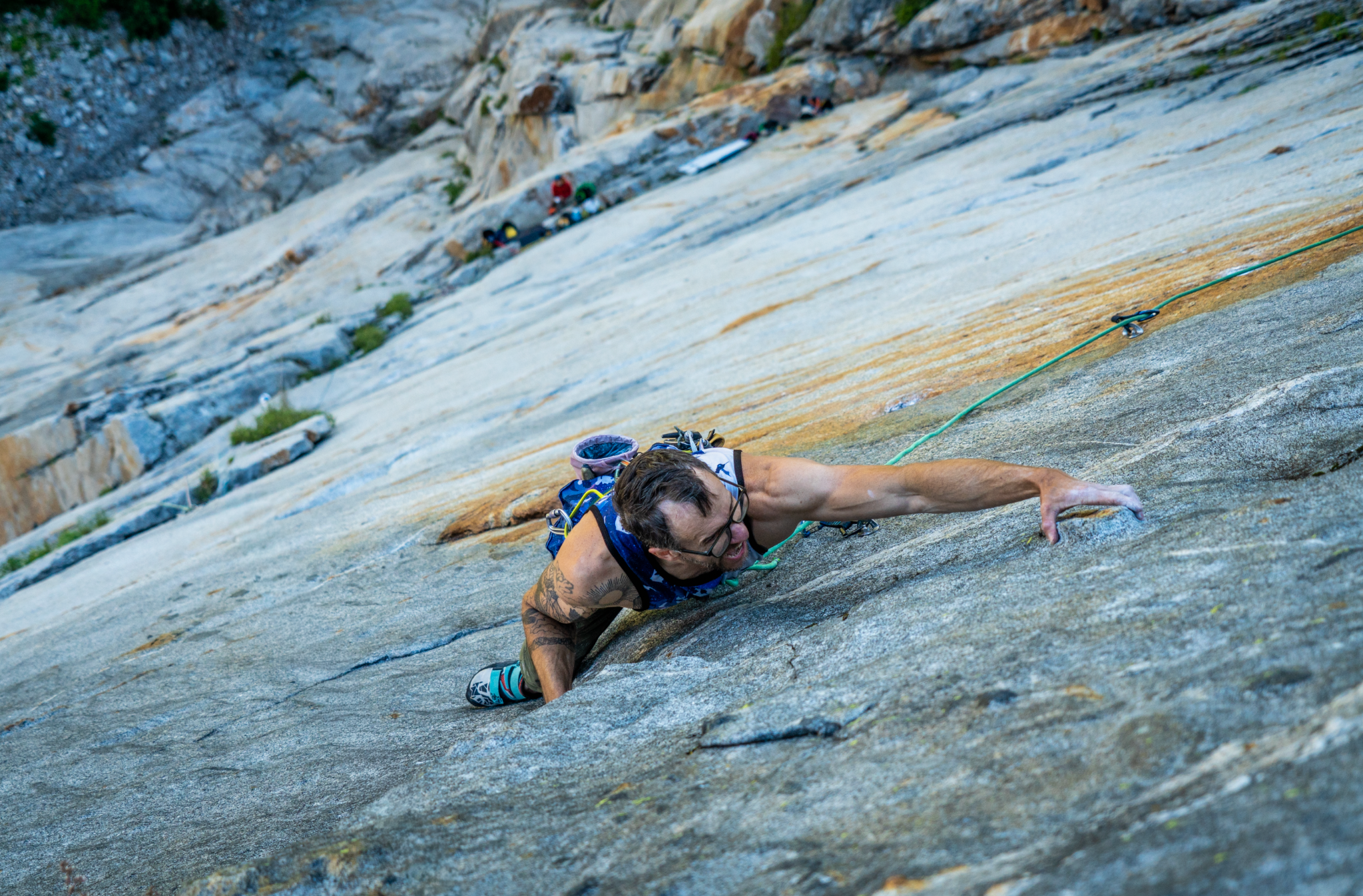
Brandon Adams climbing the Robin Traverse (pitch 10) of Borealis. Photo: Brett Wines
Interview with Brandon Adams, who recently freed a new Grade VI route on Middle Cathedral
For those who don’t know you, can you give a little backstory and introduce how you got into climbing and how it has given shape to your life? Where do you live and work now? What’s your relationship with Yosemite?
I’ve been climbing for about 15 years. For most of that time, I was devoted to Yosemite and obsessed with aid and speed ascents of El Capitan. I’ve been drawn more towards free climbing in the last few years. New routing and first ascents have been a primary passion of mine for most of those years as well. I worked seven seasons as an NPS ranger, five of those as a climbing ranger. I consider Yosemite a home. I have had countless grand adventures there that have molded me into who I am today. I will be returning there for the rest of my life. I now live in Bishop and work as a paramedic. ‘
Tell me about your new free route, Borealis. Where does it start / end, how long is it, how hard are the pitches, what style of climbing is it?
Borealis ascends the giant north face of Middle Cathedral in 23 pitches. It is the first free route to breach this part of the wall. Most of the climbing is technical off-vertical face climbing on clean and perfect rock. All grades are just proposals, and I'm interested in where it lands with consensus, but we gave one pitch 13a. There are also six pitches of 5.12 and eleven pitches of 5.11. It’s pretty stacked.
What are some standout pitches on the route and can you describe them a bit?
The middle section of the wall is highlighted by three pitches: The Robin Traverse (12c), The Great Blue Heron (12b), and The Golden Eagle (13a). All three are standout pitches. They are memorable, technical, beautiful, varied, and on perfect rock. Lots of aggressive standing. I feel very fortunate and grateful for the opportunity I had to discover, establish, and climb them. The climbing throughout the whole route is high quality though. Highly recommended.
Is this your proudest free climbing route that you’ve established
Absolutely. I'm quite proud of this route and our efforts on it.
What was the process of establishing the route like? When did this project start and how many days spread out over how long did you sink into it?
This project kept expanding. Lance and I started with just the first pitch, then decided to continue up the buttress to Panda Palace seven pitches up. We then returned and developed an aid route to the top. We then dropped in from the top to find a free route. All told, we put three years of spring and fall seasons into this wall. I would say that I personally spent at least 60 days up there toiling and giggling. That estimate may actually be low. A lot of that time was spent finding the route. The face climbing is not obvious and finding a path that linked was complicated. The send was accomplished on a civilized and hugely fun week long push with a great team. Again, I am so thankful.
You pride yourself on creating routes that are quality finished products able to be enjoyed by everyone. Can you speak to that? Why is this important to you? A lot of your well equipped free routes have become instant favorites, including Wayward Son and Free Radical.
We developed the route with intent to create a product. It is a modern style route with good hardware and is approachable for the grade. We are psyched with how it turned out and hope that many others enjoy it. I take the process of development rather seriously. I believe that we owe it to the rock, and to those who come after us, to take pride in our work as first ascensionists and to develop routes appropriately. There are two factors that determine the quality of a climb. The first is what nature provides, the features and the rock. The second is the human component and how the route was developed. Both of these factors must be high quality for a route to be a true classic.
There is a lot of discussion surrounding the rebolting of old routes and this is a particularly sensitive time regarding permanent climbing hardware with the Department of the Interior opening its drafts about climbing management to public comment. Can you speak to the responsibility of the first ascensionist to be thoughtful about where they install hardware and how we as climbers must be responsible for our impact on the rock and how we leave it for others that come after us?
This is an important issue that new route developers must be conscious of. Placing bolts permanently alters the rock. The impact is substantial. Bolts are necessary for routes like Borealis to be possible, but placing them requires an honest conversation with oneself. I am nervous about DOI involvement in these matters. I don’t want outsiders unfamiliar with the realities of climbing determining what we can and can’t do. That, and I may have a wee problem with authority these days. Rebolting is one thing, unilaterally and inappropriately retrobolting Snake Dike is an entirely different thing.
Having worked as a Yosemite climbing ranger previously, can you talk about the different kinds of impact climbers have on wild spaces and some ways we can mitigate those impacts ourselves before regulations step in to try and control the sport’s impact?
Yosemite is highly impacted by humans. We climbers contribute to this. I propose two rules that every climber should follow:
Be humble. Your adventure is no more important than anyone else's.
Be mindful. Consider the impact of your actions. Ask yourself if you are improving or hurting the world around you. It really is that simple.
You work as a paramedic on the East Side now. How is your work life balance and what motivates you the most?
I love my job and find purpose in it. However, work life balance is a huge part of why I am a paramedic. The flexible schedule allows me the time to pursue climbing. It has allowed me to build a sustainable life based out of Bishop. I now have a real job, and I still climb my face off. Life is all about balance.
What is the most satisfying aspect of a big project like this? What are you looking forward to next?
I think that climbers in general are too goal oriented. I sometimes fall into this trap as well. I can say with honesty that now that I have sent Borealis, I’m actually a bit sad it’s over. The journey is more important than the destination. I really loved the process of being up there and working on this route. I will forever treasure the memories of being on that wall, and the people that I was able to share it with. Now on to the next thing. There will never be a shortage of new projects that inspire me.
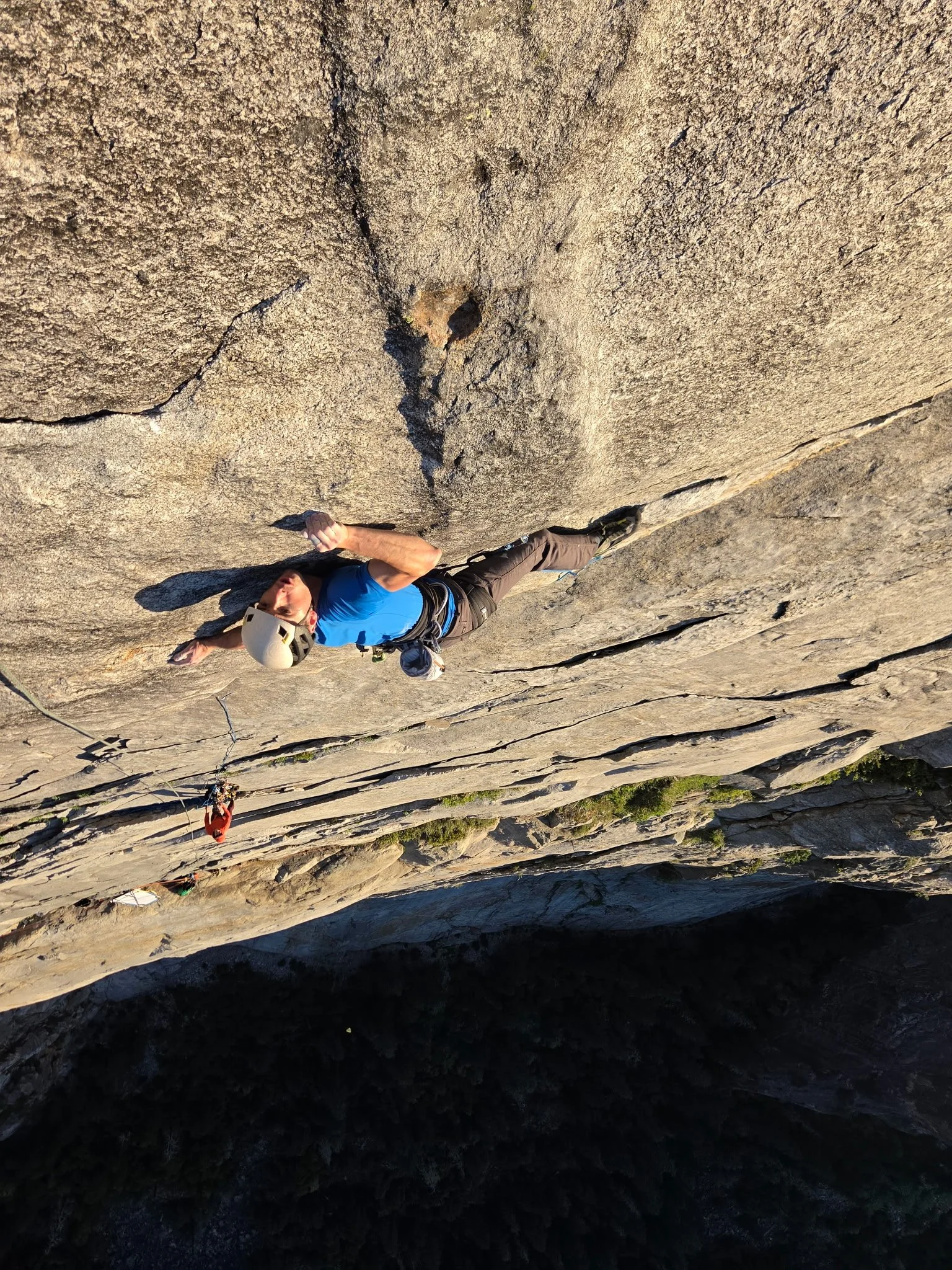
Brett Wines climbing The Albatross (pitch 18) of Borealis. Photo: Brandon Adams
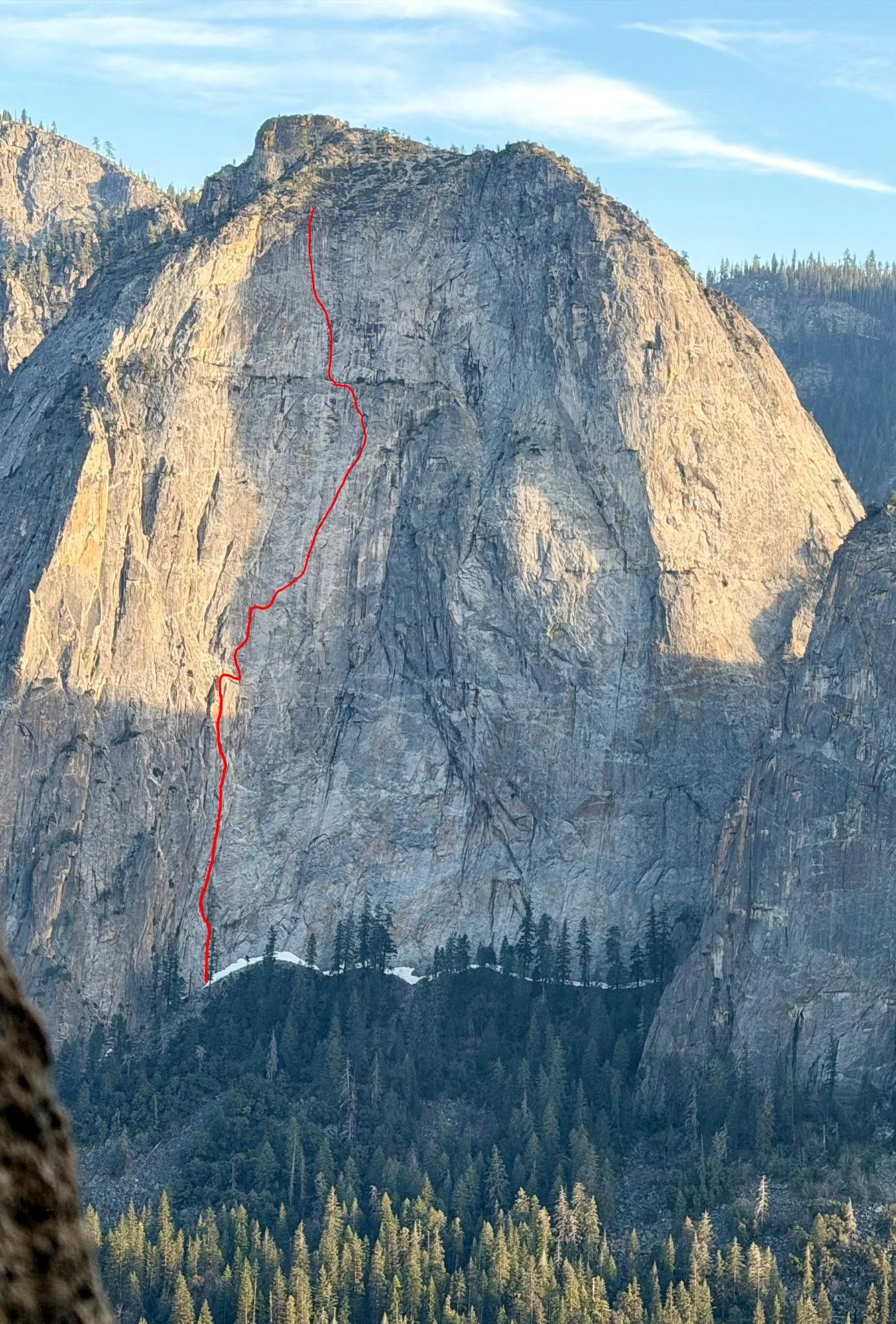
Approximate route overlay of Borealis on Middle Cathedral Rock. Photo: Brandon Adams
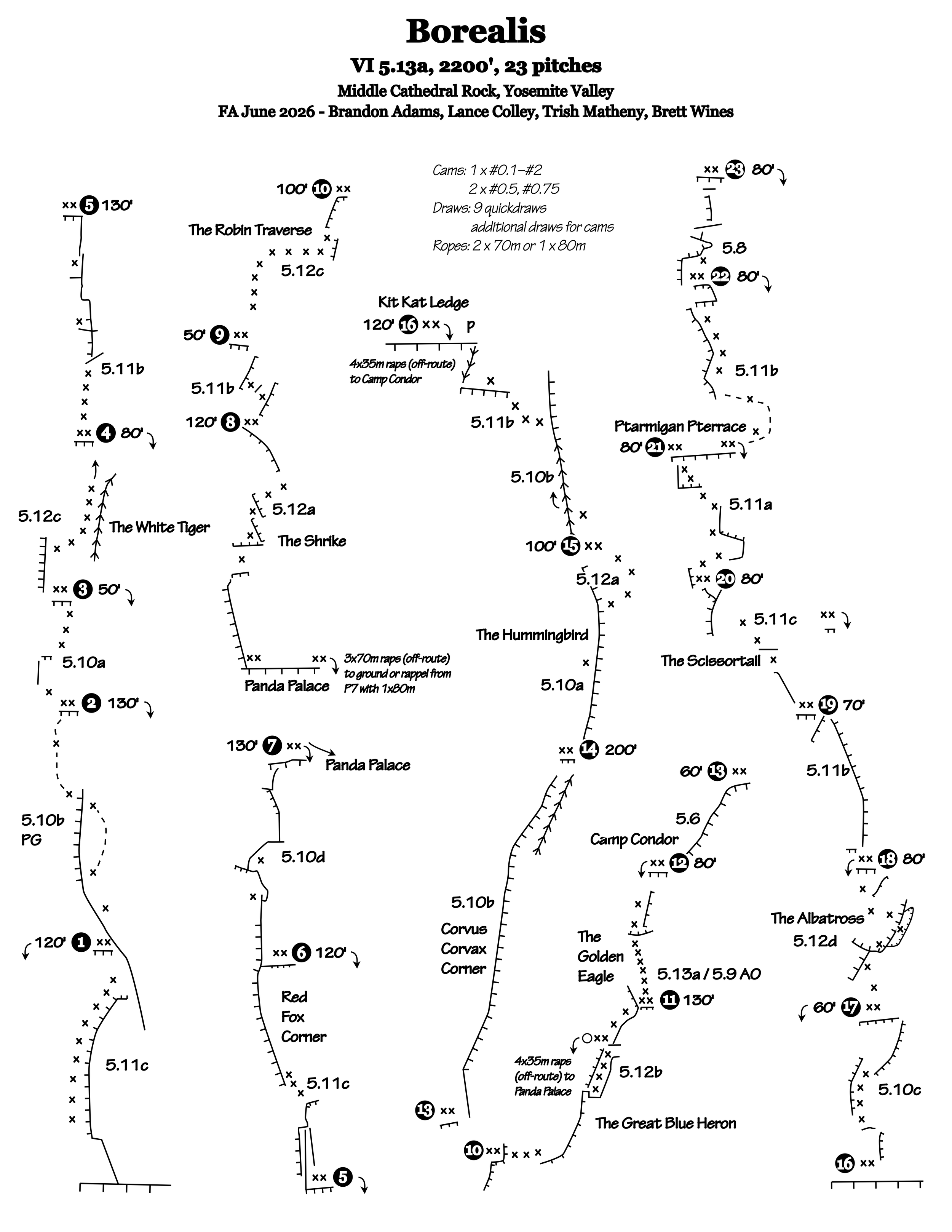
Topo of Borealis.
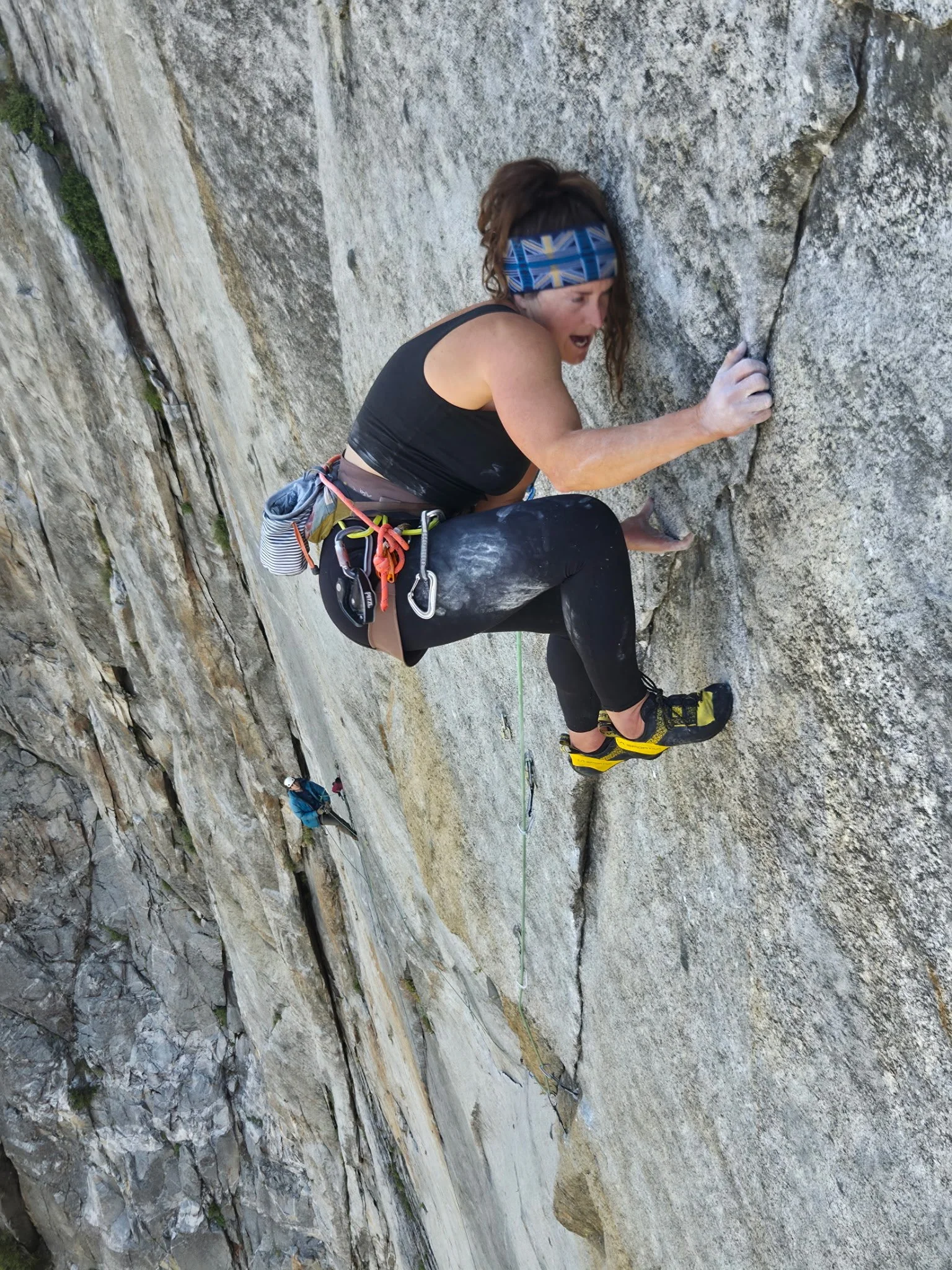
Trish Matheny climbing The Great Blue Heron (pitch 11) of Borealis. Photo: Brandon Adams

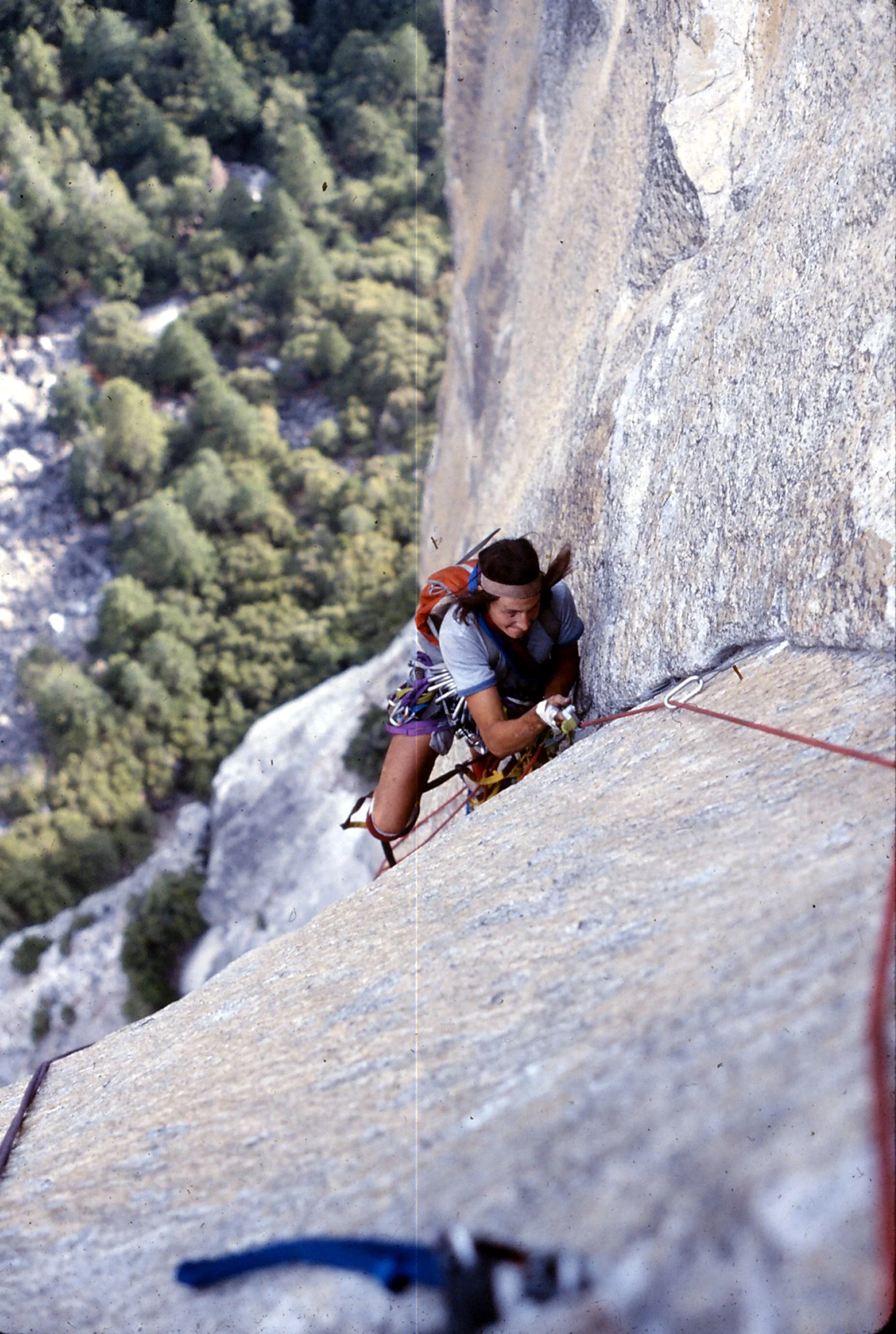
Ken Yager on the Prow of Washington Column in the summer of 1977. Photo: Ken Yager Collection
To Climb a Wall, Trials and Tribulations
I fell in love with Yosemite during my first visit at 13 years old. After seeing El Capitan for the first time I had to run to the base and touch the monolith. I decided then that I wanted to climb it. It gave me a goal, and it forever changed my life in an obsessive way. I read Royal’s books, Basic Rockcraft and Advance Rockcraft and practiced the techniques he described. I studied Steve Roper’s red Yosemite Guide. His route descriptions were terrifying to read, instead of scaring me off I became more determined to climb these magical routes. I made my own aiders and learned to aid climb and how to haul in the large fig tree in our back yard. I had my younger brother belay me while I climbed up the tree. I then took my newly learned skills and applied them elsewhere. I climbed up the inside of the large backstop in our neighborhood park which gave me a taste of how strenuous overhanging climbing could be. I only had a Swami belt, and it was difficult to breathe if you couldn’t keep your feet under you. I learned to balance in my aiders using the classic drop knee and one leg forward stance in the aiders that was made famous by Royal. It is harder than it looks.
I heard about the bolt ladder on the ivy-covered UC Davis auditorium. I climbed it many times until I was caught by the campus police force. The High School had a couple of seams on a tall building over the concrete walkway. I climbed both with tiny stoppers and later with Crack & Ups when they came on the market. The seams had brick on one side and metal flashing on the stucco side. I would gently ease onto the gear as it slid down the crack until it caught and could hold my bodyweight. In retrospect it was very dangerous and I am lucky I didn’t get hurt.
I soon took my new-found aid skills to the rock. I picked a route at Sugarloaf called The Fracture. Sugarloaf overlooks the town of Kyburz along the North side of Highway 50 between Placerville and South Lake Tahoe. Sugarloaf was mostly a free climbing area that had granite cracks similar to Yosemite’s. For the Sacramento area climbers, it was the training ground for ambitious Yosemite trips. The Fracture was three pitches and was the token aid climb with a giant roof at the top being the crux. I had a slew of free climbing partners, finding one to aid climb with was difficult. Jon Ranstrom, Tom Walters, Howard Kazematis and Rich Stevenson were the only ones that went out with me more than once.
Jon and I hiked to the base and flaked out the rope. I led the first pitch placing stoppers in a thin flake that diagonalled up and left. I was able to find some decent stopper placements. We only had a few pitons, and I was hesitant to use them as I hadn’t placed one before. I had seen it done before, so I knew the concept. I belayed Jon up as he cleaned the pitch. We didn’t own any jumars. Jon led the next one to a belay beneath the Fracture Roof. It was long and severely overhanging. A beautiful crack split the roof.
I grabbed the rack and started up with the confidence that I had trained on the interior of a backstop. It was about the same angle. At the start of the roof, it became quite clear that pitons were needed. I started hammering them in. I wailed on them until they were ringing. I was not skilled and hit my fingers and skinned my knuckles while dangling in my aiders as I spun around in space. It was strenuous and I was bleeding all over. I ran out of gear slightly over halfway up. I had to downclimb cleaning my precious pitons which I had over driven. A couple of them flew out of the crack bouncing down the face below. After more smashed fingers and bloody knuckles I made it back to Jon and we rappelled back to the ground. We found the dropped pitons and walked back down to the car.
I borrowed some extra pitons from my stepfather and went back up with Howard. We climbed up to the roof, and I started climbing up it with my piton arsenal. I did a little better and was drawing less blood. I placed a piton at the lip of the roof and standing up in my aiders I got a glimpse of the terrain above. I had about 10 feet to go to reach the end of the climb. I could not get any of the gear I had left to work. I decided to free climb the rest. It was not steep. I stepped as high as I could in my aiders and stepped out of them into a lieback. It was the first time I had dealt with severe rope drag. I could barely move and it was a scrappy fight to the end. My hand-me-down Robbins boots were skidding all over the place. I built an anchor and put Howard on belay. I could hear him swearing as he struggled underneath the roof cleaning the pitons. I kept his belay tight hoping it kept him from swinging wildly. Howard got to the last piton and peered over to have a look at the lieback. He looked miserable. I held him with rope biting into my waist, as he reached down and cleaned everything except for the piton. He struggled on the last section, and I pulled him as hard as I could using my legs to pull against him. We were both relieved when he made it to the anchor. We made it back to the car just as it got dark. I was psyched, Howard not so much. That was the last time he went aid climbing with me.
I spent most of the summer of 1973 picking apricots and almonds on a small farm west of Davis. My goal was to save enough money to buy a perlon rope, a pair of EB’s and a pair of jumars. I found the job to be fun. We would spread a tarp around the almond trees. Being the climber, it was my job to climb up in the tree and hit the branches with a large rubber mallet. Picking apricots was done from an orchard ladder. The best thing was learning to drive both the trucks. I was 14 and it was legal for me to drive on a farm. I took every opportunity I could to drive. I also worked during my lunch, slicing apricots in half for drying.
By the end of the summer, I had saved over $125 and had enough to purchase a new rope, jumars and EB’s with more than $25 left over. I had continued to climb on the weekends and felt that with my new gear I was ready to climb a Yosemite big wall. I had read Roper’s guide several times and had picked the South Face of the Column as my first one. This was considered the easiest Grade V in his guidebook. I talked my Stepfather Steve into trying it with me.
We made our own haulbag out of a tie-died canvas bag that we reinforced with webbing. We loaded up and hiked up to the Column from our campsite in Upper Pines. After identifying the start, we started climbing. We climbed 3 pitches to Dinner Ledge. I learned that there is a big difference from hauling a bag of rocks up in a tree compared to hauling a bag dragging up the rock. There was a thing called rope drag that hadn’t occurred to me. The hauling was harder than the climbing. We still had a little time until the sun set, and I decided to lead the Kor Roof to fix the next pitch off the ledge. I made it to the anchor and rappelled thinking I could clean the gear as I descended. The crack above the roof diagonalled up and right. As I rappelled it got harder and harder to remove the gear. Next thing I knew my feet skated off the roof and I swung to the right in a giant pendulum with my rope raking over the edge. It scared the hell out of my Stepfather. I had him anchor the rope for me and I was able to jumar over to the gear with my six-carabiner break bar still on the rope. It was difficult but I was able to make it back to Dinner Ledge. It was a good lesson for me. The next morning, we weren’t feeling it, so Steve jumared up to the anchor to get our lead line, and he rappelled back to the ledge. After emptying the water bottles, we divvied up the gear and rappelled back to the talus. On the drive back home, we vowed to come back for another try.
We did try it again and didn’t get any further. We decided maybe a Grade 4 aid climb would be better to start with. We picked the Northwest Face of Lost Brother. My Stepfather had done some mountaineering in South America with his friend Tom Cosgrove. Tom had climbed the North Face of Half Dome with Dennis Henneck and Tom was a big wall veteran in our eyes. We packed up and hoofed it to the base. We could see the big corner that we wanted to reach but could not figure out where to start the climb. We spent two days scrambling around and didn’t get any climbing in. It was a little disappointing.
I next made plans with Rich Stevenson to climb the Northwest Face of Half Dome. I put the rack together and Rich gathered food and water bottles for the climb. We hiked past Happy Isles, and it took most of the day to get to the base. It was the longest approach I had ever done. We didn’t know about the spring at the base and carried water from Little Yosemite Valley. We arrived at dark with raw shoulders and waists from carrying uncomfortable packs. Waking early, we started climbing. I led and hauled the first few pitches. I was super psyched to be climbing on Half Dome. Rich jugged up to me and pulled a water bottle out the haul bag and passed it to me. The bottles he had chosen were Prestone antifreeze bottles. He had bleached them and rinsed them multiple times. Well, the bleaching and rinsing didn’t seem to help at all. The water tasted like antifreeze and I nearly puked. There was no way we were going any further. Once again, I dumped the water out, Rich and I rappelled back down with our gear. At the base we rinsed our mouths out with spring water to get the antifreeze taste out of our mouths. The fresh water was delicious. The hike back to the saddle was not attractive to either of us, so we decided to go down the Death Slabs. Why not, it would be all downhill and we had ropes if needed. We started down in the afternoon. As we were trying to find our way down dark clouds started rolling in and it started to smell like rain. We hadn’t gotten very far before the lightning started hitting all around us followed by incredibly loud thunder. We were in the middle of a forested section when the rain hit us with a vengeance. We could feel the electricity in the air and needed to find some shelter. We cowered underneath a tube tent sitting on our ensolite pads for protection against the lightning. Bolts were hitting the trees close to us all night and we didn’t get any sleep. By morning it was starting to clear, and it got cold. We started descending early, soaking wet and shivering violently. Warming up in the cafeteria while eating breakfast never felt so good.
Moving to Camp 4 in Yosemite December of 1976, I immediately searched for a wall partner among the few hard-core residents of the campground. The only one interested was 23-year-old Mike Corbett. We let our impatience get the better of us and slightly over a week after I moved into camp we tried to climb the Nose of El Capitan. In another story I wrote about this attempt in detail. Our lack of experience nearly got us killed. We spent 2 and a half days on it before retreating. Once safely back down we had a new respect for Yosemite’s granite walls.
After talking to some El Capitan veterans, we were given a list of three climbs to do as preparation for El Cap. Those climbs were the South Face of Washington Column, the West Face of Leaning Tower, and if those went well, then the more technical Prow of Washington Column. Mike and I followed that advice and climbed the South Face of the Column first. It was my third attempt on this route, and it was anticlimactic. I remember very little. It seemed uneventful after our near-death experience on the Nose. It was almost a letdown and left us hungry for the real goal, El Capitan. I ended up doing 7 walls that year including 4 El Cap routes. It was a year I will never forget.
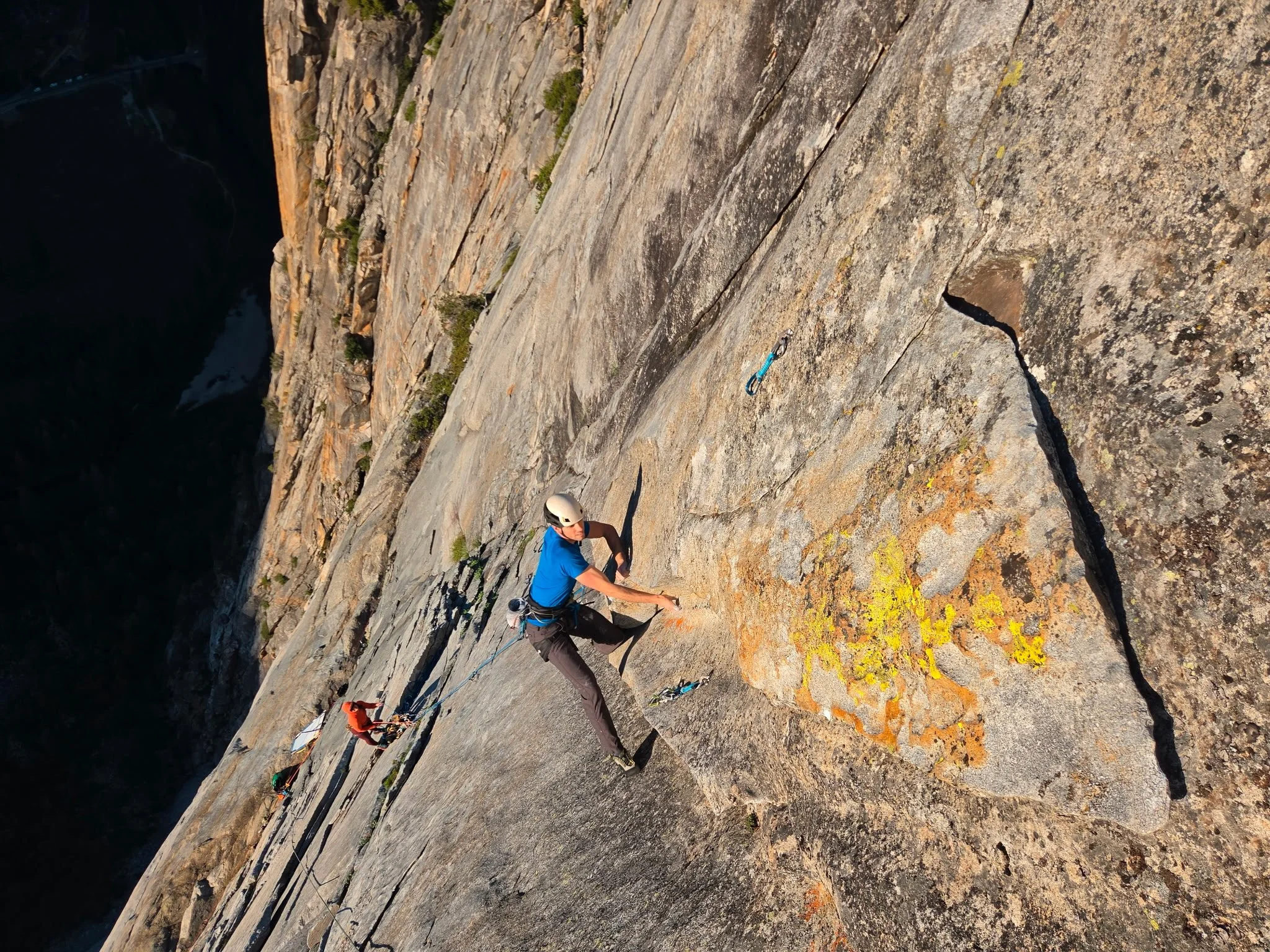
PHOTO OF
THE WEEK
Brett Wines climbing The Albatross (pitch 18) of Borealis. Photo: Brandon Adams

Stay up to date on the latest climbing closures in effect!
Get your permits, do your research, and hit the wall!
Visit the Yosemite Climbing Museum!
The Yosemite Climbing Museum chronicles the evolution of modern day rock climbing from 1869 to the present.
The YCA News Brief is made possible by a generous grant, provided by Sundari Krishnamurthy and her husband, Jerry Gallwas