
EDITION 44 - FEBRUARY 6, 2026

Your window into the stories, history, and ongoing work to preserve Yosemite’s climbing legacy.
A Note from the Editor
Warm, clear conditions persist in Yosemite. Although January and February are usually the wettest months, the park’s year-to-date precipitation is currently about 59.5% below the 30-year average, according to an internet search. Yosemite has received 4.6 inches of rain so far this year. A major storm early in the year brought 37 inches of new snow to higher elevations by January 7. Since then, snowfall has been sporadic, with no significant new accumulation in nearly three weeks.
I climbed at Pat and Jack last week, and it was t-shirt weather all day. The rock was so warm I was glad my chalk bag was full—I was constantly dipping into it. It wasn’t that you’re greasing off every move like in summer, but it felt like spring in February. It’s been even warmer in Mariposa, where it’s still in the low 70s.
According to my weather app, Clime, light freezing rain is expected tomorrow (Feb. 6) in Yosemite Valley, with blowing snow on the 10th and heavy snow showers on the 11th.
As for Yosemite in the news: in a story from Feb. 4 (updated and originally posted on March 11, 2019), Joe Yogerst at National Geographic wrote a story with the headline: Everything you should know about Yosemite National Park.
Our expert guide will help you make the most of your visit to this epic California park, home to El Capitan and Half Dome.
Yogerst continues:
It may be chilly, but winter is a magical season in the park. Snow blankets the meadows and mountaintops, while waterfalls freeze solid. With very few people, visitors who brave the temps find plenty of room for snowshoeing and skiing at Badger Pass, ice skating at Curry Village, and the possibility of walking through a snowy redwood grove.
And on Feb. 2, Outside posted this remembrance by Larry Arthur titled "This Guide’s Guide Climbed Yosemite’s Big Walls With Iron Age Gear."
Jerry Anderson, 78, May 7… Jerry Anderson was a “guide’s guide” and all who were lucky to share his company learned more about nature. He shared facts about flora, fauna, geology, and astronomy, as well as how to move efficiently—from hiking and skiing to, of course, climbing.
In the 1960s, Jerry moved into Yosemite’s Camp 4, employing “Iron Age” gear and tactics to climb big walls. In the ’70s, he put in time with Yosemite Search and Rescue (YOSAR), while embracing the then-new lightweight “clean climbing” ethos. This became the “Aluminum Age.”
As the popularity of climbing in the ’80s and ’90s grew (and up until his passing), Jerry saw the value of creating quality bolted routes—where crack protection was scant, sketchy, or non-existent. His emphasis was always safe fun at all grades, and fun for all climbers, regardless of experience or ability. Endorsing and practicing the principles of the American Safe Climbing Association (ASCA), he also volunteered his time and energy for approach-trail and climbing-route maintenance.
Remembering another pioneering climber from Yosemite: Royal Robbins was born on Feb. 3, 1935, and passed away on March 14, 2017. The New York Times called him “The most influential American rock climber of the 20th century, and a serious-minded fellow who disdained vanity.”
Daniel Duane wrote, “Robbins saw climbing as spiritually exalted — ‘a game in which we play at acquiring the courage necessary to a beautiful life,’ as he once put it.”
This week’s Founder’s Note features Ken Yager taking readers back—way back—to 1977 and the infamous drug plane that crashed in Lower Merced Pass Lake.
And for the week’s feature, I talk with Marc Manko, Heide Lindgren’s fiancé (see story on Heide in last week’s news brief), a Yosemite big wall climber who works as a physician assistant in Idaho.
Chris Van Leuven
Editor, YCA News Brief
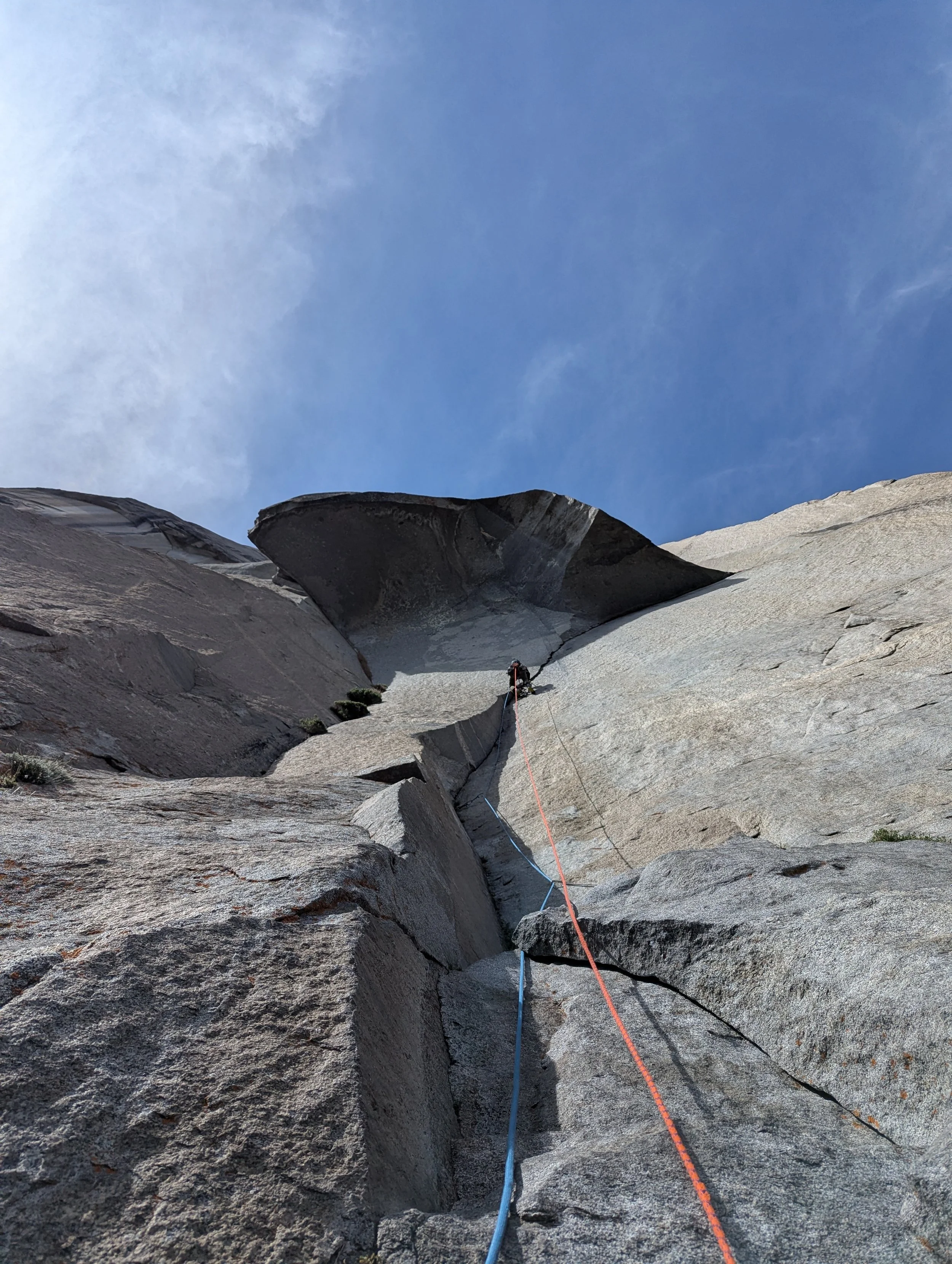
Marc leading the Great Roof, the Nose. Photo: Manko collection
Marc Manko: He Came to Crag, Then Stepped Right up on The Nose
The Boise-based emergency-medicine PA and long-route free climber has now topped out El Cap twice—both times on the Nose—and keeps coming back for the history, the community, and those “how is this real?” moments.
It’s hard for me to think about Marc Manko without smiling. Any time I saw him in the Sierra Foothills—at my place or downtown over dinner—as soon as he walked in the door (annoyingly so, for most people, I imagine), I’d hit him with: “Oh, hi Marc,” quoting The Room. He never tired of it, or at least he never showed it.
Marc and Heide live in Boise, Idaho, where free days and nights are spent climbing—at the gym, outside, wherever they can squeeze it in. They travel far and wide during vacations and make yearly trips to Yosemite. They’re getting married on June 6 in Stanley, Idaho.
When I caught up with Marc and Heide last week, Marc talked about working as a physician assistant in emergency medicine—and the constant juggle of jobs and life while still keeping climbing central. Yosemite kept coming up as the place that makes everything feel bigger: the history, the scale, the community, and those “how is this real?” moments. He plans to return this summer.
His first trip to Yosemite was in 2018; “I can’t believe it took me until then,” he says. He started climbing in 2008. He showed up thinking he’d crag for a couple of days, get a feel for the granite, and then go climb the Nose.
The first time he climbed the Nose, he came to Yosemite with his friend Noah after months of training. They’d never slept on a portaledge, so they built up to it on a road trip: Desert Shield in Zion (their first portaledge night), then the original route on Rainbow Wall in Red Rocks, then bouldering in the Buttermilks.
There was one major problem: Noah’s shoulder was wrecked—torn labrum and supraspinatus—so he couldn’t really climb. Marc told him that he had two weeks off and needed to know whether to change plans.
Noah didn’t cancel, despite the pain in his shoulder.
“You’ve got a golden ticket here,” he told Marc. “We’re going up the Nose, and I’m gonna be your belayer on whatever you want to climb.”
Then they rolled into Yosemite—Marc’s first time ever here. The plan was sensible: Crag a day or two, maybe do Butterballs at the Cookie or Braille Book on Higher Cathedral Rock, to experience how Yosemite granite actually feels.
They pulled into the Valley, stared up at El Cap, and watched parties moving on the wall. They did the "El Cap layback"—lying down in the meadow to watch the great stone in the sky. After, they bivied in Curry Village. In the morning, they wandered down to El Cap Meadow to cook breakfast and “watch the wall” again—only this time, the Nose looked clear of other parties so they could just cruise right up to it.
Half the teams were cruising, already well past El Cap Tower. The other half were bailing. And suddenly there was an open lane.
“So we just rallied,” Marc said. “Got our stuff together.”
And just like that, the first rock Marc ever touched in Yosemite was pitch one of the Nose. They didn’t start early, so they slept on Sickle that first night and encountered another team on the ledge who had taken over. Marc and Noah pitched their portaledge completely off the ledge and didn’t get to sleep until 2 a.m. At 4 a.m., the portaledge flipped over, and Marc fell onto his daisy chain. (A year and a half later, Noah finally told him that in the middle of the night, he got up to pee and stood out of the ledge, and caused it to flip.)
The other team bailed first thing in the morning. With Noah’s shoulder limiting what he could do, Marc led most of the route—something like 25 pitches.
Near the top, he spotted Nina Caprez working on freeing the Nose, with Lynn Hill by her side. After Changing Corners, Marc and Noah helped adjust Nina’s fixed line, then moved past and continued upward.
When they topped out, Lynn Hill was standing there—racking gear, hanging out, supporting Nina.
“It’s my first climb in Yosemite,” Marc said. “We just climbed the Nose—and Lynn Hill is just standing there at the top. It was a surreal, seminal moment in my climbing career.”
Marc’s Yosemite resume goes beyond El Cap. He’s climbed the Steck-Salathé on Sentinel (he did it on his last visit while staying at my place), plenty of cragging and multi-pitch with Heide, and he’s already planning his next visit.
Sometime after their upcoming wedding, he says, “I just want to take Heide up Lurking Fear. I think the combination of distance above the deck and runouts and exposure—I think it’ll be a little spooky for her. It’s more fun to go with someone who’s never done it before.”
As for why Yosemite keeps pulling him back?
“It’s amazing out there.”
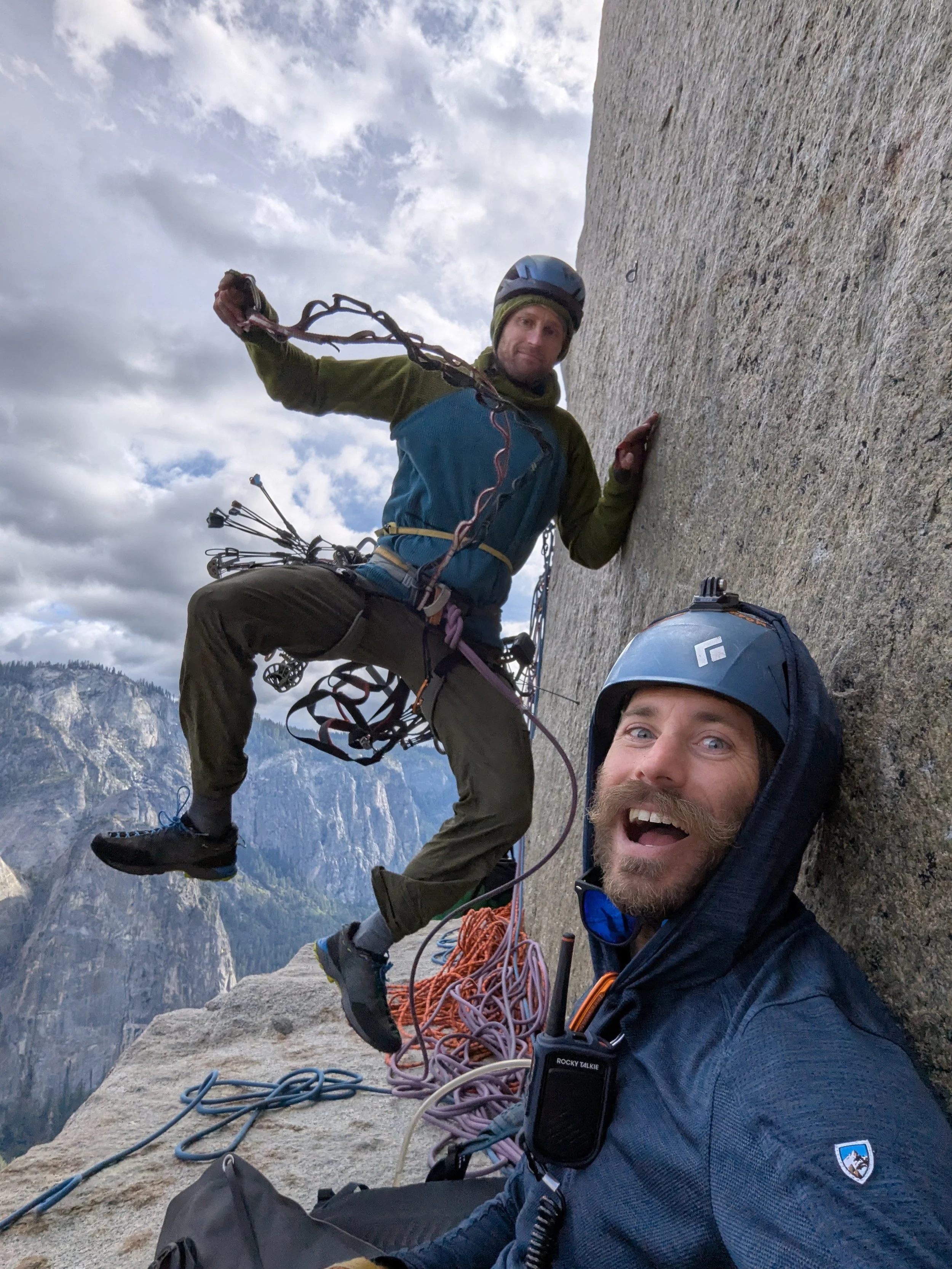
Marc clicking his heels on El Cap Tower, with Justin in the foreground, the Nose. Photo: Manko collection
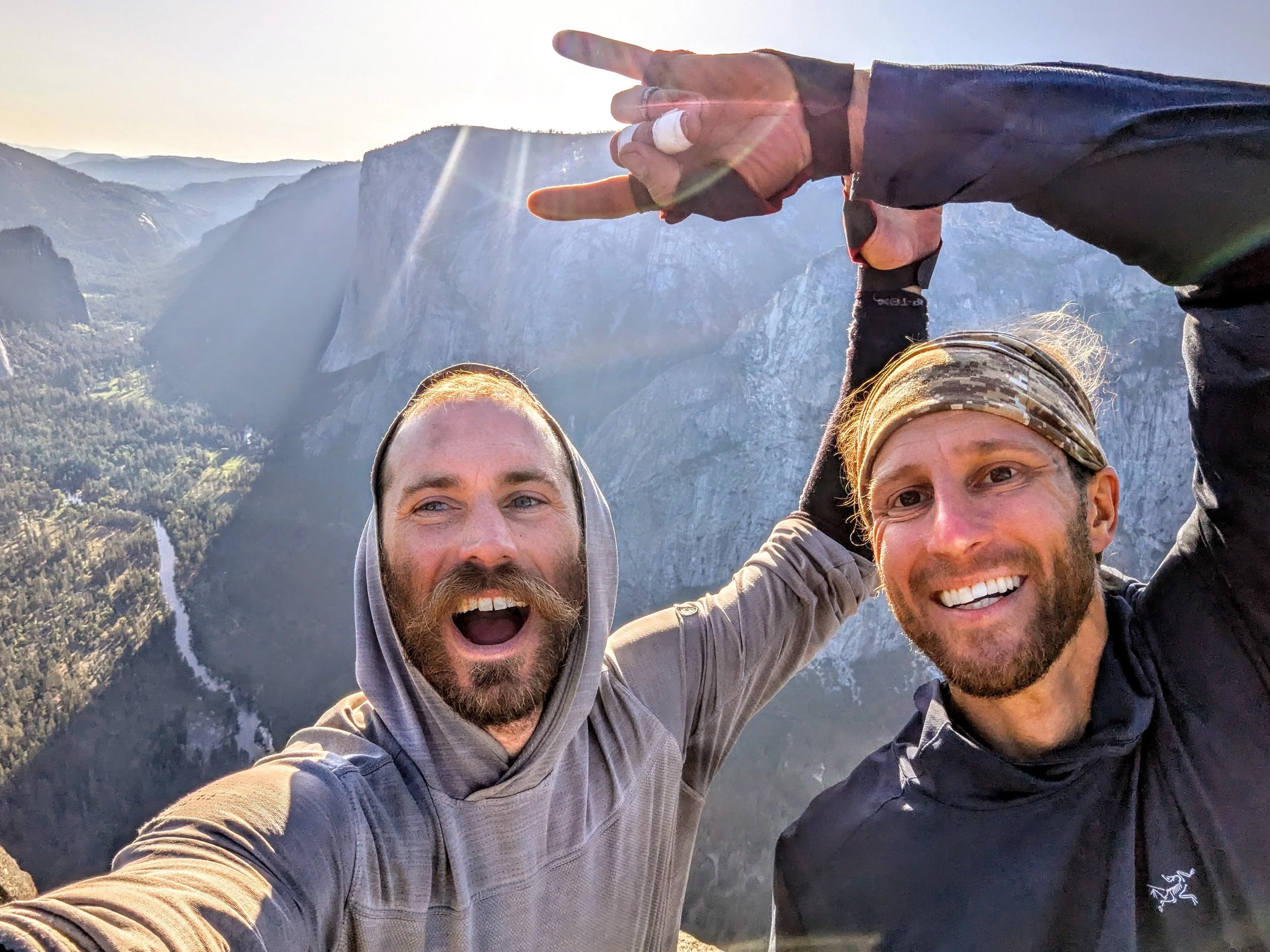
Justin (left) and Marc on the top of Sentinel. Photo: Manko collection
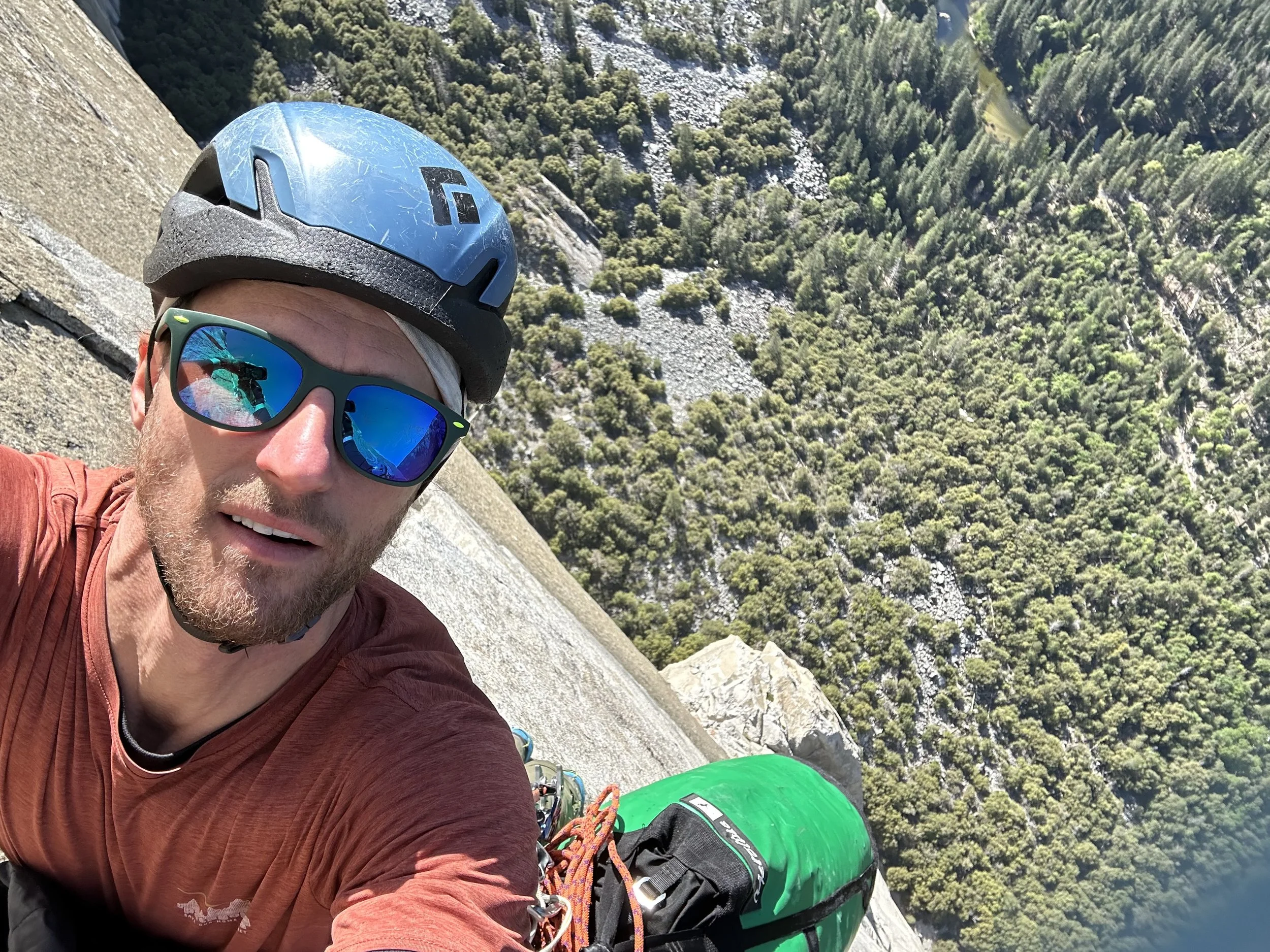
Self-portrait on the Nose. Photo: Marc Manko
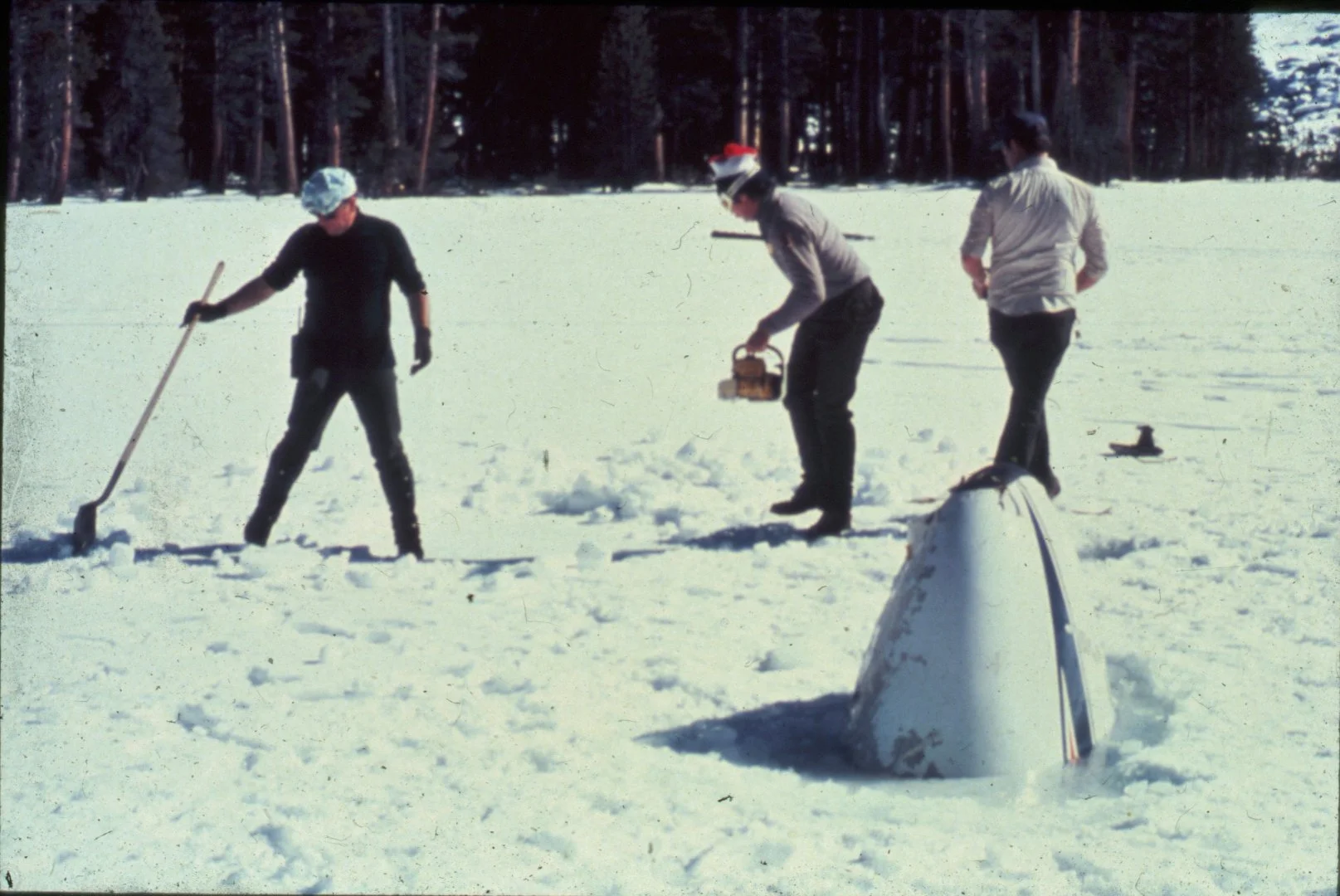
Airplane Crash Lower Merced Pass. Photo: Ken Yager collection
The Nose Attempt
Founder’s Log | By Ken Yager
Winter 1977 in Yosemite was cold crisp nights, and warm days on the rock. I was 18 and climbing almost every day.
Then the helicopters started.
For more than a week, a chopper landed repeatedly near the Village Store in a flagged-off area. Word spread: a plane loaded with marijuana had crashed in a backcountry lake. We watched law enforcement unload heavy bundles, and even from a distance, you could smell weed under the sharp stink of gasoline. Then the flights stopped, the first storm passed, and we went back to climbing.
A few weeks later, in an employee room at the Annex, someone lit a joint—apparently taken during the retrieval. That’s when the Valley question shifted from “Did you hear about the crash?” to “Is there more up there?” Soon enough, people started hiking in and returning with wet bales. The location came out: Lower Merced Pass Lake, near 9,000 feet. The lake was frozen under thick ice, and rumor had it that bales were trapped beneath it—keep chopping holes until you hit one.
My friends Big Mike and Little Mike asked me to go the next morning. The only hitch was that my mom, stepfather, and siblings were visiting for Easter vacation, and camped in Upper Pines. I told them I was going to climb Mount Starr King and might spend the night. I felt guilty for lying, but I went.
We borrowed Werner Braun’s car and drove up Glacier Point Road to the Mono Meadows trailhead. I had no headlamp and no food, and I was wearing jeans and tennis shoes. We hit firm snow, lost the trail a few times, and forded icy creeks, soaking ourselves early.
When we saw someone hiking down toward us, we half expected trouble. Instead, it was Grant Hiskes, a climber friend from Curry Company. He agreed to hike back in and show us the way.
The final climb faced north, and the snow hardened. Then I smelled it: airplane fuel. Trees were studded with twisted aluminum line and chunks of yellow insulation. The place had a spooky, dead feeling.
At the frozen lake, an aircraft nose cone stuck three or four feet straight up out of the ice, about fifty feet from shore. Across the surface were dozens of random holes—no pattern, no clues. It was pure guesswork.
We picked an untouched section and started chopping with an ice axe and a firewood axe, taking turns and warming up at a small fire on shore. The hole filled with water, splashing icy spray as we worked. After more than two feet of ice, we found only dark water. Late afternoon was closing in, and I needed to be back by morning, or my family might report me missing.
I walked to the wreckage, grabbed a 15-foot length of fuel line, bent it into a right angle, and used it as a probe under the ice. About ten feet out, I felt something soft. We started a new hole and dug hard. I kept thinking: what if it’s a body?
We broke through onto something dark, frozen in place. It took several of us to haul it onto the ice—a bundle wrapped in dark plastic. Under three layers was a labeled burlap sack, soaked and brutally heavy: 27 kilos of Grade AA marijuana from Mexico. Balanced upright, it came to my chest.
We ran for our packs, split the load, and stuffed all four packs full. Time to disappear.
As we were leaving, a group of Curry employees arrived with a heavy ice bar. They lost it to the lake within minutes, and our wood axe went right after it. Swearing echoed off the trees as we started down fast so we wouldn’t get separated.
Without a headlamp, we crawled through the darkness. Our backs were soaked, and green icicles hung from the bottoms of our packs. Worried law enforcement might be at the car; we decided to walk all the way to Camp 4. After midnight, we finally stopped to sleep.
A couple of hours later, I woke to snow. It was sticking. We packed up and moved before the trail vanished, crept through an icy traverse on the John Muir Trail, and reached Happy Isles at first light.
The Valley was silent. We passed my family asleep in Upper Pines—only a couple of hundred feet away—and made it to Camp 4 unobserved. I stashed my wet pack in my tent, changed into clean clothes, and walked back to Upper Pines for breakfast like nothing had happened.
I’d gone in and out in 22 hours. My tent reeked. It was full of wet marijuana that needed drying before it molded—but that’s another story.
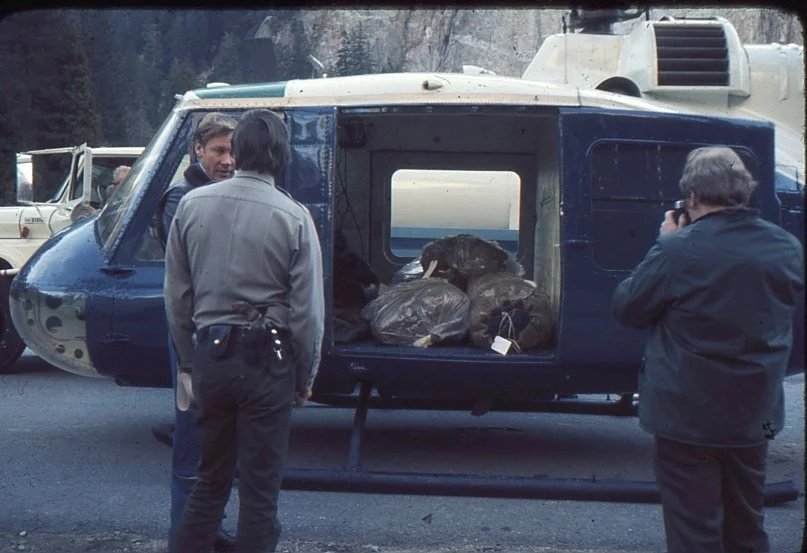
An NPS helicopter after visiting “Dope Lake” in ’77. Photo: Ken Yager collection

We are pleased to announce that we have joined 1% for the Planet as an environmental partner! This partnership will advance our impact and help to promote local and visitor stewardship of our precious public lands.
1% for the Planet is a global network with thousands of incredible businesses and environmental organizations working together to support people and the planet. Businesses may now select the YCA as an environmental cause they’d like to support, how neat is that!
Started in 2002 by Yvon Chouinard, founder of Patagonia, and Craig Mathews, founder of Blue Ribbon Flies, their members have given hundreds of millions of dollars to environmental partners to date.
“The intent of 1% for the Planet is to help fund these diverse environmental organizations so that collectively they can be a more powerful source in solving the world’s problems,” writes Yvon Chouinard, co-founder of 1% for the Planet.
Learn more by viewing YCA’s profile below.
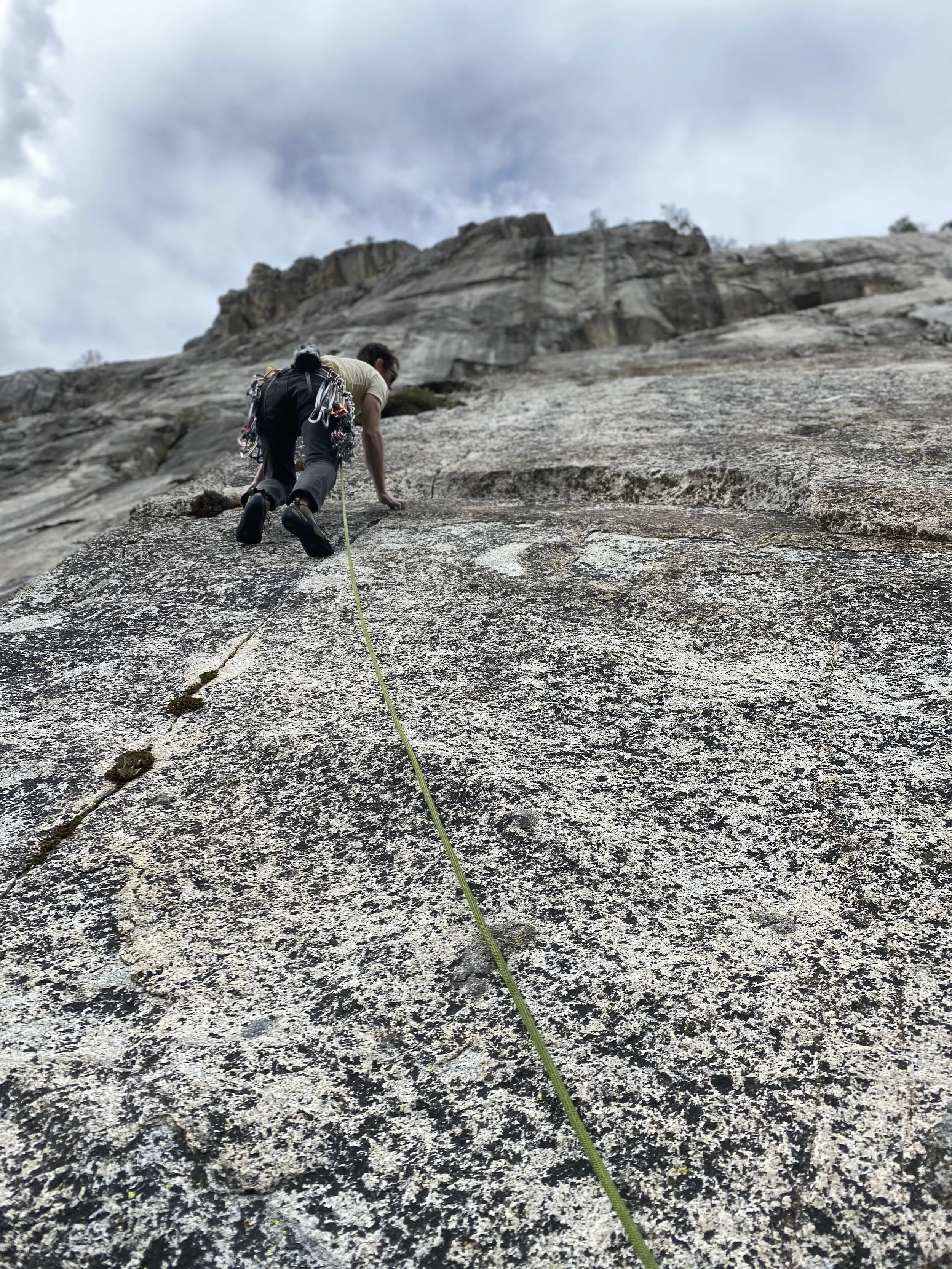
PHOTO OF
THE WEEK
Aaron Martin on Stonequest, Parkline Slab. Photo: Chris Van Leuven

Stay up to date on the latest climbing closures in effect!
Get your permits, do your research, and hit the wall!
Visit the Yosemite Climbing Museum!
The Yosemite Climbing Museum chronicles the evolution of modern day rock climbing from 1869 to the present.
The YCA News Brief is made possible by a generous grant, provided by Sundari Krishnamurthy and her husband, Jerry Gallwas