
EDITION 57 - MAY 29, 2026

Your window into the stories, history, and ongoing work to preserve Yosemite’s climbing legacy.
A Note from the Editor
Memorial Day weekend usually marks the first major weekend of the busy summer season for Yosemite National Park, and this year proved to be especially hectic. With the elimination of the timed-entry reservation system, the park experienced record crowding. So far this year there have been more than 836,000 visits - roughly 100,000 more visits than this same time last year.
Entry line delays were reported to exceed an hour and a half, and some parking lots were already full by 8 in the morning. Visitors have been parking along the roadsides and traffic was shunted across El Cap bridge in the early afternoon, preventing visitors from accessing the east side of the Valley without waiting in long lines to access the overcrowded shuttle buses.
Despite the second half of this week being overcast with rain showers, a lot of climbing was accomplished over the weekend and into the first half of this week. On Friday the 22nd, Noah Fox and Jake Whisenant climbed the Nose twice in a day, summiting the second time for a total time of 14 hours and 38 minutes.
On Saturday the 23rd, Tyler Karow and Julian Kraus topped out El Corazon after eight days on the wall, having successfully freed every pitch on the long and demanding route. The 13b pitch was Karow’s first of the grade. They were preceded on the route by Fiona Layton and Ari Child, who started one day before them. The four of them climbed out together to the top.
On Sunday the 24th, as the Valley was swarming with people hunting for places to park, Olly Tippett and Anton Korsun escaped the madness by heading up El Capitan. They made the second ascent of Sticky Rice (A4) in 19 hours and 24 minutes. Olly took four falls over the course of the day when several of the innumerous old heads on the route ripped out. The quality of the route was reported to be dubious at best, with extensive ladders of chiseled heads involved.
On Tuesday, clouds rolled into the Valley and brought rain, which returned the park to a quieter and cooler state. The weather is expected to clear by Friday the 29th, with slightly cooler temperatures following for a few days before warming back up again.
For this week’s feature I speak with Skot Richards. He blends passion and innovation by developing specialized equipment for big wall climbers, and he puts his own gear to the test during his own ascents of El Cap routes.
Miles Fullman
Editor, YCA News Brief
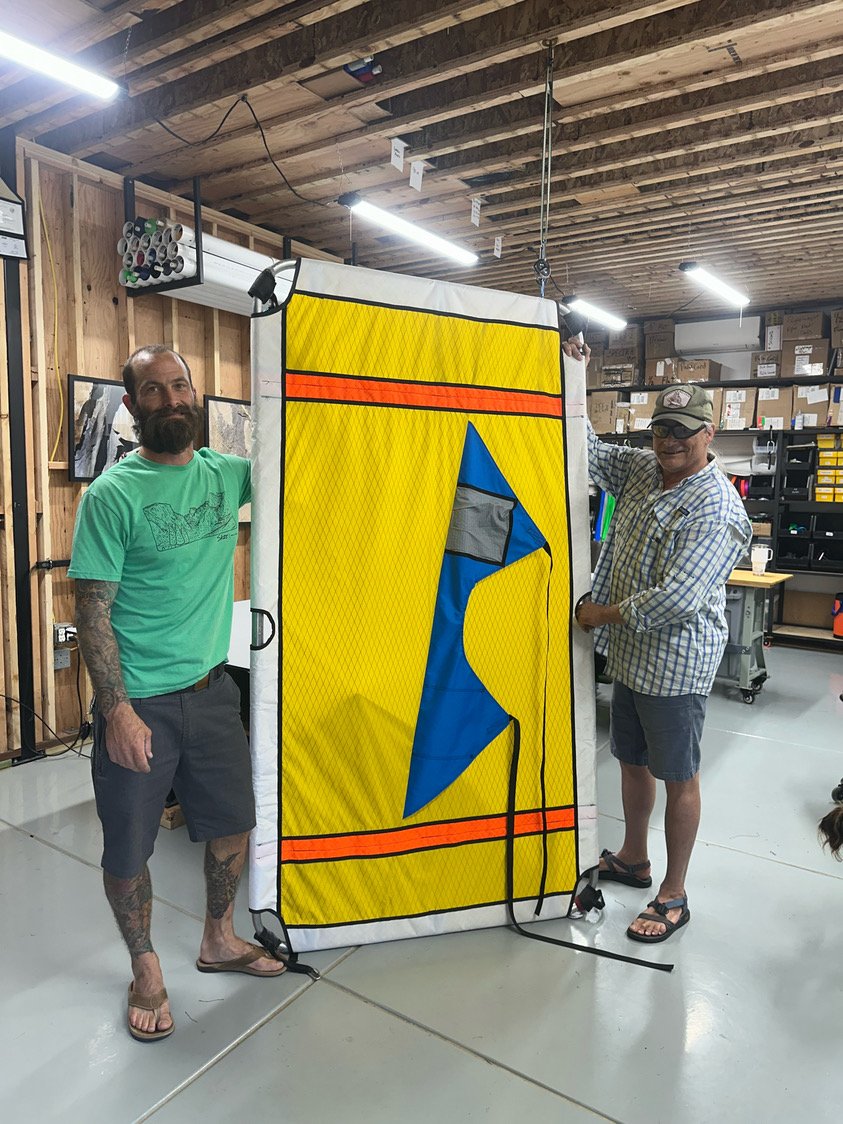
Skot Richards holding up one of his “Skot’s Kots” portaledges in his workshop. Photo: Skot Richards collection
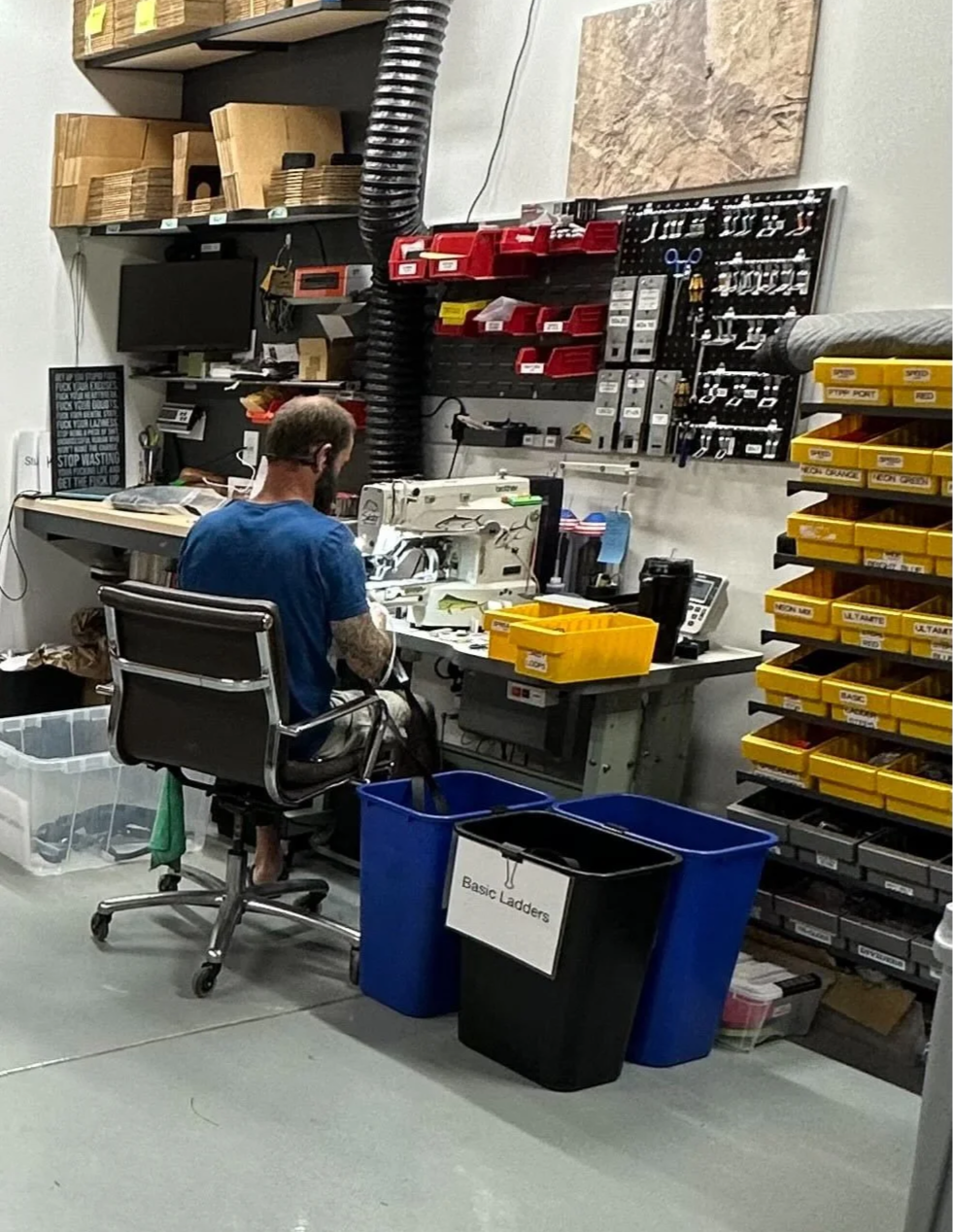
Skot Richards busy at work at his industrial sewing machine in his workshop. Photo: Skot Richards collection
Skot Richards is Building Gear for Big Wall Adventures
Skot Richards works as an industrial mechanic. Born and raised in Southern California, he currently lives in Lakewood, California just south of Los Angeles. He first started climbing in a gym with his son. He started to grow bored of indoor climbing and began looking to bigger challenges. Having camped and hiked in Yosemite for years, he naturally gravitated towards figuring out how to climb on El Capitan.
Richards started designing and creating gear not long after getting into outdoor climbing. He used to work as an ironworker and was an experienced rigger, so the first piece of gear he ever made was a small wire dog bone similar to what used to be called the frost draw for 2:1 hauling kits.
As he got more into wall climbing, he also started creating more gear as he identified specific needs during his own ascents. The more routes he climbed, he discovered that the big wall gear available at the time didn’t meet his needs or it could be improved upon if it was modified in a certain way.
He set up a shop designed from the ground up to be part sewing shop and part workshop. His regular job is a night job where he works seven nights a week. During the day he sews and designs his big wall equipment. Being able to balance his professional career with his gear business has been a constant struggle. Richards attributes the sustainability of what he describes as his “addiction to gear production” to the patience and support of his wife, who he says is “far too tolerant… she’s the behind the scenes star that really makes the gear business possible.”
Recently, Richards has begun designing and constructing portaledges which are based on a traditional D4 design, originally put together by the late great John Middendorf. Richards has updated the design in several key ways. The edge in contact with the wall features some more advanced materials that will be significantly more durable in the long run than earlier D4 ledges. He intends to make his portaledges as durable as possible to ensure they withstand the abuse of being flagged while hauled to avoid dismantling and reconstructing the ledge every morning and evening while on the wall. He plans to construct his ledges in small batches, ideally opening up orders in the winter for spring delivery and in the summer for fall delivery. He states that his ledges “will not be the lightest, or the cheapest. They will be the best and most durable ledge you can get… built to withstand the rigors of real big wall climbing”.
Richards also sometimes works in collaboration with other big wall equipment creators. Moses Enterprises has been working on a large #4 Tomahawk prototypes for some time, a few of which were given to Richards to test out. He believes they will be a must have piece of gear for big wall aid climbers. Another piece of equipment that has been in the works for a few years is a “beak bar”, something he designed in tandem with Mark Hudon after having climbed a number of routes together and identifying the need for an easier way to clean beaks. He made some versions himself and tested them on the wall before reaching out to Theron at Moses Enterprises to do some prototyping as well before they do a run of production models.
Richards’ favorite El cap route is probably Sea of Dreams or Disorderly Conduct. He described both routes as “long sustained difficult climbing through terrain that doesn’t get traveled very often.” He enjoyed an exceptionally special ascent of Disorderly Conduct when he made only the sixth ascent. It wasn’t always obvious where the route went or where the next placement should go or where placements had been made previously like one finds on more well traveled routes.
Some pieces of gear have changed the way Richards climbs: tomahawks, totem cams and the adjustable Fifi or Alfifi that he has made for years. It’s allowed him to ditch ladder daisies and climb with just the Alfifi. The Alfifi is extremely intuitive and easy for anyone to quickly become comfortable with. Richards is particularly proud of his adjustable Fifi design, as it is one piece of gear that nearly everyone who has used one has raved about how much better it is than a traditional Fifi or two adjustable daisies. He finds it incredibly rewarding to know that so many people have been able to achieve their big wall goals and objectives while using gear that he created.
Richards has always enjoyed building or tinkering with things, so it was natural for him to want to make things better or make improvements or modifications. He constantly had ideas for new products while out climbing which he would then produce and then test with Hudon on their next climb, which would then lead to revisions of the original design. Few climbing gear manufacturers are undergoing such an intimate and specific process of testing and fine tuning with their equipment.
Since Richards is such a prolific wall climber himself, he knows exactly what gear he needs and is able to create it specifically to suit those particular needs, as opposed to mass producing a poorly designed product by engineers who aren’t out there climbing hard wall routes themselves and have no appreciation for the details that make the difference. The best climbing gear has always been produced by climbers themselves.
Middendorf was definitely an inspiration for Richards, as was all of his gear that he designed over the years. John Yates was also super helpful to him when he was getting started with gear production. The two would talk on the phone regularly about sewing designs, materials to use and different sewing machines. Luke at Runout Customs was another source of inspiration since he’s been making his own gear in his own backyard for such a long time.
Small producers like Richards have always been important to big wall climbing because they are able to innovate much more than big companies. Large scale companies are more concerned with production timelines, schedules and profits than they are about making the absolute best piece of gear for one particular niche with a small return upon investment. Richards is simply concerned with making the best gear possible. He uses all of the gear he makes, so he knows it needs to hold up and be dependable. He knows what works, what lasts and what is just junk.
Richards is soon to return to the Valley this weekend to get back on El Cap with Hudon, with hopes of climbing Kaos together - assisted with equipment he has designed himself for his exact needs on the wall.

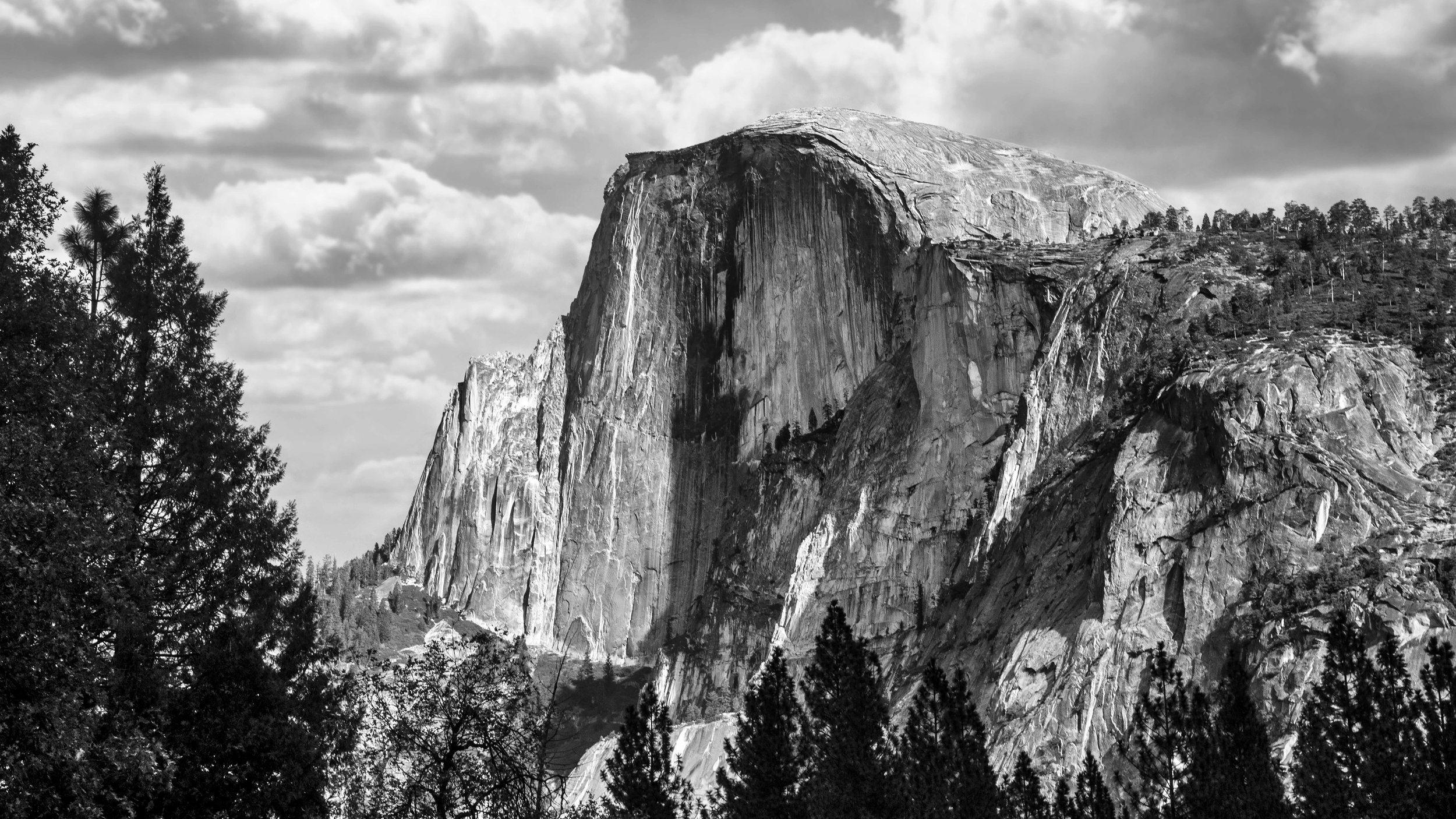
Half Dome, Yosemite National Park
Why Archives Matter: The Story a Six-Page Article
By Jim Thomsen
There is a particular kind of loss that happens quietly, without drama. No fire, no flood, just time. A magazine goes out of print. Subscribers die or move on. Libraries thin their collections. And one day, a document that shaped history simply cannot be found.
That is nearly the fate of Royal Robbins's April 1964 article in Summit magazine, "Half Dome-A Direct Ascent of the Northwest Face." Six pages. Photographs. Robbins in his own words, describing one of the most consequential climbs in American history.
In June 1963, Robbins and Dick McCracken made the first ascent of the Direct Northwest Face of Half Dome, a harder, more direct line up the same face that Robbins, Mike Sherrick, and Jerry Gallwas had first climbed in 1957, establishing the first Grade VI big wall route in the United States. That 1957 climb had already redrawn the map of American climbing. The 1963 direct route pushed the boundary further still. The Direct Northwest Face first ascent has since been rated 5.13c/d, an incomprehensible difficulty in 1963. When Robbins sat down to write the Summit account, he was documenting not just a route but a turning point in how climbers understood what was possible on granite.
Dozens of books and articles have cited that climb. It appears in histories of Yosemite, biographies of Robbins, guidebooks to the Valley walls, and academic analyses of the Golden Age of American climbing. The route itself has been repeated and studied. The ascent is, in every meaningful sense, part of the public record.
And yet the original article, Robbins's own account, written at the time, before mythology settled around the man, is essentially unfindable. Summit ceased publication. Archival copies are scattered, incomplete, or locked in private collections. You cannot walk into a library and read what Royal Robbins actually wrote about what he actually did in June of 1963.
You can at the Yosemite Climbing Museum.
The museum holds a copy of that six-page article, and it is available through the Yosemite Climbing Association's online museum. That single document is the difference between a researcher citing secondary accounts of Robbins's account, and a researcher reading Robbins's account. That distinction is everything. Secondary sources compress, interpret, and inevitably reshape. The original source, written in the voice of the person who was there, is irreplaceable. It contains details no summarizer thought to preserve, phrasings that reveal how a climber understood his own work, and context that later historians cannot reconstruct from inference.
History is not made only of landmark books and official records. It is made of exactly this: a climber writing down what happened, in a small magazine, for an audience that cared. The Yosemite Climbing Museum's job is to make sure that when a scholar, a filmmaker, a climber, or a curious reader wants to know what Royal Robbins said, in his own words, at the time, the answer is: it's right here.
That is why archives matter.
Preserve the History. Donate to the Museum.
The Yosemite Climbing Museum exists to prevent that loss.
If you have climbing films, photographs, equipment, correspondence, or personal journals connected to Yosemite's climbing history, the museum wants to hear from you. Professional archival storage, digitization, and cataloguing ensure that items donated today will be accessible to researchers, filmmakers, and climbing communities for generations. Donations are tax-deductible through the Yosemite Climbing Association, a registered 501(c)(3) nonprofit.
The Golden Age of Yosemite climbing produced some of the most influential ascents in the history of mountaineering. The people who lived it are aging, and the physical records of that era are fragile. A film reel, a rack of pitons, a hand-drawn topo, a stack of black-and-white prints, these are primary sources. Once they're gone, they're gone.
Please consider donating to the Yosemite Climbing Museum.
To inquire about donations, contact the YCA at: museum@ yosemiteclimbing.org
To read the Royal Robbins Article: https://hub.catalogit.app/yosemite-climbing-museum Search for Summit Magazine. Volume 10, #3. April 1964
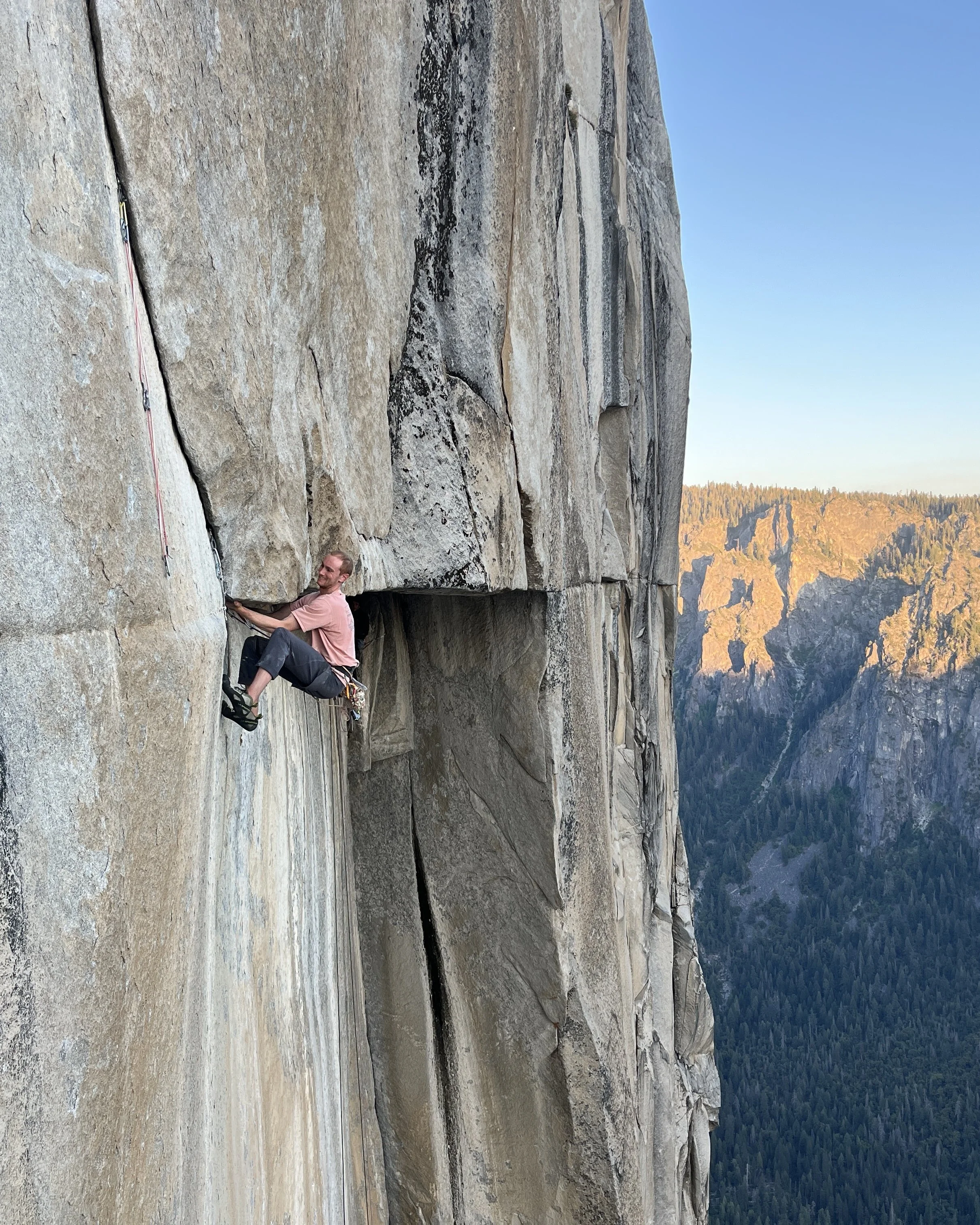
PHOTO OF
THE WEEK
Tyler Karow turning the El Corazon roof. Photo: Fiona Layton
From Tyler: I do not promote helmet-free climbing, but this pitch is particularly difficult to climb with one on, being so up close to the roof while underclinging out of it.

Stay up to date on the latest climbing closures in effect!
Get your permits, do your research, and hit the wall!
Visit the Yosemite Climbing Museum!
The Yosemite Climbing Museum chronicles the evolution of modern day rock climbing from 1869 to the present.
The YCA News Brief is made possible by a generous grant, provided by Sundari Krishnamurthy and her husband, Jerry Gallwas