
EDITION 48 - MARCH 12, 2026

Your window into the stories, history, and ongoing work to preserve Yosemite’s climbing legacy.
A Note from the Editor
Well, it seems to have turned into spring overnight here in the Sierra foothills. I was just out riding and it was t-shirt weather. It’s 66 today, and over the next week, temperatures are expected to climb, topping out in the 80s. In nearby Yosemite Valley, which is about 10 degrees cooler on average, temperatures are expected to climb into the 70s by next week, with a mix of scattered clouds and clear blue skies in the forecast.
Newsroom Meteorologist Anthony Edwards at The San Francisco Chronicle reports (March 10):
California to see unprecedented heat wave in coming days
One of California’s most startling weather events in recent memory is set to unfold over the next 10 days, a spell that could shatter records by extraordinary margins.
Daily temperature records are a near guarantee. Monthly records are likely. Highs as much as 30 degrees above normal are forecast in parts of California. The first 90- and 100-degree readings of the year might occur more than two months earlier than normal in many cities.
As Yosemite NPS writes:
Spring is a time of transition in Yosemite. While lower elevations may be in full spring bloom, higher elevations are still buried in snow, with rain or snow still possible. Weather can be warm and sunny one day, and cold, wet, and stormy the next.
And in Yosemite news—though not climbing related—National Park Traveler writes:
Library of Congress Acquires Early Drawing of Yosemite Valley
The Library of Congress has acquired one of the earliest known drawings of Yosemite Valley and a rare companion lithograph. Both pieces were created by artist Thomas Almond Ayres in 1855. Ayres is credited with the visual introduction of Yosemite National Park to Americans who had never seen the park or its sublime landscapes.
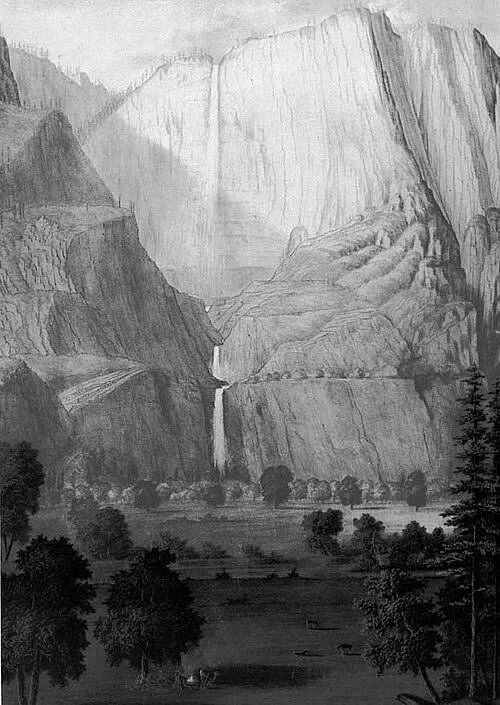
Yosemite Falls by Thomas Ayres, June 1855
The drawing of Yosemite Valley, titled “The High Falls, Valley of the Yo Semity, California,” was created in graphite, ink, chalk and charcoal on paper, and it depicts what is now known as Yosemite Falls. It measures 20 x 14 inches and captures the scale of the waterfall and surrounding cliffs. Ayres sketched the scene for several days in June of 1855.
I haven’t climbed in Yosemite since running into free soloist Brian Ludovici the weekend before last—see feature below—but by what I’ve seen on social media and texts from my crew, people are definitely climbing. Pat Curry and company did El Cap base routes and climbed at Five and Dime last weekend, and my friend Dan Leavitt just did a Dolt run on the Nose. Haven’t heard anyone mention wet rock, though I imagine Royal Arches is wet (though I haven’t had eyes on it).
In this week’s Founder’s Note, Ken Yager recalls a story from 1979; after moving to Mammoth Lakes for a ski-area job, he made his first trip to the Buttermilks with Yosemite friend Grant Hiskes. The adventure began with rough skiing lessons at Mammoth and a harrowing hitchhike to Bishop in a reckless Dodge Charger, but ended with moonlit boulders, Sierra views, and two days of memorable climbing. Ken fell in love with the Buttermilks on that first visit and returned often over the next five winters.
And for this week’s feature, I talk with Brian Ludovici. Brian is a Yosemite-based climber originally from North Carolina who came west after being inspired by Valley Uprising. He now lives in the Valley, works as the park’s after-school program coordinator, and spends much of his free time soloing, bouldering, and linking together big days like the Yosemite Picnic. Drawn to movement, volume, and covering ground efficiently, he says Yosemite holds nearly all of his long-term climbing goals, which is why he keeps returning to the rock.
Chris Van Leuven
Editor, YCA News Brief
ACCEPTING FILM SUBMISSIONS NOW!
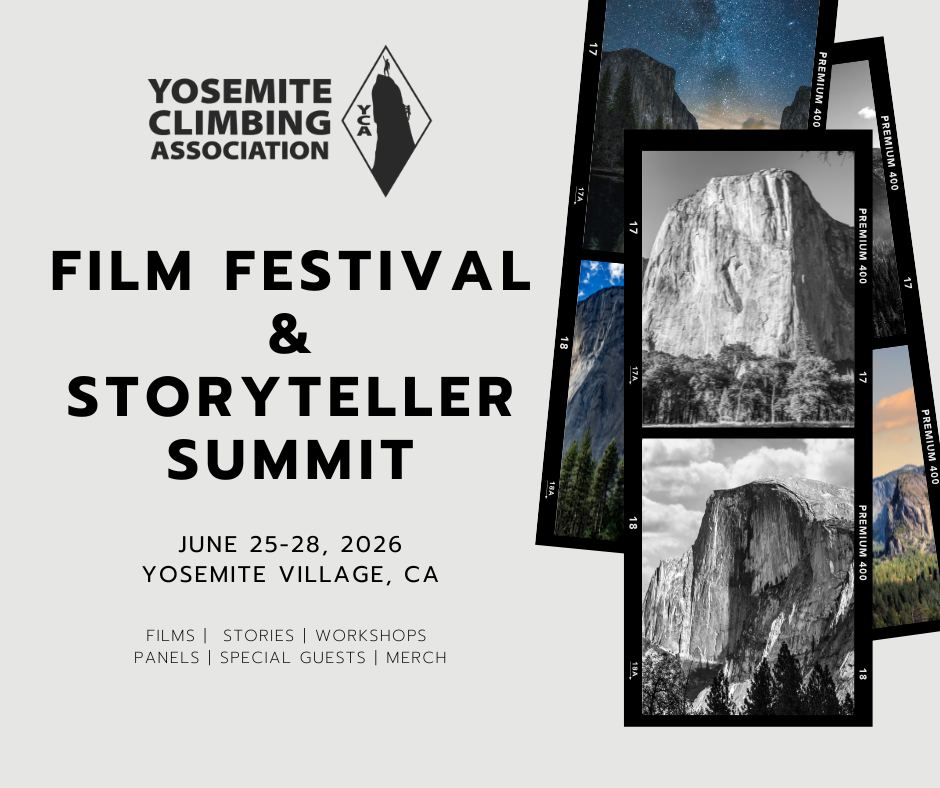
The Yosemite Film Festival & Storytelling Summit is coming to the park June 25-28, 2026 and we’re accepting film submissions!
Please share the following with the creatives in your life. We’re accepting film submissions until April 10th via FilmFreeway.
We’re seeking films that explore climbing, outdoor adventure, and human powered experiences through a strong sense of place, responsibility, and respect for public lands.
As the birthplace of modern climbing culture, Yosemite has shaped not only how people climb, but how they tell stories about climbing. We welcome both historical and contemporary films that engage with this legacy and reflect evolving ethics, voices, and relationships with the land.
Selected films should demonstrate care in how landscapes, communities, and recreation are portrayed, and reflect thoughtful, ethical approaches to storytelling in wild and protected places.
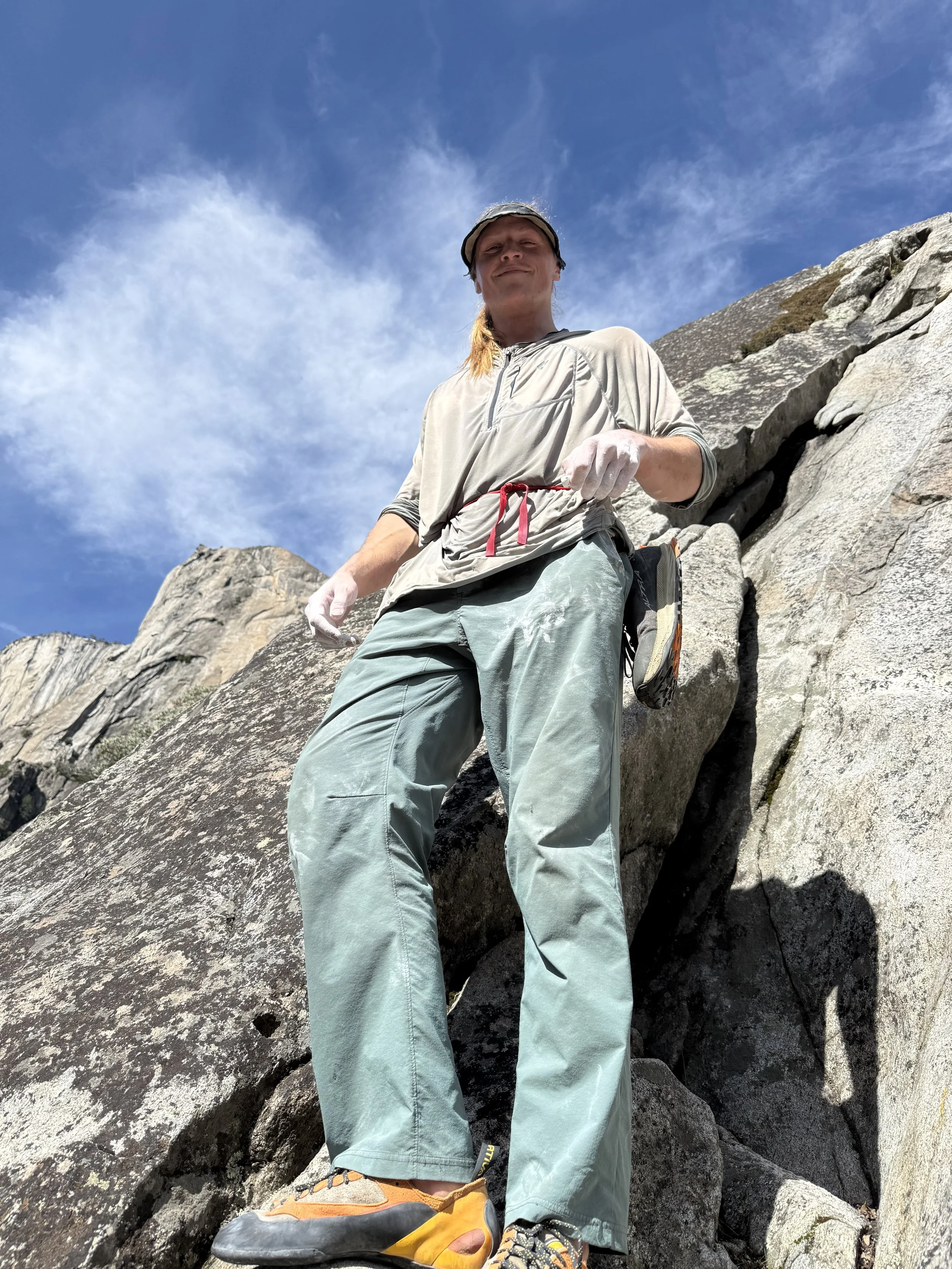
Brian soloing C.S. Concerto to After Six. Photo: Chris Van Leuven
Brian Ludovici: Following His Psych in Yosemite
Ludovici talks about moving west after seeing Valley Uprising, building a life around soloing, bouldering, and big linkups, and why the Valley still feels like the best place in the world to climb.
After Brian lapped Eric Johnson and me half a dozen times on C.S. Concerto to After Six a few weeks ago as he free soloed past, I rang him up for this story to learn more about his love of climbing in Yosemite.
He picked up and told me about taking a rest day, spending the afternoon gold panning in Mariposa, doing chores, and how cool the fog looked in Yosemite that day.
As for gold panning, he had donned a wetsuit and dove into the Octagon swimming hole between Midpines and Briceburg, hoping to sift through the thick gravel at the bottom of the pool, but he couldn’t reach bedrock.
Today Brian lives in NPS housing, climbs before work—he starts at 1 p.m.—and now that daylight saving time has kicked in, “things are so good!” he texted. “Daylight saving means I get to climb after work now!”
Raised in Cary, North Carolina, he later moved to Connecticut and attended college in both Pennsylvania and Connecticut, but dropped out after 3.5 years, deciding it wasn’t a good fit. He started climbing in 2017, built out a van, and moved to Boone, North Carolina, where he grew close with the Southeastern climbing scene before heading west.
After seeing Valley Uprising, he decided that Yosemite represented “real climbing,” and in 2019, he moved to the park and worked for the concessionaire. He had such a blast that he knew he had to come back. After spending some time back east, fixing his van and ski instructing in Big Sky, Montana, he returned and has now spent five seasons in Yosemite, which for him, is not just a place to climb—it is the place. He says that nearly all of his long-term climbing goals are here, with more great rock than he could climb in a lifetime, and that he sees little reason to leave, saying, “It’s probably the best place to climb.”
To Brian, soloing is about freedom, movement, fitness, and efficiency. He says soloing lets him climb more in less time, avoid the systems and hassle of ropes, and get cardio that he feels translates directly into roped climbing. He compares it to running, but says soloing is much more fun. He also emphasizes volume: he likes covering a lot of terrain, doing circuits, grabbing a bike and a chalk bag, moving from thing to thing, and spending a day in motion.
As for his solos, his circuit includes “Royal Arches, Sunnyside, Swan Slab and Bay Tree Flake; things like that.”
He doesn’t plan his climbing objectives too far out, preferring to “follow my psych.” He might go bouldering, do circuits, climb with friends, or suddenly devote a week to gold panning.
He loves the Cookie Cliff, likes dry winter rock, loves volume more than projecting, and seems especially alive when talking about the sheer fun of moving over Yosemite stone.
During our interview, we talked about two main climbing goals he’s achieved. One was doing Midnight Lightning sans clothes and barefoot for a photo, and the other was the Yosemite Picnic, which he did with Laura Pineau.
On Midnight Lightning, everything went well until the mantle at the lip of the boulder. His big toe repeatedly blew off the “clamshell” hold he was smearing, causing him to take several large falls. As for the clamshell foothold, he says, “It’s like this little rounded thing near the lip that you can put your foot on. There’s also an edge a little bit further, but I’ve always used the clamshell.” He refined his technique to make it more secure, and now, whenever he does it, he uses his new, more secure beta.
“When you rock up for the mantle, I do the rock really fast and put a lot of weight on my foot,” he says, “and it just wouldn’t stick. It kept basically dry-firing off, and I would fall uncontrolled through the air and land on my side. It happened like three times in a row.”
“Ever since then, whenever I climb the boulder, I’m really careful about my foot, even though I have shoes on. I know it could come off that way now. Before that, I didn’t think it could.”
As for the Yosemite Picnic—which he did on a mountain bike while Laura used a road bike—it links some of the park’s biggest terrain into one enormous push: ride 43.5 miles from El Cap Bridge to Tenaya Lake with 6,500 feet of elevation gain, swim the 1.1-mile length of Tenaya Lake, then run and hard-scramble the 10.7-mile Tuolumne Triple Crown—Tenaya, Matthes, and Cathedral—with 5,200 feet of gain and climbing up to 5.6–5.7. After that, you swim the 1.1 miles back across Tenaya Lake, then bike 44.5 miles back down to El Cap Bridge, still with another 2,400 feet of climbing mixed into all the descent. Altogether, it adds up to a little over 100 miles in a single day: 88 miles of biking with 8,900 feet of gain, 2.2 miles of swimming, and 10.5 miles on foot and rock. It took Brian and Laura 23:56.
He barely trained for it, other than climbing a bunch. Since his mountain bike had more drag than Laura’s road bike, as she coasted on the downhill stretches, he’d be pedaling as hard as he could just to keep up. And when it came to the swimming sections, “I sort of barely swam it. I cheated as much as I could while still feeling like it counted for me personally, so I had the wetsuit, and I had a mask and snorkel, and I just kind of floated across.”
Before teaming up with Laura for the Yosemite Picnic, “We climbed some easier stuff, and we went to Tioga Cliff and did some sport climbing, and we tried Heaven a few times together at Glacier Point, and we did a lot of bouldering together.”
When it comes to climbing, there is so much inspiring terrain in Yosemite that he can’t imagine exhausting it, and that abundance—plus the quality of the rock—keeps him psyched. “I think it’s probably the best place to climb, and why would I go anywhere else?”
As for his future plans, he’d like to work for Yosemite’s helicopter rescue team and maybe one day become a pilot.
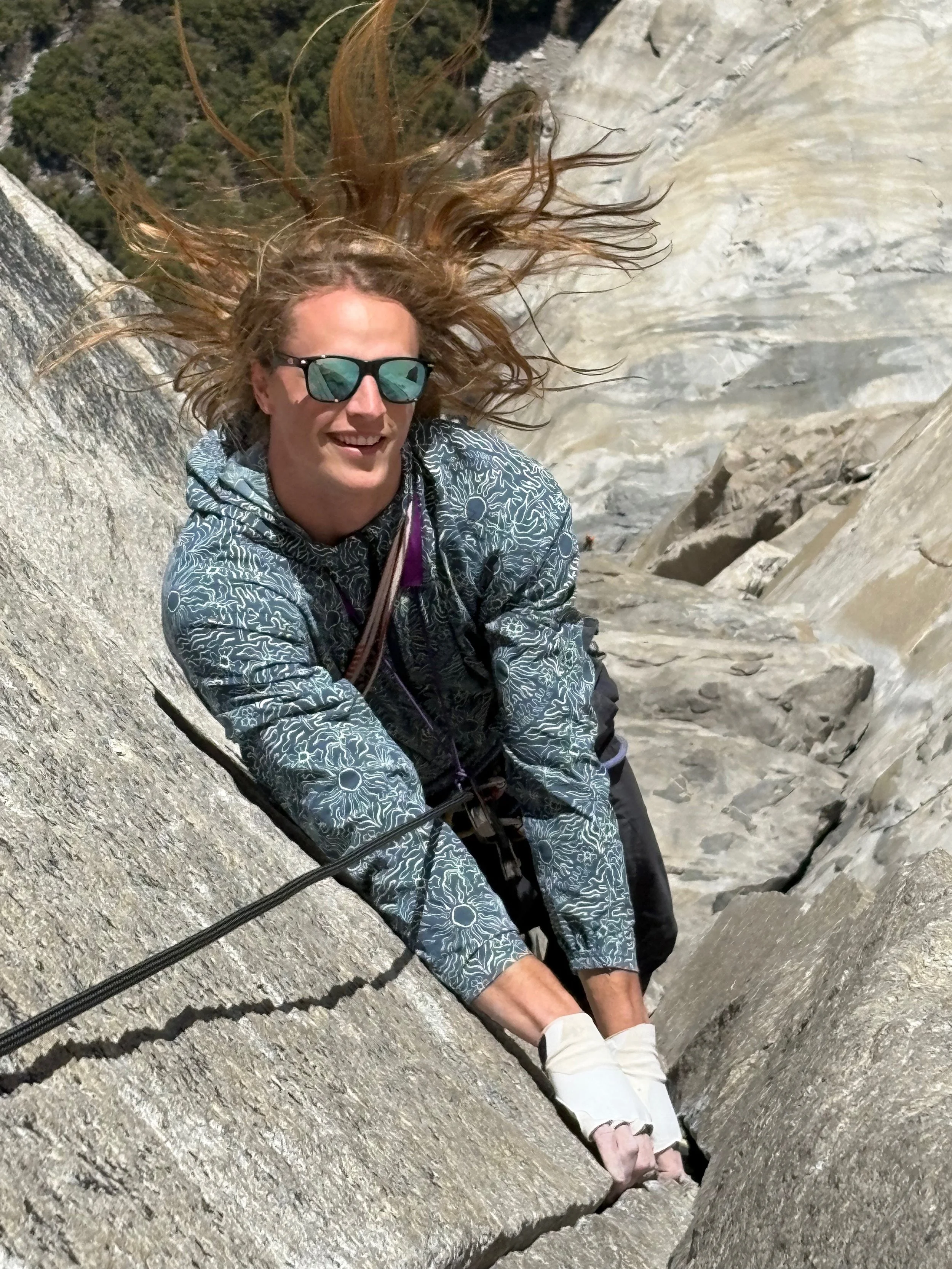
Brian Ludovici high on the Nose. Photo: Justine Ortiz
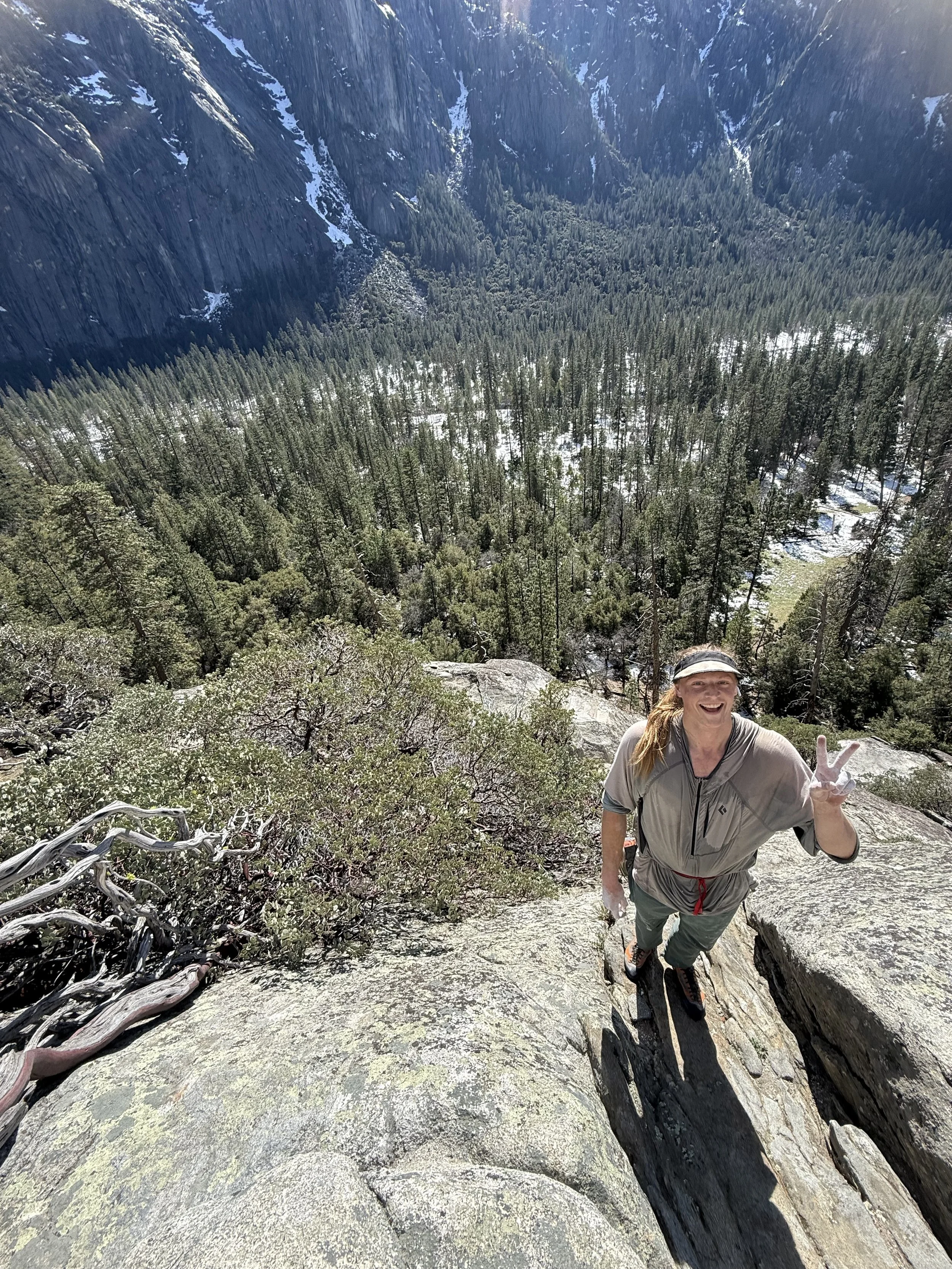
Brian Ludovici on C.S. Concerto to After Six. Photo: Chris Van Leuven
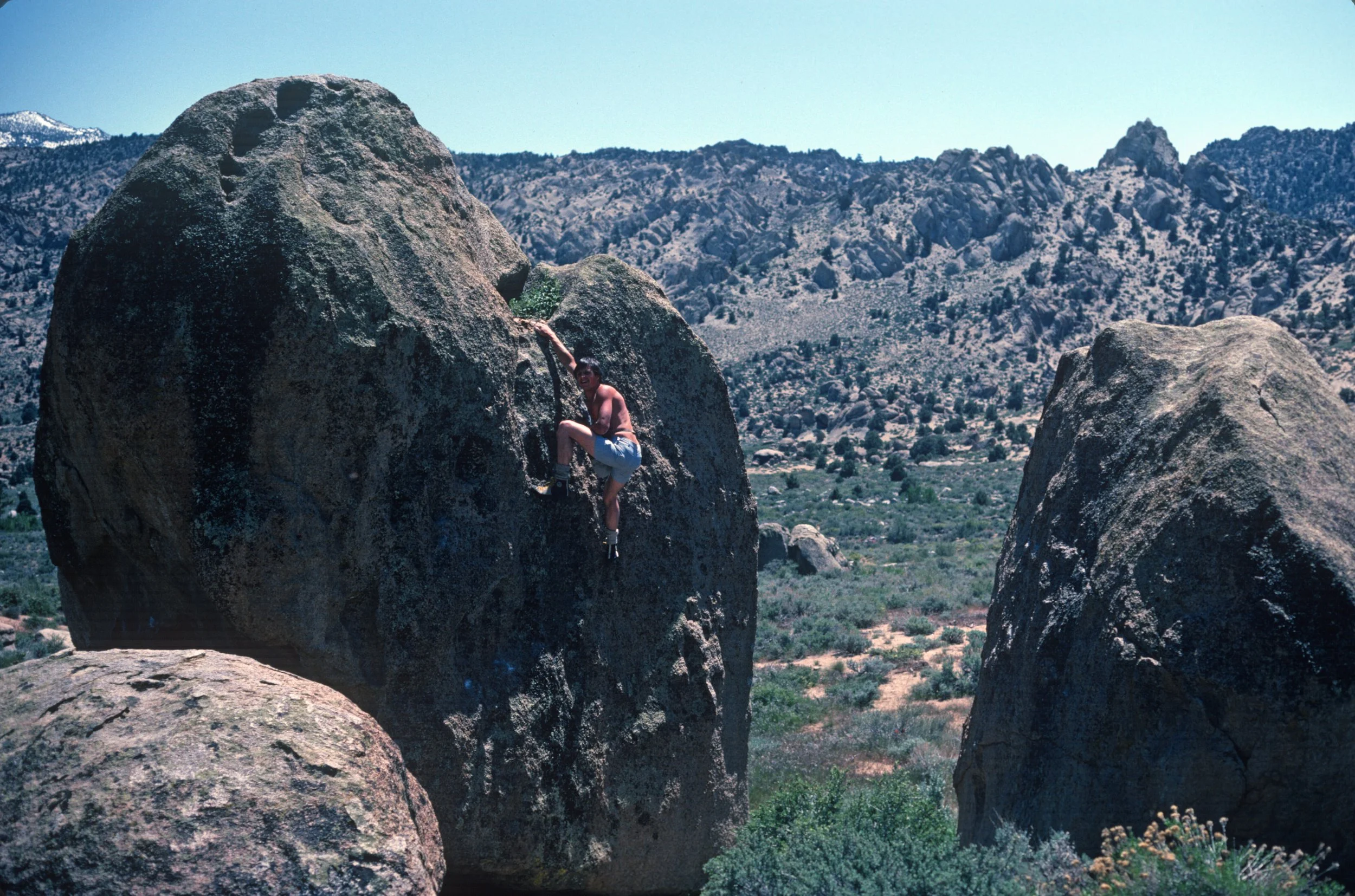
Photo: Ken Yager Collection
The Buttermilks
Founder’s Log | By Ken Yager
In the spring of 1979, I moved to Mammoth Lakes and started working for the ski area. The only position available was in the Main Lodge cafeteria. I didn’t mind because there were still a few months left in the ski season. The job came with a free ski pass, food, and housing, the perfect arrangement for a 20-year-old.
My new housing was across the street from the Main Lodge at the Mammoth Mountain Inn. My roommate was Grant Hiskes, a climbing friend from Yosemite. The room we shared had a spacious lower floor with a loft. It put Yosemite housing to shame. It faced the mountain and gave a bird’s-eye view of avalanche control. Early morning shots of artillery were aimed at pillows of snow below the cornices along the summit. You could see the black spot appear in the snow, with a puff of smoke, as the charge hit before you could hear it. The sound was delayed. Sometimes the slopes would avalanche, sometimes they didn’t. I stayed in that room through the next ski season and witnessed some huge avalanches. One in particular I remember well. It fractured along the whole right side of the mountain and traveled into the trees farther than I had ever seen before. The trees were getting uprooted in front of it by the windblast. I nearly ran out of the room as it headed toward us. It was terrifying.
My feeble prior experience was a couple of seasons skiing at Badger Pass, one of the easiest areas in California to ski. Mammoth Mountain looked like Mount Everest compared to it. Grant offered to show me around. Of course, he took me to the top for my first run. It looked even steeper from the top. There was a mandatory cornice drop to access the run below. I asked about other options. Grant assured me that this was the easiest run off the top. He jumped off the cornice and made some high-speed turns. He stopped halfway down and, looking up, indicated it was my turn. Nervously, I pushed off the cornice, caught the tails of my skis, and went headfirst into the slope below, and started sliding. I managed to get my skis underneath me and tried to slow down, sending spray in my face. I kept picking up speed and was blinded by the snow covering my face and sunglasses. My skis popped off, and I just rode it out until I stopped after a thousand-foot slide. Grant grabbed my skis and skied them down to me, laughing as I nursed an ice-cream headache. I got beaten up a lot in my first few years chasing skiers who were clearly much better than I was. I foolishly made up for it in boldness.
Grant and I decided to make a trip to the Buttermilks and check it out. Neither of us had a car, so we would have to hitchhike. With our packs loaded for two days of camping and climbing, we started hitching late in the afternoon. We got picked up twice for short distances and made it to Tom’s Place as the sun was setting. There was absolutely no traffic heading out of Tom’s Place. It looked grim, and we were wondering whether we would spend the night there. There was traffic on the highway, so we walked out to the end of the on-ramp and stuck out our thumbs. The first car that drove by slammed on the brakes, skidding to a stop several hundred feet in front of us. They immediately threw it in reverse, and a burnt orange Dodge Charger backed up at high speed, stopping right beside us. Opening the passenger door, the driver asked where we were going. We told him Bishop, about 25 miles away. He said, "Hop in,” and, like idiots, we did. We were desperate for a ride.
He was a thin, wiry guy with a crew cut and thick black-framed glasses. He was very talkative and tended to slow down as he was talking, not always staying in his lane. Other cars would pass us, sometimes honking. This would anger him, and he would speed up, harassing them by getting close to their bumper and shouting at them. Terrified, I told him that the next stretch of highway was well known as a speed trap and a favorite of the Highway Patrol. Grant piped up in agreement. The driver thanked us and backed off, slowing down. He proceeded to tell us that he was smuggling Canadian whiskey and had been up for two days straight. We made it down the grade and could see the lights of Bishop in the distance. It got quiet, and we started drifting out of the lane toward the sagebrush. Our driver was nodding off. We shouted in alarm, and he swerved back into the lane. We started asking him about his car, and he perked up. Without further incident, we made it to the Buttermilks turnoff on the far side of town. He dropped us off with our packs and sped off. Grant and I let out a huge sigh of relief. Shouldering our packs, we started walking up the road toward the Buttermilks in the moonlight. We walked, putting our thumbs out whenever a car drove by, but it was late, and we walked all the way on pavement to Buttermilk Road without getting a ride. We arrived at the boulders late in the evening. They were beautiful in the moonlight. They looked like frozen creatures. Walking up the hill, we found a nice flat area in an alcove formed by two overhanging boulders leaning against each other. I threw my sleeping bag down and fell asleep.
We woke late, exploring the textured boulders until our fingertips were thin with skin. Snow-covered Sierra peaks loomed over us to the west. In the distance to the east were the White Mountains. Excellent bouldering with a gorgeous backdrop. On day two, my body was sore, and it wasn’t long before I had split my fingertips. We were fortunate that some Mammoth climbers showed up, and we didn’t have to hitchhike back.
After that first trip, I fell in love with the place and spent a lot of time climbing there over the next five winters with friends I had met in Yosemite. I hitched out there several times, and each trip was an adventure. None was as bad as the ride we got from the guy in the Dodge Charger.
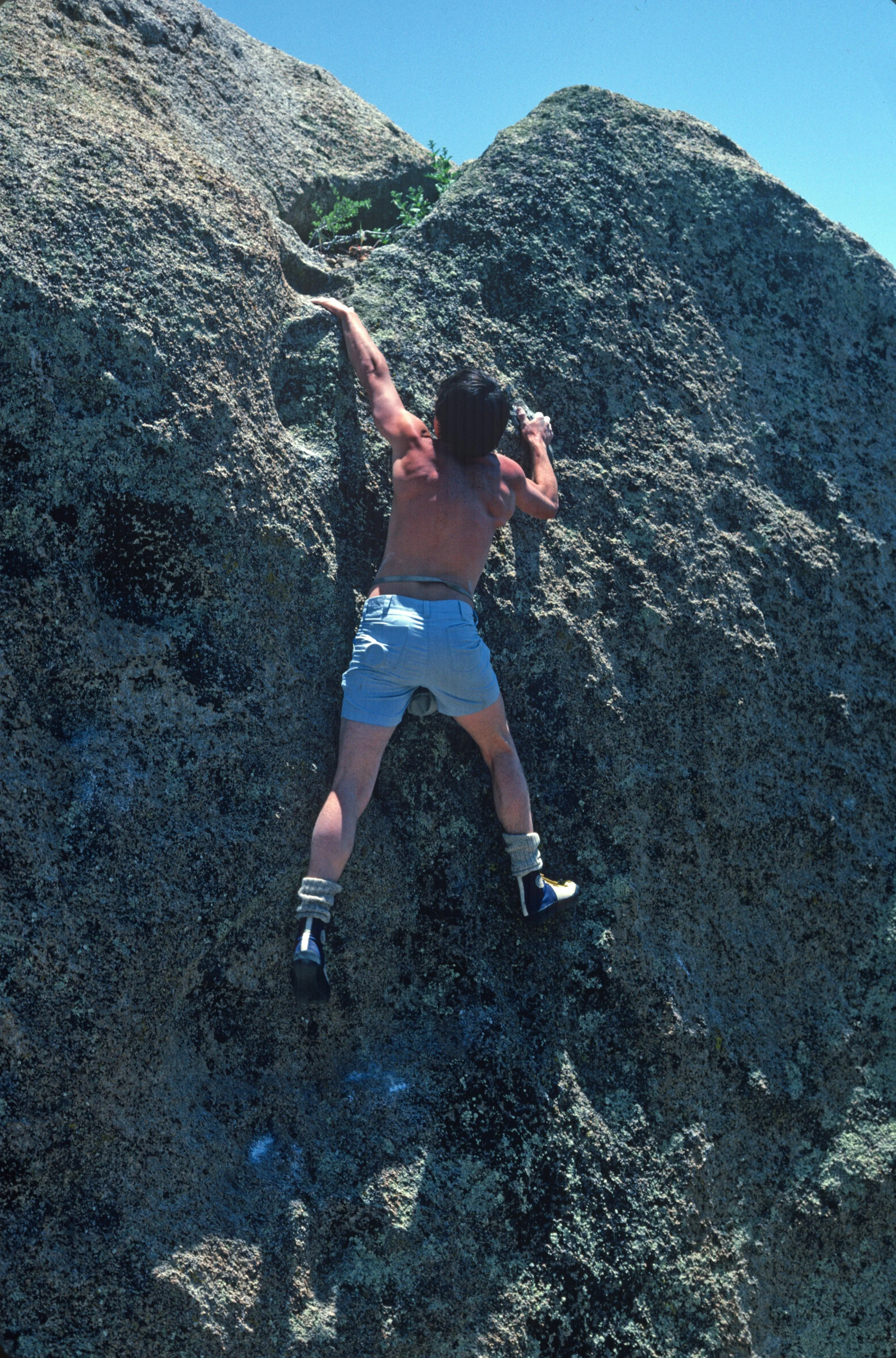
Photo: Ken Yager Collection
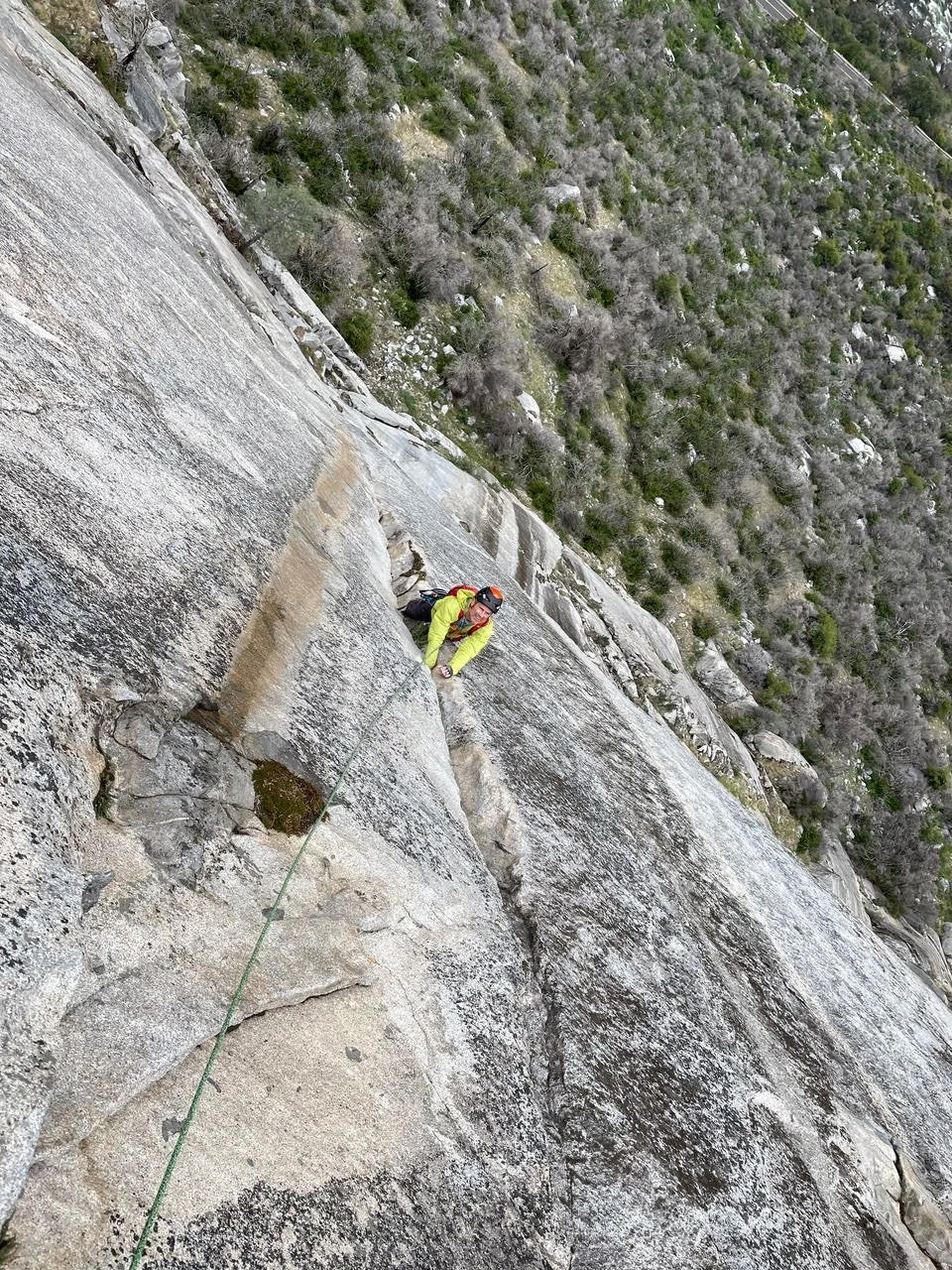
PHOTO OF
THE WEEK
Jack Wurster on Flying in the Mountains. Photo: Chris Van Leuven

Stay up to date on the latest climbing closures in effect!
Get your permits, do your research, and hit the wall!
Visit the Yosemite Climbing Museum!
The Yosemite Climbing Museum chronicles the evolution of modern day rock climbing from 1869 to the present.
The YCA News Brief is made possible by a generous grant, provided by Sundari Krishnamurthy and her husband, Jerry Gallwas