
EDITION 39 - DECEMBER 31, 2025

Your window into the stories, history, and ongoing work to preserve Yosemite’s climbing legacy.
A Note from the Editor
As I write this on Dec. 30, it’s likely the last climbable day in Yosemite for 2025, as rain is expected tomorrow and for at least a week. The National Weather Service reports that today will be partly sunny, with a high of 61°F, and precipitation is expected by late morning tomorrow. The rains are expected to continue, with the heaviest totals Friday night and a chance of thunderstorms, plus freezing temperatures at night., along with freezing temperatures at night. Saturday and Sunday could see a mix of rain and snow, with temperatures dipping into the upper 20s. Light rain is expected through Monday.
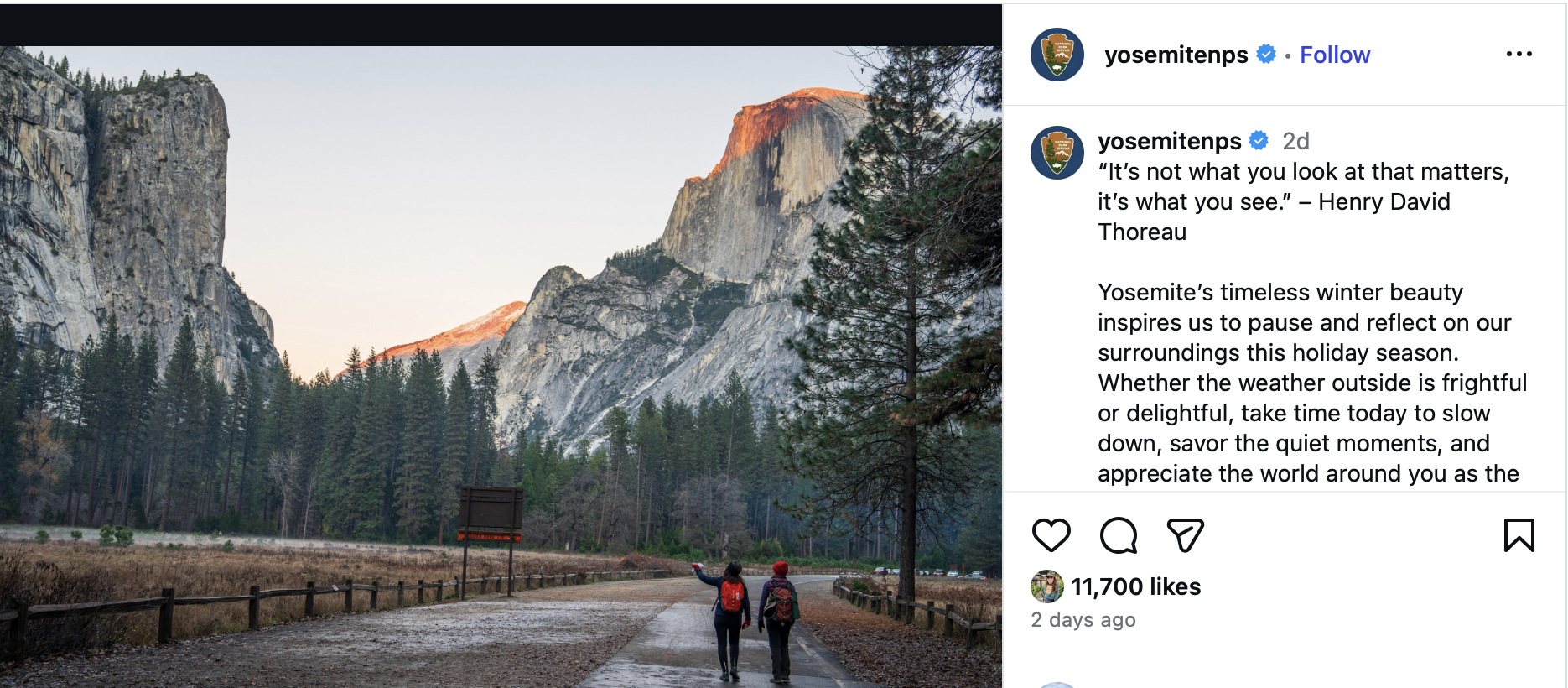
Since it’s the holiday season, some climbing publications are putting out annual round-ups, including Brandon Pullan at Gripped, who wrote:
Yosemite in 2025: Dawn Wall and 15 Other Remarkable Climbs
From speed records and first free ascents to new routes and history-making solos, it was another memorable year in the Valley
In the story, Pullan lists Sébastien Berthe’s repeat of the Dawn Wall; Connor Herson’s success on Magic Line, Triple Direct, and his fast ascent of The Nose. The list also includes Sasha DiGiulian’s ascent of the Direct Line/Platinum Wall, plus Tommy Caldwell and Alex Honnold’s ascent of the same route; Jim Pope and Sam Stroh’s free ascent of Magic Mushroom; and Oliver Tippett’s new El Cap aid route Cardiac Arrest. Pullan also includes Kate Kelleghan and Laura Pineau’s Yosemite Triple Crown, the El Cap Triple by Jordan Cannon and Michael Vaill, and Will Moss’s in-a-day flash of Freerider.
In bouldering news, Pullan includes David Fitzgerald’s first ascent of Last Line of Defense, V16. “Previously a longstanding open project, the problem is a low start to The Shield, a V11 put up by Randy Puro in 2006. The crux of Last Line of Defense features one of the most difficult moves of any established boulder problem,” Pullan says.
As of Dec. 21, it’s now officially winter, with spring arriving on March 20. It’s the quiet season, and each month from December through March typically accounts for only about 3–4% of Yosemite’s annual visitors. “Although the park is open all year, nearly 75% of visitors come during the busiest six months (May through October),” writes the National Park Service.
Jonathan Farrington at Yosemite Mariposa Tourism wrote in an email:
December volume is typically lower for the beginning of the winter season. The lack of snow in the Sierra Nevada is negatively impacting December bookings, particularly for the holiday season. There is not yet enough snow to open Badger Pass Ski Area, reducing demand in the Wawona and Yosemite West areas of the national park, as well as High Sierra - Fish Camp, and, to some extent, in El Portal.
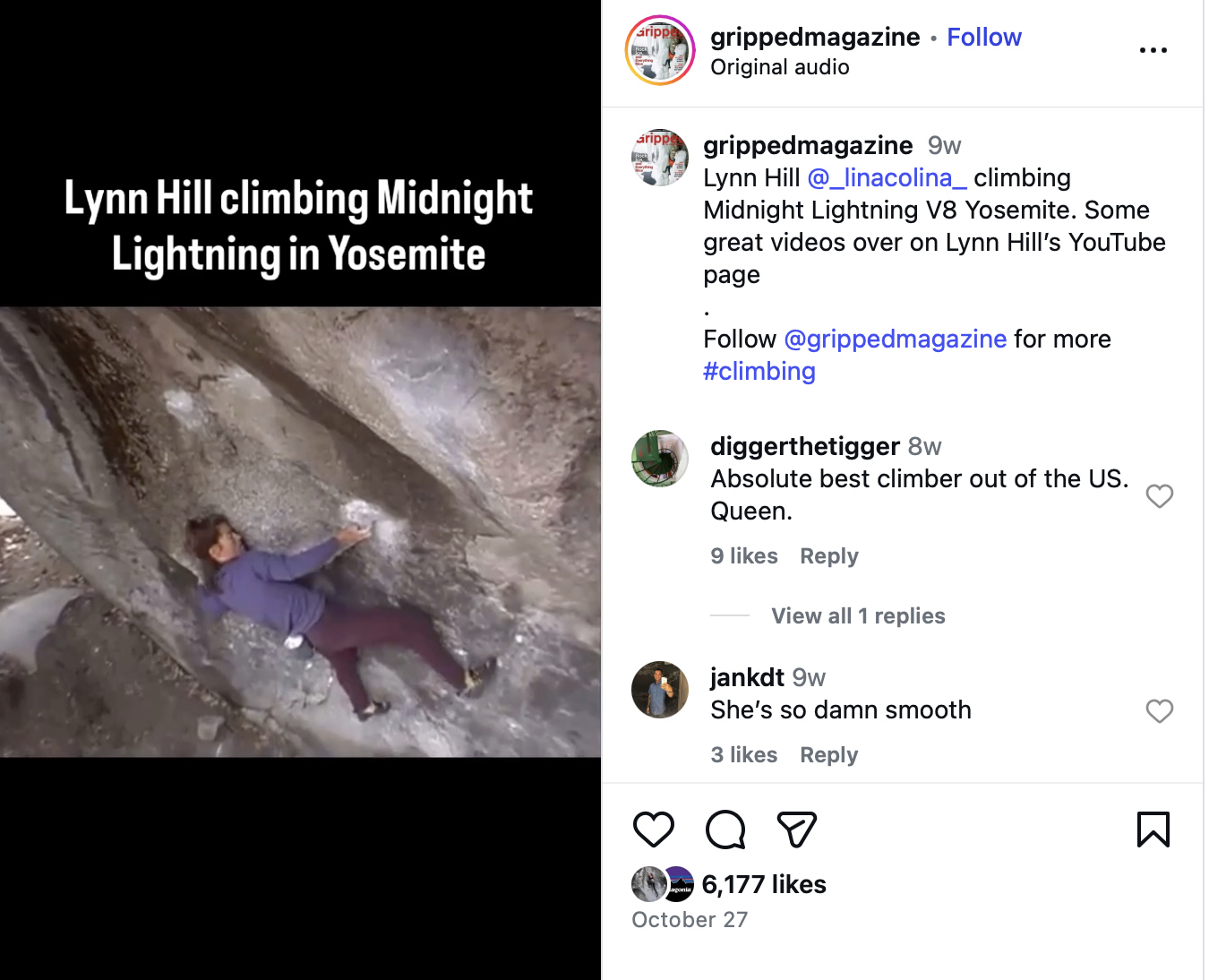
For this week’s Founder’s Note, Ken Yager writes about running into Lynn Hill after injuring his wrist with a drill bit while roofing in Foresta, then agreeing to film her as she trains to free The Nose in a day.
This week’s feature is on Julian Bigi. I recently ran into Bigi while climbing at Pat and Jack Pinnacle with Pat Curry, Maggie Sogin, and other friends, and we chatted about his love of climbing in Yosemite. When I arrived late in the morning, Pat was preparing for Rocky Horror Show, a 40m single-pitch 5.12-. Before leaving the ground, he mentioned something about doing a 5.10b, but he was referring to the start—Boneheads—and that wasn’t clear. Pat floated the route, and I followed, confused about why “10b” seemed so extremely difficult. Next, Maggie had me follow her up a nearby 10a, and before starting, I asked if she thought I could do it. Confused—I’ve been climbing with Pat and Maggie for years, and we’ve been up the N. Face of the Rostrum—she asked me why I was so hesitant. I said something like, “That 10b was really hard!” and she replied, “That’s because it’s a 5.12!” We had a good laugh about that, and I spent the rest of the day belaying Pat and Maggie’s crew on Rocky Horror Show, including Julian.
Chris Van Leuven
Editor, YCA News Brief
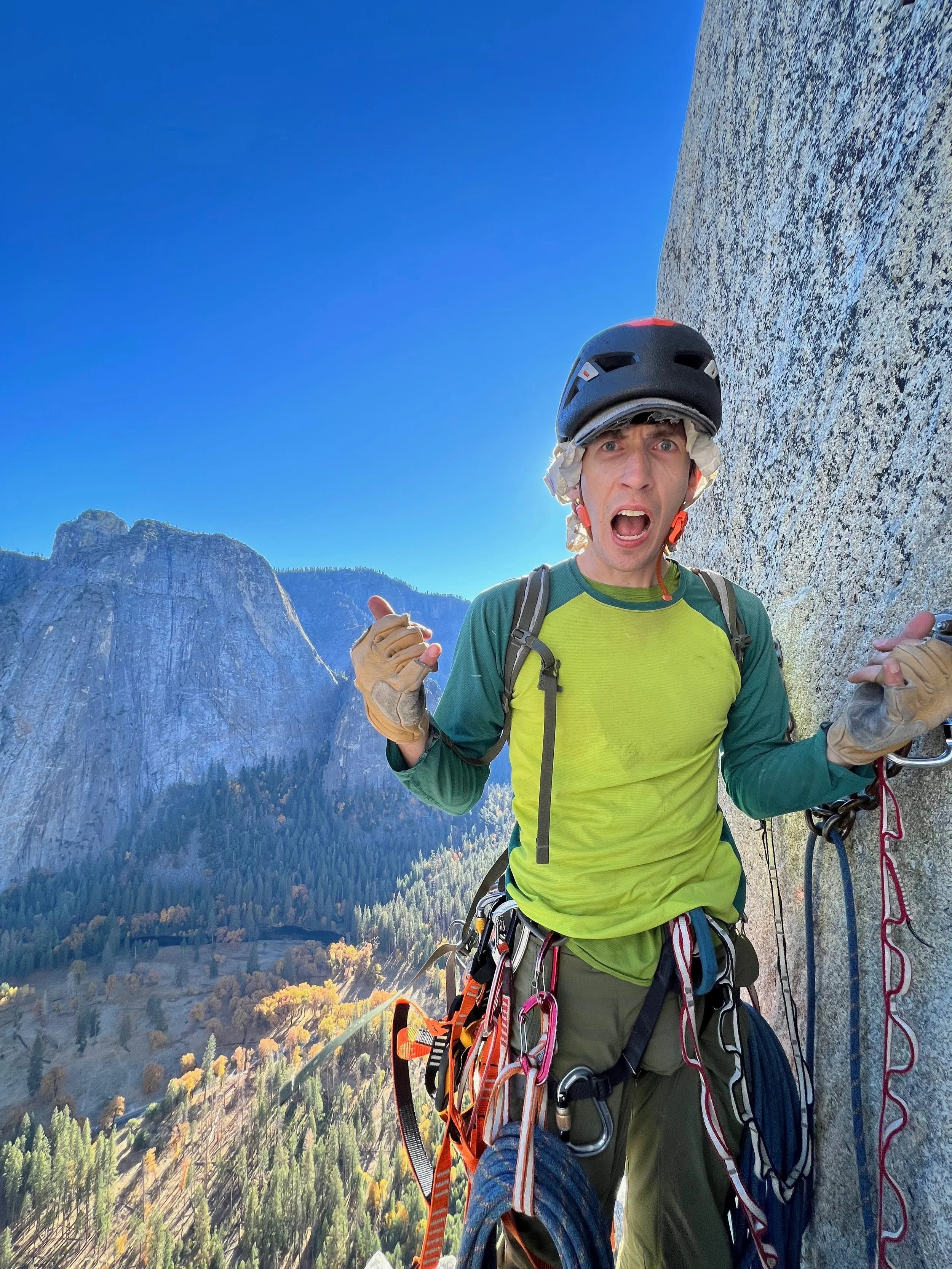
Bigi on Dolt Tower, the Nose. Photo: Alex Blum
The Long Game in Yosemite: Julian Bigi on Community, Craft, and Consistency
Bigi talks crack training, his early years, and why Yosemite remains the most motivating place he knows
After finishing our climbing day at Pat and Jack last week, our group headed down to the Cascade Falls parking lot to leave the park for the weekend. I saw my car, Norm’s climber van, Pat and Maggie’s Sprinter, and next to that, the fanciest car I’d just about ever seen. “I don’t know who parked there,” I thought, “maybe a tourist.”
Then Julian unlocked the 2025 BMW SUV and told me it was his. We had talked earlier about how he works with electric car batteries; he mentioned he lives in Sunnyvale, but mostly we discussed climbing. However, he didn’t say he works for the luxury-car brand. Standing there by the tailgate, he downplayed it, telling me that since he’s with BMW, he gets a great deal on leasing, and he pays less for this than he did for his old Subaru. His official title is Senior Battery Technology Engineer.
When I called him for this story, he said he used to work in the lab, but now he spends most of his time scouting for new technologies—meeting with startups, evaluating scalability, and attending conferences. For the holidays, he’s headed to Arizona, then Texas, back to his childhood home in Indiana and returns in early January.
Growing up in South Bend, Indiana, near the Michigan border, Julian recalled a childhood divided between Lake Michigan and Chicago—dunes and lake days, followed by city weekends for culture. Chicago was close enough for “concerts, food, museums, that kind of thing.”
Bigi has been in California for about 18 years and has been climbing for about 15. He started during grad school at UC Berkeley when friends took him to Berkeley Ironworks. It began as gym top-roping after class and in the evenings, then developed into a steady obsession. He bought a crash pad and started visiting the boulders regularly. After grad school, he worked at various startups, first as a chemist blogger, then as a research scientist, process chemist, senior scientist, and battery tech engineer.
In the East Bay, he climbed at Indian Rock and Mortar Rock, as well as in the hills at spots like Cragmont and Remillard Park. He also spent time at Ring Mountain in Tiburon—Split Rock and Turtle Rock—practicing movement on real stone.
Eventually, he was also pulled into ropes outside—early days of learning systems and getting comfortable on easy terrain before advancing through the grades. One trip that stayed with him was Indian Creek, which he visited before he even knew how to jam. He described it as the moment he realized how much he didn’t know—gear, technique, leading, all of it. Back home, he bought a set of stoppers and started practicing wherever he could, often placing and cleaning them at the boulders.
His first visit to Yosemite (2009) happened before he became a climber (2014), but it left a huge impression on him. He went with a friend and hiked the Upper Falls Trail. What he remembers most is how the weather split: warm on the valley floor and snowing at the top. At that time, he admitted he “knew nothing” about the outdoors—how to navigate or how quickly mountain conditions change—so the experience felt both beautiful and overwhelming. Yosemite was, to him, “the biggest of everything.”
Later, he returned and visited Swan Slab, climbing Oak Tree Flake into Bay Tree Crack. The next day, he went to Tuolumne and did Holdless Horror on Dozier Dome—5.6 and about 550 feet. Julian says, “When you’re relatively new to crack climbing, and you don’t really know how to climb knobs, it just seems extreme.” The climb took all day, and they didn’t get home until late Sunday night.
Once he moved from Berkeley to the South Bay, around 2016, the years didn’t feel the same, and he began breaking them down into climbing seasons.
He tells me, “You keep track of all the routes you do, set goals, and say, I wanna do this and that. By the end of the season, you’ve completed all these routes, and it’s just so much fun because you’re exploring this place and sharing these experiences with your buddies. Then, you go to work on Monday, and you’re just like, what am I doing here?”
Over time, he went from shorter routes to bigger days and eventually walls. His first wall was the South Face of Washington Column, then the Prow, then the West Face of Leaning Tower, and later the Nose. “Walls make everything feel extreme in a new way—because you don’t just go up and go down. You’re up there, living in it.”
Back home, he spent less time on the face climbs at the gym and more time on the cracks.
He climbs at The Movement in Sunnyvale, which he says, “probably has the best gym cracks in the Bay Area. Almost like pin scars, proper jams, where you’re doing locks, everything from fingers up to full squeeze chimneys so you can practice heel-toe camming.” All this training helps him climb better outdoors.
“I can go to Yosemite and then do it on the real thing pretty reliably because it’s only 4 hours away.”
Julian’s first time climbing with Pat and Maggie was during Pat’s 40 pitches for his 40th birthday. Pat and Maggie knew Julian through mutual friends, and Julian says, “he invited me and so I helped put up a couple of ropes, and then we’ve stayed in touch.” That’s how he met Norm, too, and how he joined the crew.
Talking with Julian during that hour interview brought back memories of my early days at the gym and on the boulders and crags around the Bay. We had both climbed at the same gym and on the same boulders. We learned systems on easy terrain at Swan Slab, got humbled on our first real cracks (I couldn’t get off the ground on Jam Crack), and then visited Yosemite often as we worked up the grades.
I’m glad he’s joined Pat’s crew—and I’m looking forward to climbing with him more in the new year.
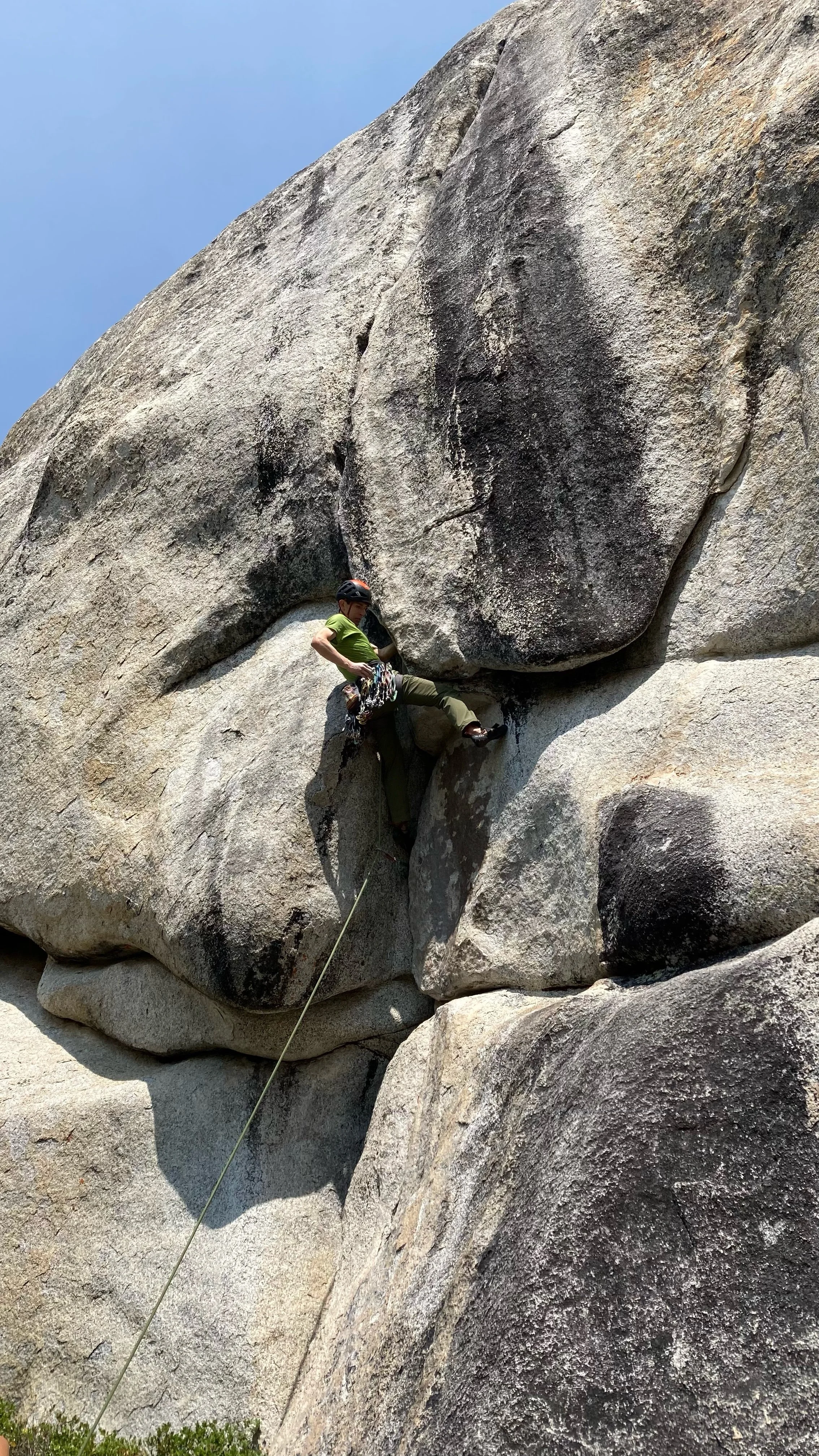
Julian on Tideline, Tuolumne Meadows. Photo: Linda Jarit
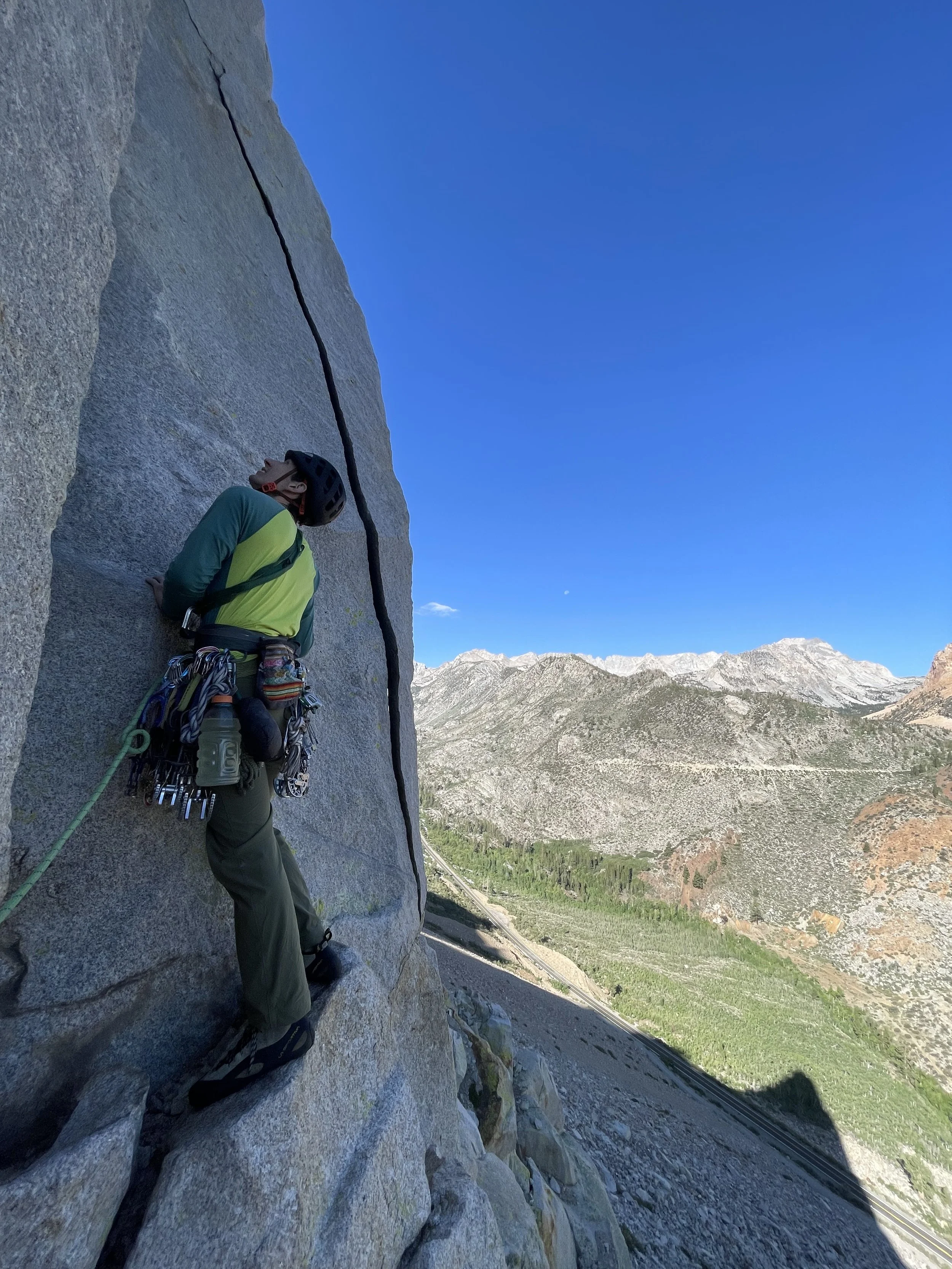
Julian Bigi on Cardinal Pinnacle. Photo: Helen Wang
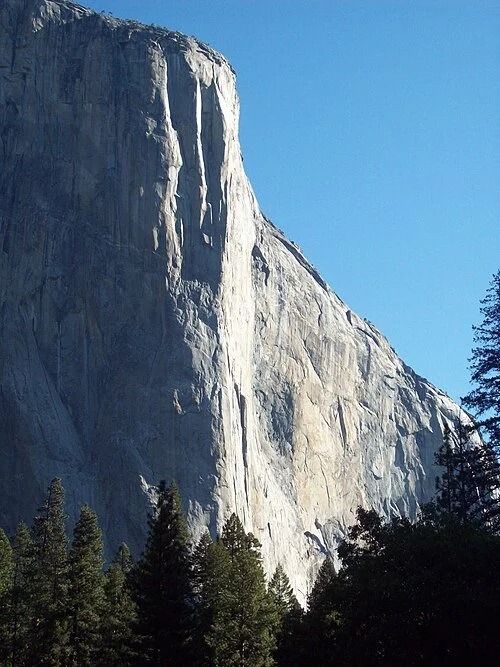
Lynn Hill
Photo: Meros Felsenmaus /Wiki Commons
Founder’s Log | By Ken Yager
I was building a house in Foresta, just two blocks from where I lived. While installing metal roofing, my drill fell out of my nail bag and bounced off the roof. I responded quickly to grab it before it slid off the roof two stories below. As I caught the drill bouncing off the roof, the drill bit went into my wrist. It hit the bone on its way through and hurt like hell.
Looking back, I should have loosened the chuck and kept the drill bit in my wrist for the doctor to handle. Instead, I pulled it out and noticed the drill bit had bent after hitting my wrist bone. It didn’t bleed much as I headed to the clinic.
The doctor was concerned about infection and prescribed me strong antibiotics after bandaging it. I was told to take at least a week off and let it rest. I called my boss to inform him and then went to the Village to check my mail.
At the Deli, I ran into Lynn Hill. She had freed the Nose the year before, and Yosemite climbers considered her the best rock climber in the world. I sat down with her to catch up. She introduced me to two French men who were here filming a documentary of her free ascent of the Nose. I cannot remember their names. She also shared that she was training to free the Nose in a day. This was incomprehensible to me.
She was looking for another person to run a camera to document for her own video while the Frenchmen filmed. She asked me if I was interested or knew anyone who could, as she looked at my bandaged wrist.
Hmmm! I was tempted. I really wanted to. On the other hand, my right wrist was messed up, and I had been warned to keep it clean and free from infection, or I may end up with trigger finger. I might not have this opportunity again. Of course, I said yes.
She said, “Great, let’s meet in El Portal this evening and pack up. We were going to head up to the top of El Cap in the morning.”
One of the Frenchmen was a skilled climber and the lead cameraman. He had done some of the famous north faces in the Alps. The other guy was much less experienced, and Lynn was worried about him. She asked me to watch out for them to keep them safe first, and I was to film when I could. I went home to get my gear and then headed to El Portal.
We met at Debby Brossman’s house. Jim Bridwell and Steve Sutton completed the team. I knew both pretty well and had climbed with Bridwell before. They had already made a trip to the summit and had strung ropes down to Camp 6.
Jim brought in a haulbag from his truck full of empty water bottles he had used on his last climb. I started rinsing and filling them, sealing the lids with tape. Several had been used as pee bottles, and I nearly threw up after opening a couple of them. It was horrendous. For the life of me, I couldn’t understand why he had mixed the bottles. After finding the pee bottles, I re-rinsed them and refilled them. We finished packing up and made plans to leave in the morning.
Jim asked me to drive his 1966 blue Ford truck. He had lost his driver’s license and was afraid of getting pulled over by the rangers. His truck had the loosest steering of any vehicle I have ever driven, and it was slow to respond. It was important to pay attention, or you would end up off the road in the woods. I had a 1965 Ford stepside and was used to the loose steering, but my truck wasn’t nearly as bad as his.
Jim, Steve, and I rode together to Tamarack Flat Campground, with Lynn following behind in the rental car with the two French filmmakers. We parked, unloaded our packs, and prepared to hike. Although we carried a lot of weight, the heaviest item by far was a V-shaped metal boom made from two-inch galvanized pipe, at least 8 feet long. The burden of carrying the boom was shared between Steve, Jim, and me, as they were hired as riggers and sherpas. To transport it, we disassembled it into two sections—one with a platform attached.
To carry it, we used straps to attach it to our packs. Since it was so long, standing upright would cause it to dig into the ground. The top caught on every low-hanging branch. It forced me to hike with my waist bent over, trying to thread the upper end of the poles through the branches. Sometimes I was on my hands and knees. It was extremely tiring, and we took turns carrying it up the trail. It got easier near the top as the forest thinned.
We arrived after dark and set up camp. It had taken us most of the day to hike up there. We ate some food, built a fire, and relaxed before falling asleep.
The next morning, we began rappelling down the ropes that Jim and Steve had fixed a few days earlier. The less experienced French cameraman didn't like the exposure and chose to stay on top, which was a relief. I would serve as the remaining cameraman’s assistant and have more time to film Lynn.
The five of us rappelled down to the Great Roof, fixing a few more pitches from Camp 6. We began setting up the boom to film Lynn. Lynn and Steve rappelled one pitch further and tied in, preparing to climb. Once the boom was in place, we helped the cameraman get onto the platform and anchored him with the fixed rope above. The boom extended him at least 8 feet from the wall, providing an exposed angle for shooting.
Lynn climbed the Great Roof three times in a row in about an hour. As I filmed, I was blown away by how effortlessly Lynn climbed. She was so graceful, and it was obvious she wasn’t climbing at her limit. It was truly mind-blowing! We filmed two pitches and jumared back to the top, to our camp and the lone Frenchman.
We filmed the next day, and it was clear we needed fresh batteries for the final day. I volunteered to hike down and recharge them. I loaded up the batteries and headed down East Ledges, just making it before dark. I hiked back up early the next morning with fresh batteries and two six-packs of Old English 800.
After that final day of filming, we drank the beers around the campfire. Old E, as it is fondly called, is a strong malt liquor and generally the beer of choice for climbers. More bang for your buck. It wasn’t the best-tasting beer, but it worked. Almost too well. It always felt stronger than its 8% alcohol content. I always called it PCP in a can.
We laughed and told stories around the fire until late in the evening. The next morning, with a little bit of a hangover, we slowly packed up. Jim, Steve, and I were going to take most of the weight, and there was no way we were going to bring the boom through the trees again. We decided to go down to the fixed ropes on East Ledges. The Frenchmen had an airplane to catch, so Lynn walked them back to their vehicle.
We carefully descended the slabs with heavy packs to the top of the rappels without any problems. Jim twisted his knee after the last rappel before reaching the third-class section. He nearly stepped off the ledge. We shared most of his weight in our packs and slowly made our way to Manure Pile, where I had left my truck. Steve and I often waited while Jim hobbled down, trying to keep up with us.
I took Jim back to pick up his truck at Tamarack Campground. He then had to drive his truck back to El Portal, following me closely. He was terrified that a ranger might see him and pull him over. I believe he was using my truck as a cover in case a ranger was driving in the opposite direction. Jim and his truck were well known to law enforcement.
We made it back to El Portal without anyone getting arrested. After sorting gear, I headed home thinking about the whole experience. My wrist was sore but fortunately free from infection. My fingers had been stiff, but seemed to work okay. Because it was my right hand, I didn’t have to grip my jumar. I was able to push it up with my palm and lean back on my harness and daisies.
I had been a little worried that I might damage it permanently. I was going to be fine. It had all been worth it. I not only had a great adventure, but I got to see the future of rock climbing!
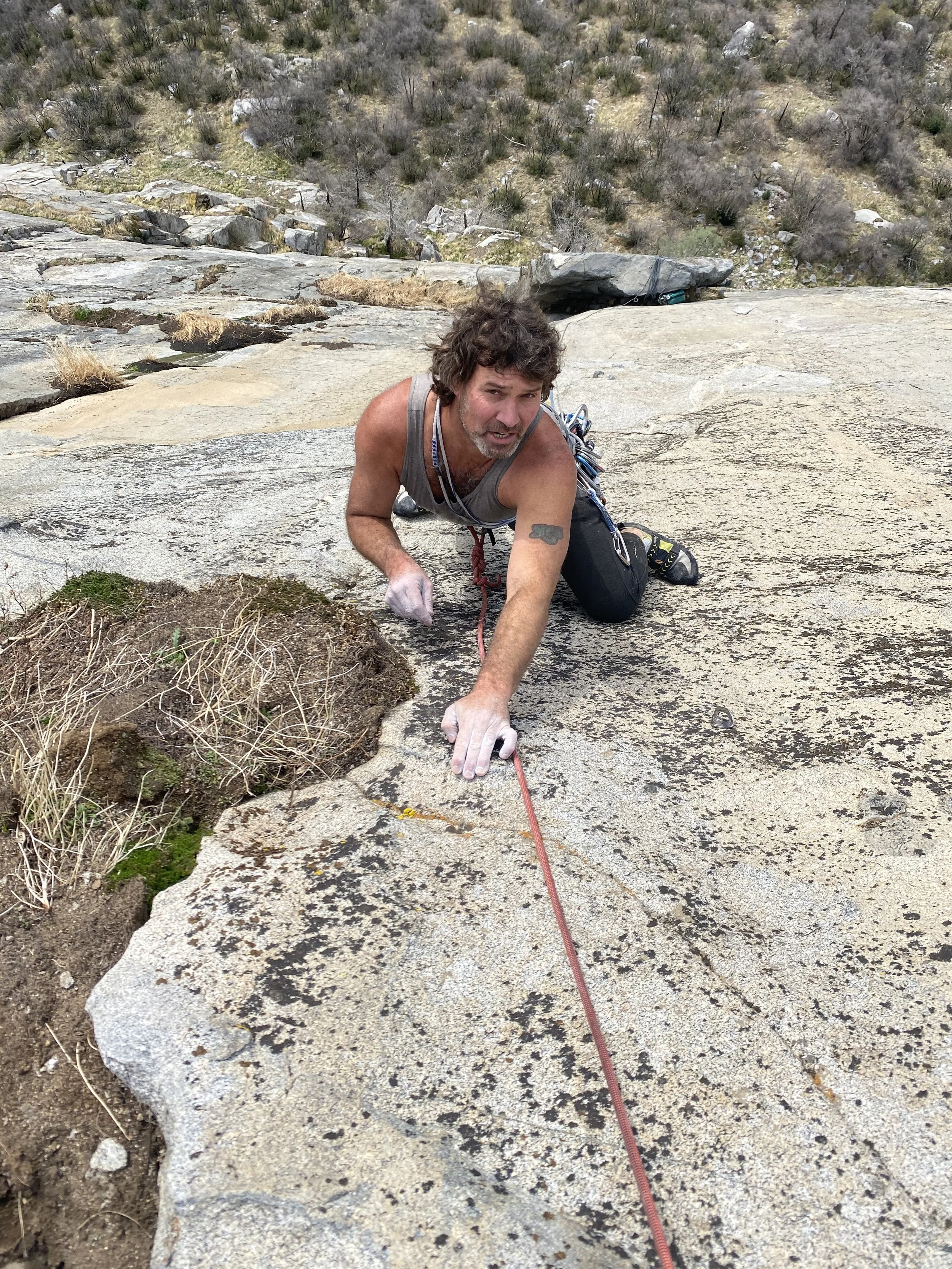
PHOTO OF
THE WEEK
Sean Jones on Otherworld, Parkline, Yosemite. Photo: Chris Van Leuven

Stay up to date on the latest climbing closures in effect!
Get your permits, do your research, and hit the wall!
Visit the Yosemite Climbing Museum!
The Yosemite Climbing Museum chronicles the evolution of modern day rock climbing from 1869 to the present.
The YCA News Brief is made possible by a generous grant, provided by Sundari Krishnamurthy and her husband, Jerry Gallwas