
EDITION 50 - MARCH 26, 2026

Your window into the stories, history, and ongoing work to preserve Yosemite’s climbing legacy.
A Note from the Editor
Well, the heat wave that drove high temperatures across California in March has finally abated. It’s still warm, though, with sunny skies, variable cloud cover, and highs in the mid- to high 60s expected in Yosemite over the next week. That said, a storm is due to arrive Monday, bringing a 45% chance of thundershowers on March 30. Heavy rain is expected to build into snow starting Tuesday and continue through the week. Those high temperatures have also caused Badger Pass ski area to close early.
However, the high temperatures have caused Badger Pass ski area to close early. In a March 23 story for People, Colson Thayer reports:
Yosemite Ski Resort Shuts Down Early as Record-Breaking Heat Wave Swelters California
The Badger Pass ski area located within Yosemite National Park ended its season early on Wednesday, March 18
“Due to the lack of freezing temperatures at night, much higher than average daytime temperatures and fast melting snow, Badger Pass operations will close for the season,” the resort says in a recorded phone message, updated on Wednesday.
And in a March 24 story for The Tribune, Brooke Baitinger reports:
Warming weather is bringing crowds to Yosemite National Park. What to know
As the weather warms up across California and schools go on break, crowds are expected to descend on Yosemite National Park.
Visitors to the popular park nestled in California’s Sierra Nevada are seeking camping, climbing and hiking opportunities, as well as colorful wildflower blooms.
I haven’t been to Yosemite recently, but with lower temps expected this weekend, I’m hoping to make it out there before next week’s storms arrive. Instead, I’ve been gravel riding with Daniel Melendrez in the Sierra foothills.
For this week’s Founder’s Log, Ken Yager recounts the 1986 first ascent of Karma on Half Dome’s South Face, a bold and dangerous route he joined while still recovering from major knee surgery. Despite pain, hard runout climbing, rockfall, and the uncertainty of a steep, intimidating dike system, Yager, Dave Schultz, and Jim Campbell kept returning until they completed the climb after 12 days of effort.
And for this week’s feature, I speak with Matt Cairns, whose Yosemite life is shaped less by technical rock climbing than by a deep desire to reach wild, remote places. After years of hitchhiking across the U.S. and abroad, guiding backpacking trips in the West, and eventually settling in Mariposa, he built a life centered on adventure, service, and time in the mountains.
Chris Van Leuven
Editor, YCA News Brief
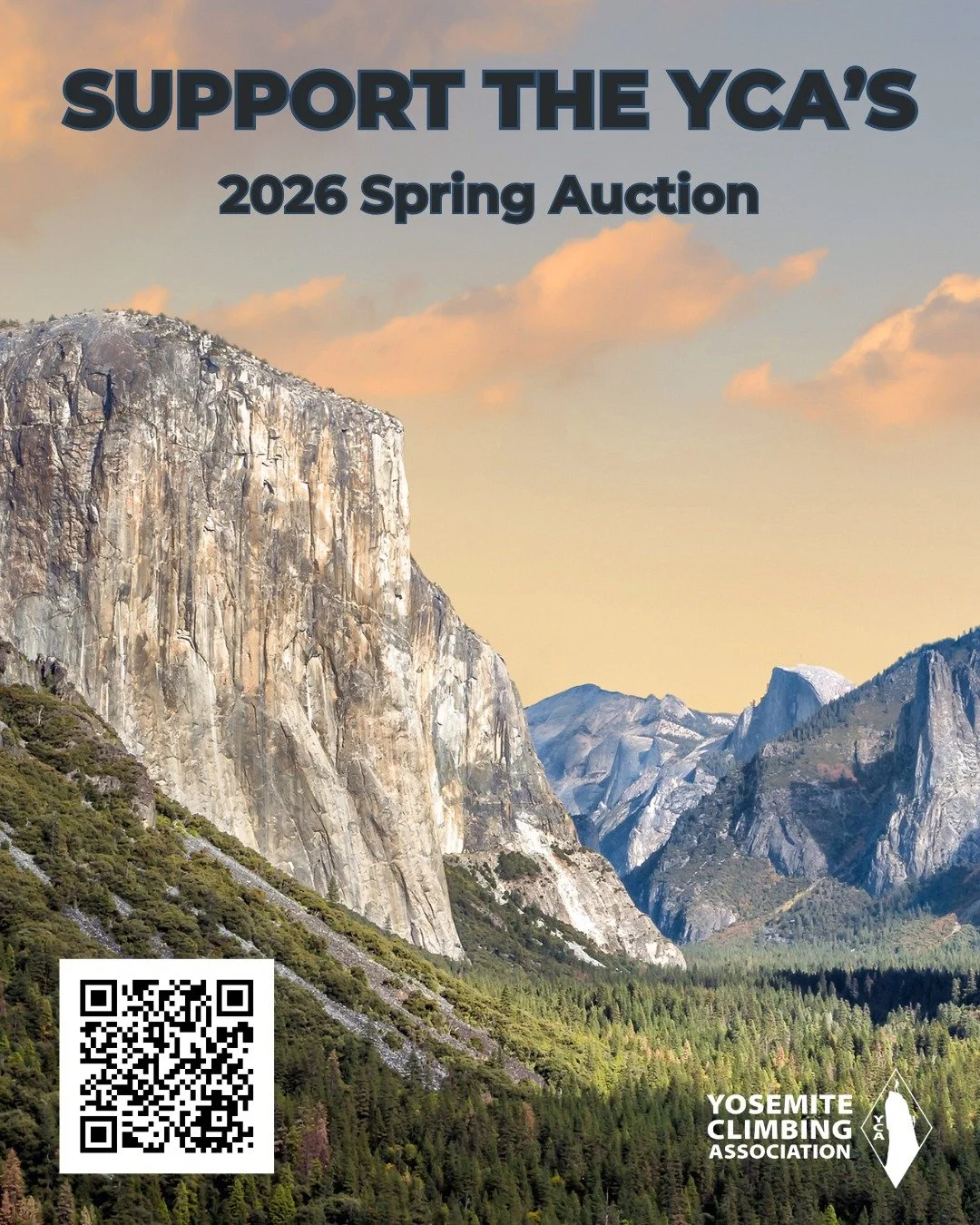
Our annual online auction kicks off this week, featuring one-of-a-kind experiences, outdoor adventures, artwork, and more! Be the first to bid on items like:
Two night stay at The Redwoods in Yosemite
OARS Rafting Trip
Four Day Pass with Camping to the Strawberry Music Festival
Patagonia, YETI, and YCA gear!
$100 Gift Card for Crowley Lake Fish Camp
🗓️ Starts: March 27 at 10 AM
🗓️ Ends: April 11 at 10 PM
All proceeds go toward Mariposa Facelift and other efforts to preserve Yosemite’s climbing history and care for our public lands. Don’t miss your chance to snag incredible items while supporting a great cause!'
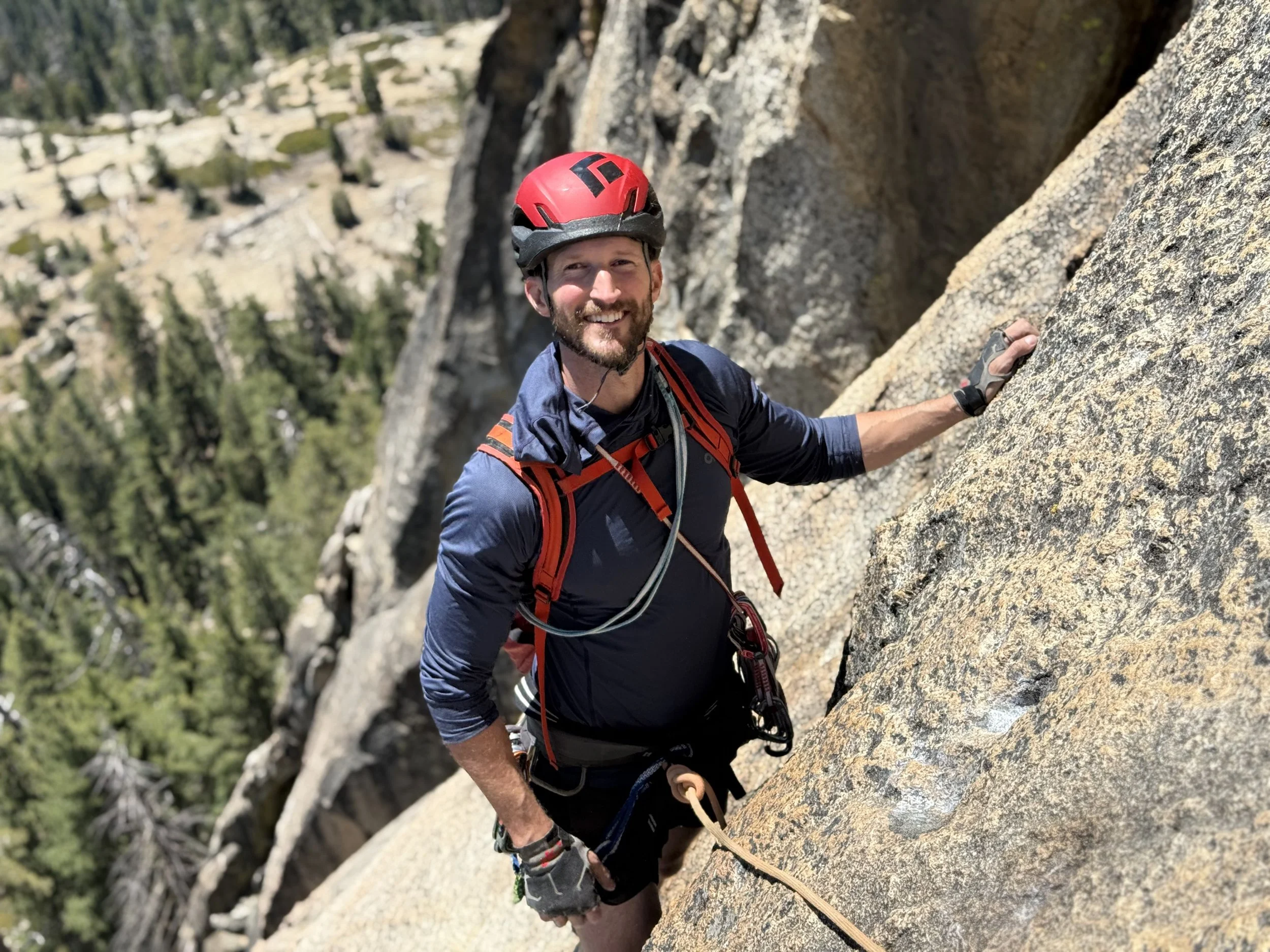
Cairns on Whiskey Bill, Fresno Dome. Photo: Chris Van Leuven
From Hitchhiking to High Routes: Matt Cairns’ Yosemite Life
Cairns’ path to Yosemite ran through far-flung rides, guiding work, and a love of reaching wild places.
I’ve been climbing with Matt Cairns for years, from cragging and multipitch outings in Yosemite to peak bagging—including Mt. Clark—and various outings up Fresno Dome south of the park. He’s always up for an adventure, but with his schedule full of EMT work, parachute packing for Skydive Yosemite in Mariposa, and skydiving, his free time is limited. We met up yesterday to walk his dog, Bat, catch up, and make tentative plans to climb this weekend.
Though we’ve enjoyed climbing together, his draw to Yosemite isn’t specifically rock climbing; it’s about getting way out in the backcountry and climbing peaks. “Class 5 is not why I do it,” he says. “For me, rock climbing is a way to access places that I couldn’t get to any other way.”
Born in Ohio, Matt went to college in Indiana, lived in Tennessee and Arizona, and settled in Mariposa. He came out west to guide backpacking trips, often spending up to 25 days a month in the field during the busy season.
During his high school and college years, Matt hitchhiked across several U.S. states and countries, including Ireland, Scotland, Wales, England, and New Zealand. He even hitchhiked a boat from Australia to New Zealand. That included, as he puts it, traveling “across Australia from the south coast to the north coast straight through the middle.” He hitchhiked in Australia for five months and in New Zealand for three or four months. That year, he traveled for 11 of 12 months, including two months in South America, where he rode a motorcycle he purchased in Chile through Peru, Ecuador, and Colombia.
Though he wasn’t a mountaineer or climber then, he sees parallels between the two, calling those outings “early versions” of his desire to adventure and see new wild terrain. “I love to explore.”
Thinking back to our Mt. Clark outing with two other friends three years ago, he recalls, “It’s a gorgeous summit. You see it from so many places in the park, and it was always something you could recognize on the horizon just waving at you.” We spent day one hiking in, following his GPS through a burn zone, crisscrossing through tight trees, encountering a bear, and finally making camp at the base of the 11,527-foot peak. On day two, we hiked and climbed together, making sure to stay on route as our friends trudged ahead, before we caught up with our friends at the technical step-across and the exposed fourth- or easy fifth-class terrain leading to the summit. We roped up a few times toward the summit, rappelled the steeper sections during the descent, packed up our camp, and made it back out by late in the day. We logged about 20 miles round-trip of steep, rugged hiking, and our toenails were black and blue by the trip’s end.
Around the time we climbed Mt. Clark, Cairns transitioned from guiding to working on the “wee-woo” bus, which is what he calls the ambulance. The guiding company he worked for changed locations to the Bay Area, and he chose to stay, saying, “Part of my effectiveness as a guide was that I was a local and that I lived and played in the places where I was taking people. Of all the places that I worked as a guide, Yosemite is God’s gift to humanity. It’s the most beautiful place I’ve ever been, though there are many such places.”
When it comes to working on the ambulance, he sees an overlap with guiding and helping people in emergencies. For years, he organized trips throughout Yosemite and beyond to help people create memories that last a lifetime. And now, he helps people in their time of need.
As for what he has coming up, though, he’s interested in taking his career to the next level by becoming a medic, but that requires working and going to school full-time. Right now, he’s content with a work schedule that allows him days off to pack parachutes, skydive, plan multiday peak-climbing outings with his friends and brothers, and simply enjoy quiet time in Yosemite, saying the grass is soft, there’s water everywhere, and there are lots of places to simply relax. Beyond his interest in the high peaks, his draw to Yosemite is the beauty, and it’s “so comfortable and human-accessible.”
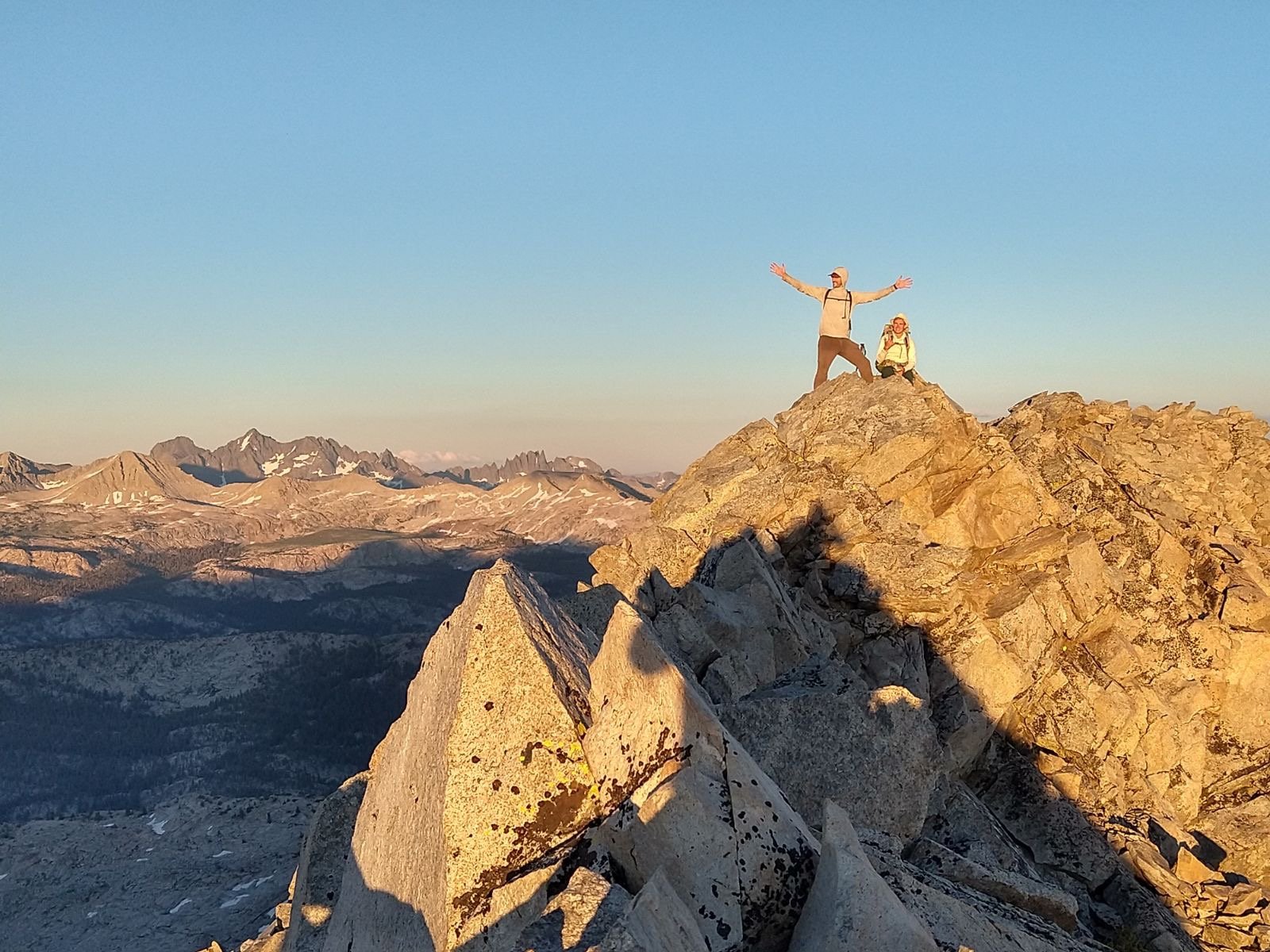
Matt Cairns and Max Crouch on the summit of Mt. Gray near Mt. Clark. Photo: Jesse Hoff
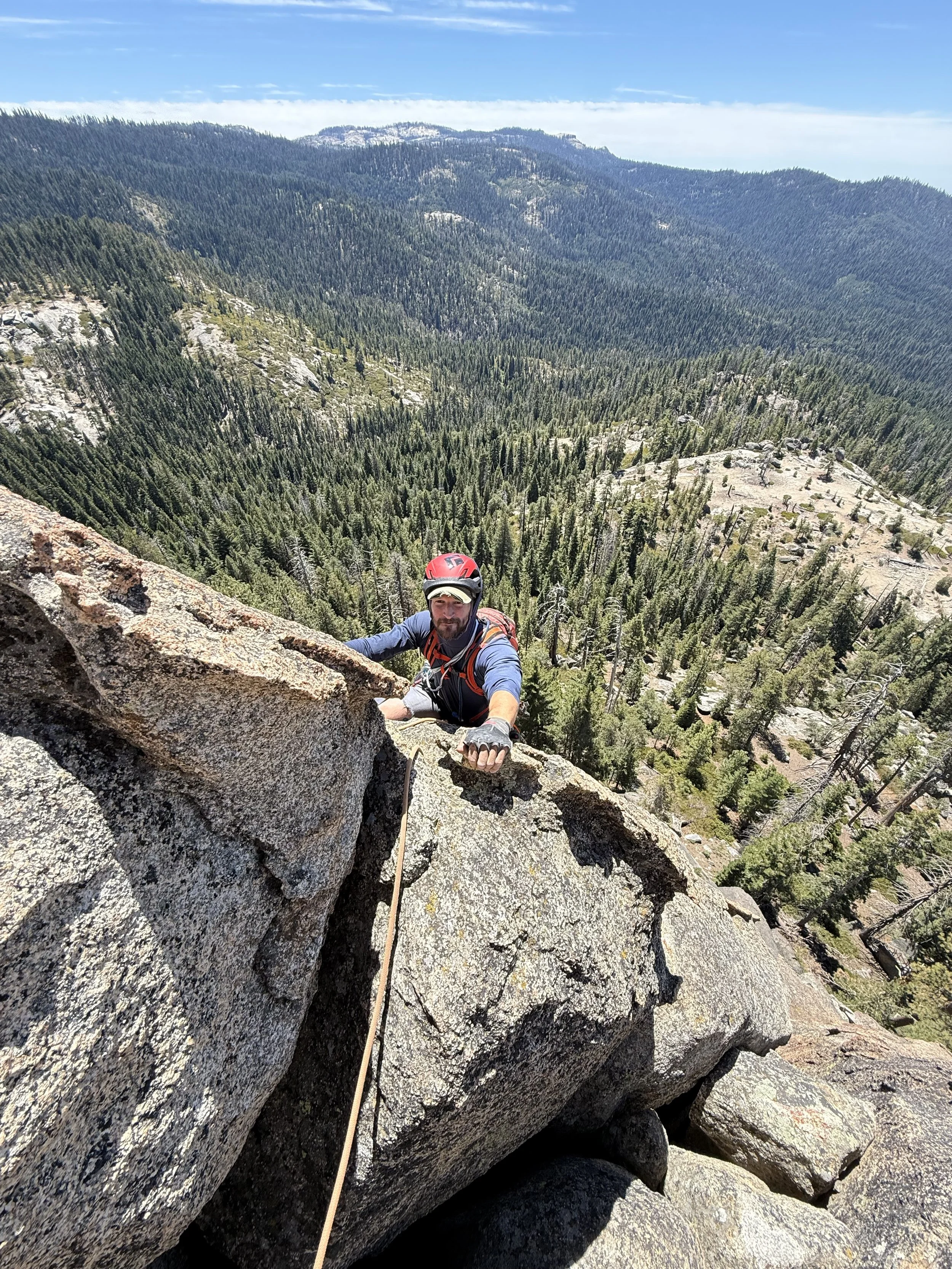
Cairns on the South Pillar of Fresno Dome. Photo: Chris Van Leuven
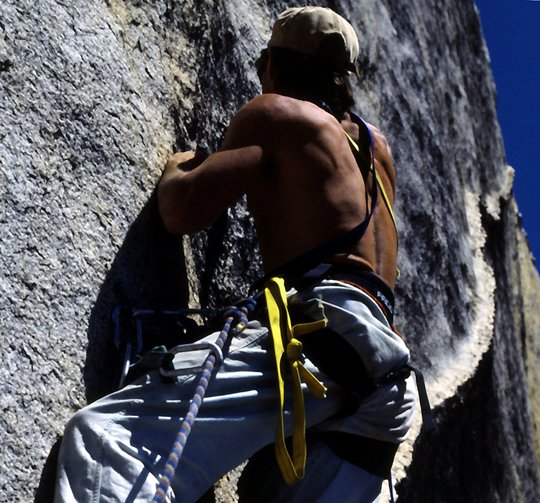
Jim Campbell drilling a belay bolt at the end of the Walking the Plank (4th) pitch. The Yardarms (crux pitch) is next with an endless dike beyond. Photo: Ken Yager Collection
Karma
Founder’s Log | By Ken Yager
In the winter of 1985–86, I dislocated my left knee in a skiing accident, tearing several ligaments and doing plenty of other damage. After surgery and the installation of a couple of screws, I began a long, painful rehabilitation. Dr. Swanson from the Steadman Clinic started physical therapy immediately. They pushed me hard, and I gave up the crutches after three weeks. The aggressive rehab paid off, and I was climbing again in three months.
I had lost 35 degrees of motion, which forced me to climb differently. My knee hurt and stayed swollen, but I could climb. When I iced it, the cold radiated through the screws and deep into the bone like an ice-cream headache. The screws made hard little knobs under the skin on either side of my knee, and if I banged it on the rock, it would scrape the skin off them. It was annoying, but I was glad to be active again.
In June, four months after surgery, Dave Schultz and Jim Campbell asked me to join them on a new route they were eyeing on the South Face of Half Dome. They wanted to climb a huge dike system. I told them my knee was still weak, that I wasn’t climbing very hard, and that the hike alone would be a challenge. Dave kept saying the dike was huge and looked easy, like Snake Dike, and that tourists walked partway down the ledge from the top. He said I wouldn’t have to lead.
I knew Dave well enough not to believe him entirely.
Still, I was tempted. I think they wanted me along because I had wall-climbing experience and the gear. I agreed to check it out. We gathered a hodgepodge of quarter-inch hardware: taperlocks, screwtops, buttonheads, and a few homemade threaded bolts I had filed to a taper. We didn’t trust any of them, so at anchors we used three different types and hoped one would hold.
The hike up the Mist Trail was brutal. My pack was heavy, my legs felt weak, and my knee hurt and swelled. More than once, I considered turning around. I finally told myself I would just make it to the base and see how I felt. We arrived at dusk and made camp.
Dave was short, stocky, blond, on the rescue team, and an incredible climber. The locals called him the Iron Monkey. Jim was older, taller, thin, with dark hair and wire-rim glasses. He worked at the Mountain Shop and could only climb on weekends, so we climbed on Jim’s schedule.
The next morning, in early light, the dike system looked monstrous and deceptive. My knee had loosened up enough to function. Near camp, under a gold-and-black streaked wall, we found three tiny seeps dripping from a mossy crack. Using a plastic tarp and pine needles, we funneled the water into a basin and collected three to four gallons a day. It turned out to be a lifesaver.
Dave and Jim had already done the first pitch on a reconnaissance trip and called it 5.7. It felt harder than that to me. The first two pitches traversed left and were the easiest on the route. Above, it looked like three more pitches would reach the main dike.
The climbing quickly got serious.
Dave led brilliantly, running it out far more than I would have. A horizontal 5.10d crack took us rightward beneath the dike, where the holds disappeared, and the wall turned blank. We were forced to bolt two short ladders. At that point, it was clear the line as we had started it wasn’t going to go free. From the anchor, we spotted a better-looking variation out left. To the right, the main dike snaked up the wall and disappeared around the corner 500 feet away. It was serrated with sharp, crystal knobs, undercut, and cast a thick, ominous shadow.
The next section looked terrifying. In fact, the rest of the climb looked terrifying.
We tied all our ropes together and made a free-hanging rappel back to the ground, passing knot after knot. I was relieved to be down. Hiking out, I trailed behind with mixed feelings. With my injured knee, I felt in over my head and had nearly decided to back out. Then, looking down, I spotted a perfect five-inch black obsidian spear point lying in the sand among the rocks. I wondered how long it had been there and how it came to rest in that exact place. I took it as a good sign. My karma felt good, so I stayed in.
On the next trip, we climbed the variation to the left. Two excellent 5.11 pitches brought us back to our fixed ropes, and the rock quality was superb. Spirits were high on the hike down.
On the following trip, we jugged back up and finally reached the start of the dike. Dave drilled four bolts straight right to gain it, then started free climbing toward a stance about 20 feet away. Jim and I watched anxiously. Pinching the dike with one hand, Dave shuffled his feet higher until he reached the stance barely able to let go. Somehow, in a precarious position, he drilled a bolt. We all exhaled when he clipped it. He continued, adding a few more bolts before building an anchor.
When it was my turn, I felt like I was going to fall over backward the whole time. The climbing felt several grades harder than anything below. I pinched the dike, high-stepped with my right leg, and dragged my bad left leg behind me, flagging my left hand out into space, trying to stay balanced. I was so happy not to fall. We named the pitch Walking the Plank.
Later, while Jim was working, Dave and I returned to tackle the overhanging section above. The wall was too steep to walk, so we had to drop below the dike and hand-traverse, with our feet dangling in space, until we could mantle back up. Just as Dave committed to a hook move, we heard a rumbling above. A slab hit the wall overhead and exploded into blocks ranging from basketball-size to nearly refrigerator-size.
We stared at each other, wide-eyed, and pressed into the wall, expecting to die. The slight overhang above us saved us. We felt the wind and saw the shadows as the rocks screamed past, narrowly missing our heads. Full of adrenaline, we finished the pitch and then watched two peregrine falcons perform an incredible midair food transfer high above us. Between the rockfall, the birds, and getting through the steepest part of the route, it felt like one of those days you never forget.
For the final push, Jim took extra days off. Dave’s girlfriend and father hiked in with us to spend the night and send us off in the morning. We jugged nearly 500 feet of fixed rope, hauled bags through knot passes, and kept going. The upper pitches were still hard and runout, but the angle slowly eased. We spent the first night in hammocks and a portaledge and the second night on a hidden ledge, then fixed higher and kept moving.
On the third day of the final push, after two easier pitches, we reached the summit late in the afternoon. The feeling was a mix of relief and exultation. A friendly tourist took our photo. I had never stood on top of Half Dome before and had promised myself I would get there by climbing it, not by hiking the cables. Coming down the cables, I was amazed by how steep and slick the rock felt. From there, we ran down through Little Yosemite Valley and made it back to the Valley floor before dark.
We spent 12 days total working on the route, most of it in two-day stints on Jim’s weekends. The final push took three days. We placed 63 bolts, not counting the dead-end variation, and named the route Karma.
Thirty-seven years later, in 2023, Oliver Schmidt and Tobias Wolf made the second ascent and freed the entire route at 5.13d. Karma remains one of the most unique routes I’ve ever been part of, in one of the most spectacular settings anywhere. The South Face of Half Dome is no place to be in a storm, and many strong climbers have been rescued from that side.
I’m just glad it wasn’t us.

Ken Yager at the belay at the start of the 5th pitch, called the Yardarms. Photo: Ken Yager Collection
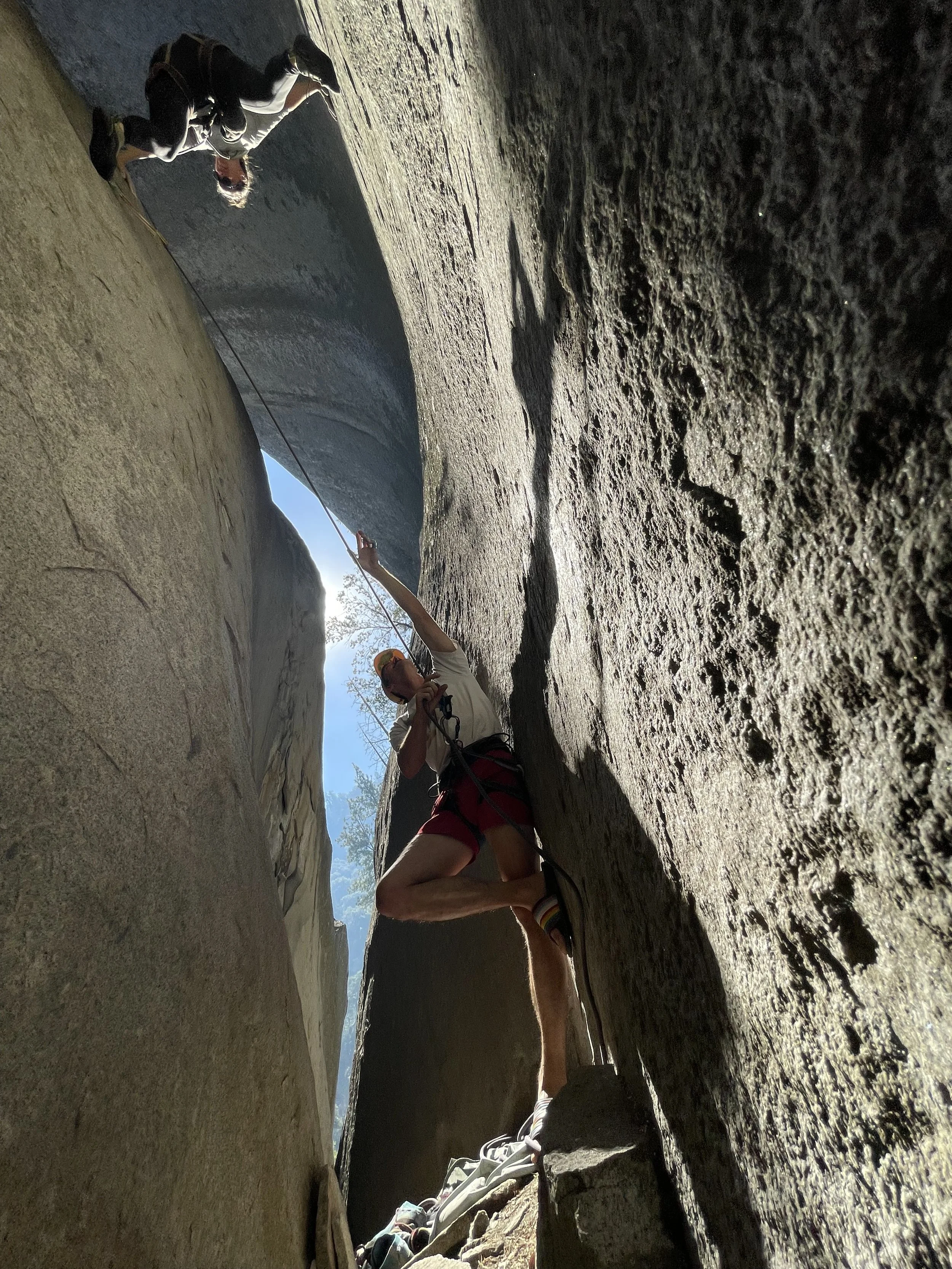
PHOTO OF
THE WEEK
Pat Curry belaying Maggie Sogin on the Short Circuit Chimney. Photo: Chris Van Leuven

Stay up to date on the latest climbing closures in effect!
Get your permits, do your research, and hit the wall!
Visit the Yosemite Climbing Museum!
The Yosemite Climbing Museum chronicles the evolution of modern day rock climbing from 1869 to the present.
The YCA News Brief is made possible by a generous grant, provided by Sundari Krishnamurthy and her husband, Jerry Gallwas